.svg)
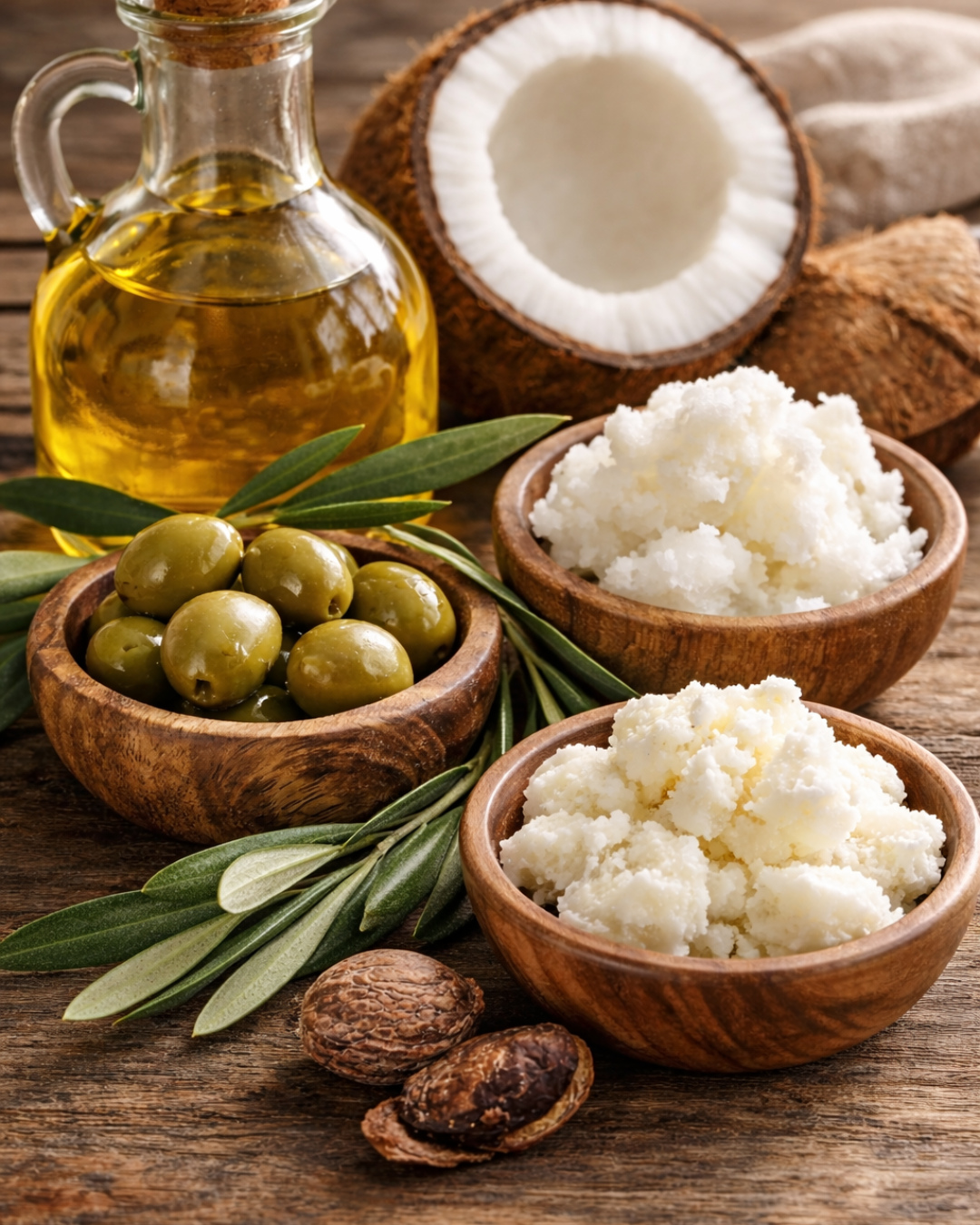
The Soap Maker's Case for Tallow. From a Brand That Doesn't Use It.
Our soaps are not for everyone. And I mean that genuinely, not as a disclaimer buried in fine print. We have come across people who have allergies to coconut or shea butter, both of which are in every bar we make. Whether those reactions are related to broader nut sensitivities or something else entirely, I am not certain, but the outcome is the same - our soap is not right for them, and we would rather say that plainly than have someone find out the hard way.
We have also encountered people with sensitivities to fragrance compounds, particularly naturally occurring ones like limonene, which gives citrus its characteristic scent, or eugenol and cinnamal, which appear in spice-forward fragrance blends. These compounds show up in our scented bars and in many essential oils, and for people with fragrance allergies they can trigger contact dermatitis even from a rinse-off product. Our Unscented bar exists specifically for this group.
And finally, cold process soap in general runs slightly more alkaline than commercial detergent bars, which can bother people with extremely reactive or compromised skin barriers, regardless of what oils or fragrances are used. If any of these categories sound like you, this may not be the soap for you. That is okay. We would rather you know now.
Which brings me to a soap that might actually be a better fit for some of you than ours - tallow soap. I want to give it a fair look, because it deserves one.
What Is Tallow Soap?
Beef tallow is rendered fat, typically from the suet surrounding the kidneys and loins of cattle. Its fatty acid profile contains roughly 35 to 47 percent oleic acid, 25 to 30 percent palmitic acid, and 15 to 25 percent stearic acid, along with fat-soluble vitamins A, D, E, and K. This profile closely mirrors human sebum, the skin's own natural oil, and that biocompatibility is the foundation of tallow's entire argument as a skincare ingredient. Other animal tallows exist as well: deer, sheep, goat, elk, and even bear fat have all been used in soap making. They function similarly to beef tallow but are difficult to source at any real scale and remain very niche.
Tallow has been used in soap making for thousands of years, referenced in Greek and Roman texts and used by early American settlers as a matter of practicality. It fell out of fashion in the mid-20th century when synthetic ingredients and vegetable oils became cheaper and easier to produce at scale. It is currently experiencing a significant resurgence, particularly in natural and ancestral health communities.
The Genuine Skin Benefits of Tallow
The case for tallow soap is real, and I want to present it honestly.
Biocompatibility is tallow's strongest argument. Its fatty acid profile, oleic, palmitic, stearic, and a small amount of palmitoleic acid, closely matches human sebum. The skin recognizes it and absorbs it readily without feeling greasy for most people. This is not a marketing claim. It is chemistry.
Deep moisturization is the next benefit. The fat-soluble vitamins A, D, E, and K found in quality tallow support skin cell renewal, elasticity, and barrier repair. Vitamin A supports cell turnover. Vitamin D promotes skin cell metabolism. Vitamin E provides antioxidant protection.
Tallow also produces a hard, long-lasting bar with a rich, creamy lather that holds up well in the shower. It is less prone to going mushy than some plant-based bars with higher water content, which is a practical advantage worth acknowledging.
There is also a genuine sustainability argument for tallow. The animal was not raised for its fat. Tallow is a byproduct of the meat industry, something that would otherwise be discarded. Using it in soap is a legitimate waste-reduction practice, and I respect that reasoning even though it is not the path we chose.
Finally, there is historical validation that is difficult to dismiss. People cleaned themselves effectively with tallow-based soap for thousands of years before synthetic detergent bars existed. The skin barrier problems that are now widespread in modern populations developed alongside the rise of synthetic ingredients, not alongside tallow.
The Diet Question: Grass-Fed vs. Grain-Fed
A cow's diet does measurably change the composition of its fat. Grass-fed and grass-finished tallow contains higher levels of omega-3 fatty acids, conjugated linoleic acid, and fat-soluble vitamins A, D, E, and K compared to grain-fed tallow. Those differences are real and documented in peer-reviewed research.
Here is where I want to be honest with you, though, because questioning big claims is always a good instinct.
The differences are real in relative terms but modest in absolute terms. Grass-fed tallow may contain several times more omega-3 fatty acids than grain-fed tallow, but both amounts are small enough that the practical significance in a rinse-off product like bar soap is genuinely questionable. The fat-soluble vitamins and fatty acids that tallow advocates point to as grass-fed's primary advantage have the most relevance in leave-on products like balms and face creams, where the skin actually has time to absorb them. In a soap that is on your skin for thirty seconds before rinsing, the difference between grass-fed and grain-fed tallow is unlikely to be the deciding factor in how your skin feels.
For leave-on tallow skincare, the sourcing argument holds more weight. If you are applying tallow to your face daily, the quality of the source animal's diet and the integrity of the rendering process matter more than they do in soap.
There is also a labeling issue worth understanding. "Grass-fed" does not automatically mean "grass-finished." Most cattle spend the majority of their lives on pasture and are switched to grain in their final months to gain weight before processing. Even the Sacred Cow authors, who are advocates for well-raised beef, note that typical cattle globally get only about ten percent of their lifetime diet from grain. The grain-finishing period does alter the fat profile, but the overall picture of a "grain-fed" cow's diet is more nuanced than the term implies.
If you are buying tallow soap or tallow skincare, grass-fed and grass-finished from a verifiable source is still the better choice. But be appropriately skeptical of marketing that uses the nutritional differences between grass-fed and grain-fed tallow to justify a dramatic premium, particularly for soap. The skin benefits of tallow soap come primarily from the biocompatibility of the fat itself — and that argument holds for well-raised tallow regardless of whether it is the single most nutrient-dense version possible.
Where Tallow Soap Falls Short
It is an animal product that is incompatible with halal and some kosher requirements, and some people simply don’t want animal fat in their skincare regardless of dietary philosophy. Clayton and I both eat meat and have no issue with animal products personally, but this is a legitimate personal choice that deserves respect.
The difference between grass-fed, grass-finished, properly rendered tallow and commodity tallow from a conventional slaughterhouse is enormous. But consumers largely cannot verify what they are getting. Small-batch tallow soap makers sourcing directly from known farms are a different category from brands simply claiming "grass-fed" on a label.
Tallow's comedogenic rating is approximately 2 out of 5, which is the same as olive oil, technically low to moderate. But for people with already oily or acne-prone skin, the rich, occlusive nature of tallow can be problematic, particularly in balm or cream form. In rinse-off soap form the risk is lower but still worth noting.
On its own, tallow produces a creamy lather with small bubbles, not the big fluffy foam most people associate with a satisfying bar. This is why quality tallow soap makers typically combine tallow with coconut oil, castor oil, or olive oil to balance the formula. A well-formulated tallow and coconut oil bar with a touch of olive oil and castor oil is a genuinely good product. A pure 100 percent tallow bar is historically authentic but not optimized for modern expectations.
There is one more consideration that does not get enough attention in the tallow conversation: the living conditions of the animals themselves. Cattle are ruminants. Their digestive systems evolved over millions of years to process grass and forage. Their multiple stomach chambers are specifically designed for fermenting cellulose. Grain is not what they were built to eat, and when they are forced to eat large quantities of it in feedlot conditions, documented health problems follow.
Feedlot cattle fed high-grain diets suffer from digestive distress, liver abscesses, and a condition called feedlot bloat — a buildup of gas in the rumen that the animal cannot release. This condition is serious enough that it accounts for roughly 3 percent of sudden cattle deaths in feedlot operations annually. Because grain feeding causes these health problems, feedlot cattle are routinely given antibiotics both to treat illness and to prevent it from spreading in the confined population. They are also given growth hormones and beta-agonist drugs to accelerate weight gain. The beta-agonists in particular have been linked to lameness and loss of mobility in some cattle.
Confinement itself creates its own problems. Feedlot cattle have limited movement, no access to pasture, and no ability to engage in natural grazing behavior. Stress in confined animals elevates cortisol levels — the same stress hormone that affects humans under chronic stress. Elevated cortisol affects the animal's immune function, its overall health, and the composition of its fat. An animal under chronic stress does not produce the same fat as an animal living as nature intended. That is not a political claim. It is biology.
Clayton and I grew up in agricultural Nebraska. We know what healthy cattle look like on pasture and what confined feedlot conditions look like. We are not anti-beef and we are not making a climate argument. We are making a straightforward observation: the conditions under which an animal lives affect the quality of what that animal produces. If you are going to use tallow soap and you want it to deliver the benefits that tallow advocates describe, the sourcing question is not a marketing detail. It is the whole argument.
A well-sourced tallow from a verified grass-fed, grass-finished operation where cattle lived on pasture, ate what they were designed to eat, and were not subjected to routine antibiotics and growth drugs is a fundamentally different product from commodity tallow. The animal welfare argument and the product quality argument are the same argument.
Tallow in Soap vs. Tallow in Creams and Balms: An Important Distinction
In rinse-off soap form, the benefits of tallow are present but limited by the fact that the product is on your skin for seconds before being rinsed away. The cleansing properties are real, the glycerin produced during saponification stays in the bar, and the superfatted portion leaves a film of conditioning fat on the skin. The potential for pore-clogging or hormone/antibiotic residue issues is significantly lower than in leave-on applications because most of the material washes off.
In leave-on applications - balms, creams, moisturizers, face creams - the tallow remains on the skin and is absorbed over time. This is where the biocompatibility argument is strongest and where the vitamin content matters most. It is also where the risks are higher: potential comedogenicity for oily skin is more pronounced, the quality of the tallow source matters more because more is being absorbed, and any residue from antibiotics or hormones in low-quality tallow is more concerning.
Tallow Combined with Other Oils vs. Pure Plant Oil Formulas
A well-formulated tallow soap and a well-formulated plant oil soap actually share more similarities than their advocates on either side tend to admit. Both can be made with cold process. Both retain glycerin. Both can be superfatted. Both can incorporate the same supporting oils.
The key differences come down to the base fat and what it contributes.
Tallow plus coconut oil is the most common tallow formula for good reason. Coconut oil provides the abundant bubbly lather that tallow alone cannot produce, while tallow provides the hard bar and the skin-compatible conditioning base. It is a complementary pairing with each ingredient covering what the other lacks.
Tallow plus olive oil adds the deep conditioning and oleic acid profile that makes olive oil so skin-compatible. A tallow, olive oil, and coconut oil formula is essentially the equivalent of what Private Oaks does with plant oils, but with tallow replacing the structural role that shea butter and the cure time play in the Private Oaks formula.
The practical difference is that tallow provides bar hardness more quickly and efficiently than plant oils, reducing the dependency on long cure times. Plant oil formulas without tallow need more time and more careful oil selection to achieve the same structural results. Private Oaks solves this with a 45-day minimum cure and the combination of shea butter's stearic and oleic acids with coconut oil's lauric acid. Tallow soap makers solve it with the saturated fat content of the tallow itself.
Neither approach is inherently superior. They are different paths to a similar destination, with different ingredient philosophies driving each.
The Honest Summary
Both tallow soap and quality plant oil soap are dramatically superior to commercial detergent bars. Both retain glycerin. Both are made from real fats rather than synthetic surfactants. Both are genuine soap in the FDA sense of the word.
The choice between them is not a question of which is better. It is a question of which aligns with your values, your skin type, and your confidence in the sourcing of what you are putting on your body.
Private Oaks made the plant oil choice because the sourcing of organic olive oil, coconut oil, and shea butter is verifiable and transparent, and because the formula produces a bar that works for a wide range of skin types without the quality variability that comes with sourcing animal fat.
That is not an argument that tallow soap is bad. It is an honest explanation of why Private Oaks made different choices, and an invitation for readers to make informed ones of their own.
And if tallow soap turns out to be the better fit for you, we genuinely mean it when we say that is okay. The goal was never to sell you our soap. It was to help you find the right one.
For a deeper look at the broader conversation around how cattle are raised and why it matters, Diana Rodgers and Robb Wolf's book "Sacred Cow" is worth your time.
If you would rather listen than read, Diana Rodgers and Robb Wolf joined Joe Rogan on The Joe Rogan Experience to discuss many of these same topics. It is worth a listen and easy to find by searching "Diana Rodgers and Robb Wolf Joe Rogan" on Spotify or wherever you listen to podcasts.
The documentary of the same name, Sacred Cow, directed by Diana Rodgers and narrated by Nick Offerman, covers much of the same ground in film form. It is currently free to stream on Tubi and worth two hours of your time.
If plant oil soap sounds like the right fit for you, our full collection is right here. For more skin benefit information: What Clays and Salts Actually Do to Your Skin.
If you want to understand more about what the skin science behind barrier function and gentle cleansing actually says, a Stanford dermatologist covers it in depth in our dermatologist blog.