.svg)
What Is Soda Ash and Why Is It On My Soap?
What Is Soda Ash and Why Is It On My Soap?
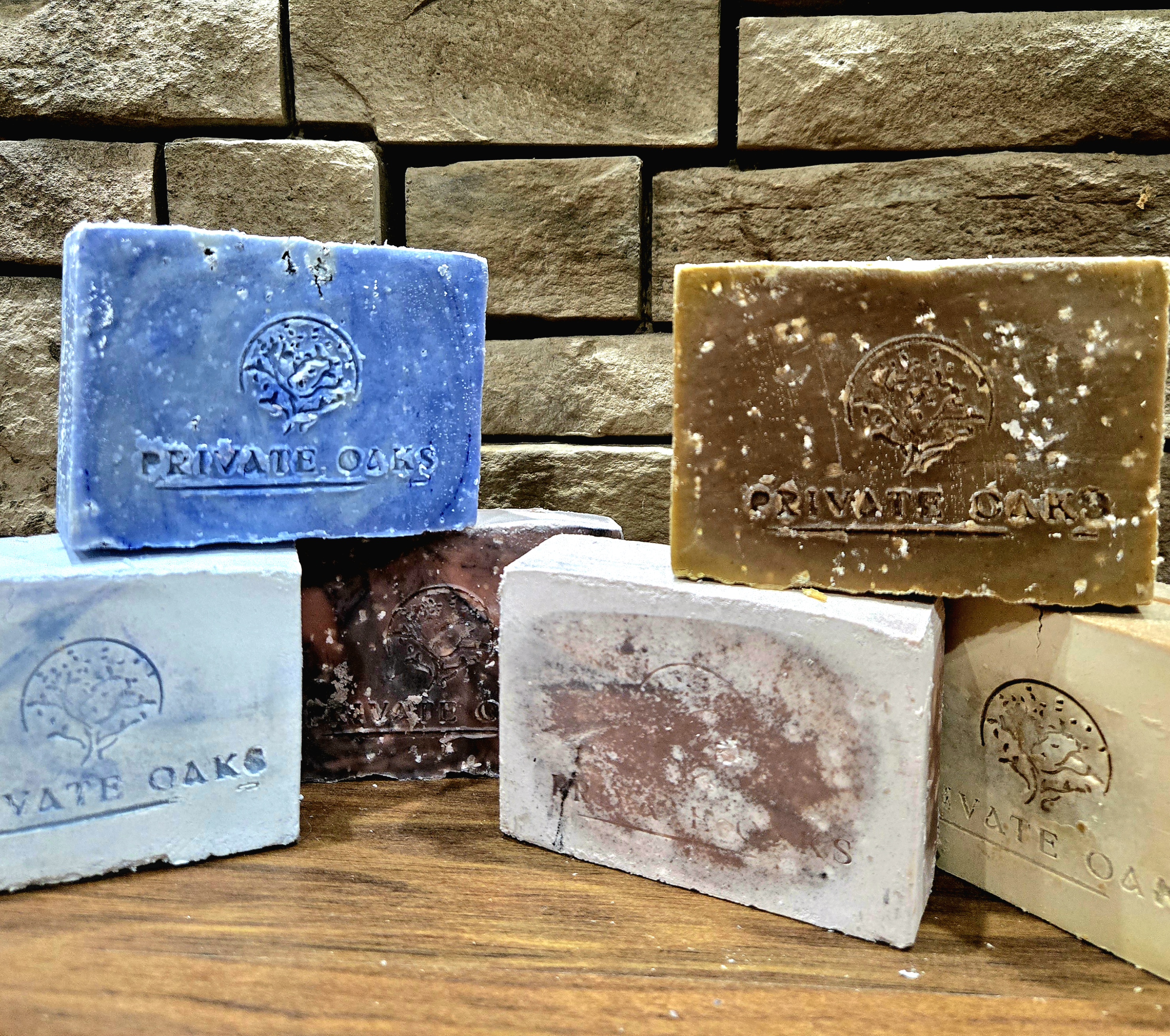
You picked up a bar of Private Oaks and noticed a white powdery film on the surface. Maybe it was across the top, maybe it ran along the sides, maybe it dusted the whole bar. Your first thought was probably some version of: is something wrong with this soap?
Nothing is wrong with this soap. Let me explain what you are looking at.
What Soda Ash Actually Is
That white film is called soda ash. Its technical name is sodium carbonate, which is the same compound sold in grocery stores as washing soda. It forms on cold process soap when a small amount of unsaponified lye, meaning sodium hydroxide that hasn't yet fully completed its reaction with the oils, comes into contact with carbon dioxide in the air during the curing process. The sodium hydroxide reacts with the CO2 and deposits a fine layer of sodium carbonate on the surface of the bar.
That’s it. That’s the whole story.
Sodium carbonate is used as a food additive, a water softener, and a household cleaning agent. It has no toxic properties. It doesn’t mean lye survived in the finished bar. It doesn’t affect how the soap cleans, how it lathers, or how it feels on your skin. It’s a surface reaction between a byproduct of the soap-making process and the air, and it’s purely cosmetic.
Why Our Bars Are More Prone to It
Not all soap gets soda ash equally. Commercial detergent bars never get it. Hot process soap rarely gets it. And even among cold process soaps, some formulas are more prone to it than others.
Ours happen to be.
The reason is olive oil. Our bars are built around organic virgin olive oil as the primary ingredient, and high olive oil cold process soap is notoriously more prone to soda ash than formulas built around saturated fats like tallow or palm oil. The reason is that oleic acid, the primary fatty acid in olive oil, slows the saponification process compared to saturated fats. Cold process soap made with high olive oil content takes longer to reach trace and longer to fully saponify inside the mold. That extended window of incomplete saponification means there is more time for unsaponified lye to interact with air before the reaction is finished. More exposure time means more opportunity for soda ash to form.
Pure Castile soap, which is 100 percent olive oil, is the most soda-ash-prone formula in cold process soap making. It’s been that way for a thousand years. Our bars aren’t 100 percent olive oil, which reduces the tendency, but the high olive oil content is still a contributing factor. We’re not going to change the formula to avoid soda ash. The olive oil is there for what it does for your skin, and that is more important than surface appearance.
What It Means for Your Bar
Nothing, functionally. The first time you use the bar and lather it up, the soda ash rinses away entirely and does not come back. The soap underneath is exactly what it’s supposed to be. If it bothers you before that first use, a soft dry cloth buffed gently across the surface will remove most light ash on a fully cured bar. A handheld garment steamer removes it completely if you happen to have one. But honestly, the quickest solution is to just use the bar.
You might wonder why we don’t simply remove it before the bar goes to market. We could scrape it off. We could wash it away and let it dry again. We choose not to, and the reason is straightforward. Soda ash is visible proof that what you’re holding is a high olive oil, cold process bar made the way we say it’s made. Removing it before sale would feel like hiding the very thing that makes our soap what it is. We have come to see it as a badge of honor. If soda ash shows up on a Private Oaks bar, it means the formula is intact, the process is honest, and the bar is exactly what we said it would be.
Why This Is Actually a Good Sign
Here is the thing worth understanding. Soda ash is a signature of cold process soap made with real oils and real lye, cured the slow way. Many commercial bars never get soda ash because they’re not made this way. They’re manufactured at high heat and high speed, stripped of their glycerin, and formulated with synthetic surfactants that have nothing left to react with the air. No soda ash. Also no glycerin, no superfatted oils, and no 45-day cure.
The white film you are looking at is evidence of the process that produced the bar in your hand. It’s not a flaw. It’s a fingerprint.
The Clay Connection
If you’ve read our clays and salts blog, you may remember that clay absorbs excess water in the soap batter during the molding phase. Less free water in the batter means less liquid available to carry sodium to the surface during curing, which means less soda ash. This is one of the reasons our clay-containing bars tend to show less soda ash than bars without clay. It’s an indirect but real and documented effect, and it’s another reason the clays in our formula are doing more than one job at a time.
If you want to understand more about what those clays are actually doing for your skin, that is covered in full detail in What Clays and Salts Actually Do to Your Skin.