.svg)
Why We Put Clay in Soap. And Why Cheap Brands Don't.
What are the benefits of clays in your soap? What is the difference between Dead Sea salt and regular sea salt? These are among the questions I get most often when I am talking to people about Private Oaks at markets or in wholesale conversations. And honestly, I did not know the answers either when Clayton and I first started down this road.
I had heard of kaolin clay, Rhassoul, Dead Sea salt, and the rest of them throughout years of seeing them listed on bath and beauty products. I assumed they were marketing fads. Ingredients that sounded exotic enough to justify a higher price but did not actually do anything meaningfully different from what you would get in a bar of Irish Spring. I was wrong about that, and this blog is my attempt to explain why for everyone who is in the same place I was not that long ago.
It turns out there is real science behind these ingredients. Not marketing language dressed up as science, but actual chemistry that explains what these clays and minerals do to your skin and why it matters. Once you understand the mechanism, the ingredient choices start making sense in a way that no product label can fully communicate.
So let me start with the one concept that ties everything together.
The Ionic Exchange
Here is the concept that makes everything else in this blog make sense. Most clays and mineral salts carry a negative ionic charge. Toxins, bacteria, excess oils, heavy metals, and impurities in the skin carry a positive ionic charge. Opposites attract. The clay or salt acts like a magnet, drawing positively charged impurities out of pores and binding them so they wash away with the lather. That’s it. That’s the mechanism. It’s basic chemistry, it’s documented in peer-reviewed research, and it’s the reason clays and mineral salts have been used in skincare for thousands of years across cultures that had no idea they shared the same ingredient philosophy.
Every clay and salt we use in our bars works through this mechanism. The differences between them come down to how aggressively they draw, what minerals they deposit back into the skin in the process, and which skin types they are best suited for. Understanding those differences is what the rest of this blog is about.
The Clay Spectrum
Not all clays are created equal, and understanding the differences between them is what separates a thoughtfully formulated bar from one that just lists clay as an ingredient because it sounds natural.
Kaolin clays belong to the gentlest clay family available in soap making. They have a low cation exchange capacity, meaning they are mild detoxifiers that lift surface impurities without aggressively stripping oils. This is why they are ideal for dry and sensitive skin. They cleanse without taking too much.
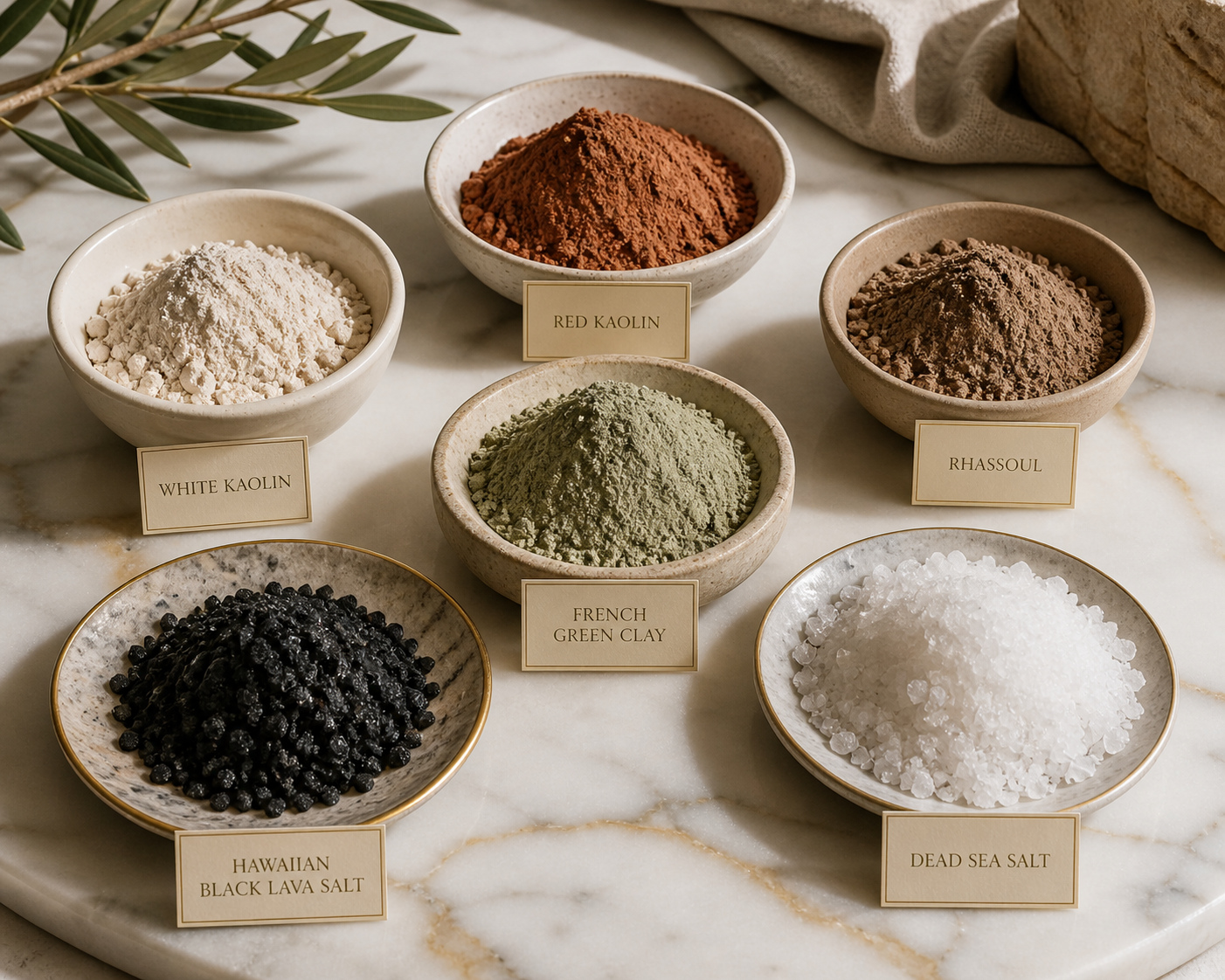
Red Kaolin Clay
Red kaolin gets its distinctive color from a higher iron oxide content than other kaolin varieties. That iron content promotes oxygen and nutrient flow to skin cells when applied topically, which is the mechanism behind its ability to stimulate circulation and tone the skin. Red kaolin is the most absorbent of the kaolin family, which makes it sound like it would be harsh, but the opposite is true. The most absorbent kaolin is actually the gentlest choice for dry and sensitive skin because it buffers oil balance rather than stripping. It absorbs just enough to bring things into balance without over-cleaning. It also contributes more to lather quality and bar texture than any other kaolin variety.
One thing that often surprises people: red kaolin is not purely a cosmetic ingredient. It is embedded in certain types of hemostatic bandages used in medicine because of its ability to promote blood clotting. That clinical application is a measure of how thoroughly studied this mineral actually is.
If your skin needs balancing, circulation support, and toning, the red kaolin in Blackcherry Merlot and Fall Sugar is your bar.
White Kaolin Clay
White kaolin, also called China clay or kaolinite, is the purest and gentlest of all cosmetic clays. It has the lowest cation exchange capacity of any clay used in soap making, which means it barely detoxifies at all by clay standards. That is not a weakness. It is the point. What white kaolin does brilliantly is improve lather texture, provide ultra-fine exfoliation without micro-tears, and leave a genuinely silky feel on skin. It is the clay equivalent of a polishing cloth rather than a scrub brush.
The silica content in white kaolin promotes circulation, encourages cell regeneration, and has documented benefits for hair and scalp health. It is the most versatile clay in our lineup, which is why it appears in three of our bars, Vanilla Bonfire, The Resort, and Prairie Breeze, and why it is a common ingredient in quality shampoo bars as well.
White kaolin is the most widely used ingredient in cosmetics globally after water and glycerin. It appears in everything from face powder to baby products to pharmaceutical tablets. That ubiquity is not coincidence. It is the most thoroughly studied and universally tolerated skin ingredient in existence.
French Green Clay
French green clay, scientifically known as illite clay, was formed from decomposed marine vegetation and volcanic ash deposited in ancient seabeds in the south of France over millions of years. The green color comes from a combination of iron oxides and decomposed kelp seaweed. The greener the color, the more mineral-rich the clay, with grey-green coloring indicating lower quality. This is worth knowing if you ever shop for French green clay products, as color is a reliable quality indicator.
The mineral profile is genuinely extraordinary. Magnesium, calcium, potassium, zinc, silicon, selenium, iron, copper, cobalt, manganese, phosphorus, and aluminum are all present. That is not a marketing list, it is a documented mineral composition that feeds the skin while it cleanses. A 2019 study published in the International Journal of Cosmetic Science found that illite clay reduced sebum production by 40 percent over four weeks of regular use. That is a peer-reviewed result, not a claim.
French green clay carries the strongest negative ionic charge of all the clays we use, which means it draws out impurities more deeply and more aggressively than kaolin. When applied to congested or acne-prone skin it pulls out bacteria, excess oils, and environmental pollutants with more force than any other clay in our lineup. That is precisely what oily and congested skin needs. The tradeoff is that this same aggressiveness can be too much for dry or sensitive skin, which is why French green clay is reserved for bars specifically formulated for oily and acne-prone skin types. Our Unscented, Smoked Leather, and Forest Fantasy bars all feature French green clay as their primary clay ingredient, each designed for skin types that benefit most from its deep detoxifying action.
One note worth mentioning on sourcing. Not all French green clay actually originates in France anymore. Deposits of illite are also mined in Wyoming, Montana, China, and other parts of Europe. The name has become more of a category descriptor than a geographic guarantee. Our French green clay is sourced from France, which is the authentic origin where the mineral profile was first documented and where quality standards remain highest.
Rhassoul Clay
Rhassoul clay is in a category of its own. It is the only clay in the world sourced exclusively from one location, a specific valley in the Middle Atlas Mountains of Morocco near the Moulouya River, approximately 125 miles from Fes. There are no other known global deposits of true ghassoulite, the mineral that makes up Rhassoul. This geographic exclusivity is not a marketing angle. It is geological fact. You cannot source authentic Rhassoul from anywhere else on earth.
Rhassoul is a stevensite clay, meaning it swells when it contacts water. This swelling dramatically increases its surface area and ionic exchange capacity, making it more effective at drawing out impurities than its mineral content alone would suggest. The primary minerals are silica at approximately 57 percent and magnesium at approximately 25 percent. Silica is essential for collagen production. Magnesium is one of the most important minerals for skin health, reducing inflammation, supporting cell repair, and improving the skin's barrier function. The combination of these two properties is why Rhassoul is considered the finest of all cosmetic clays and why it is the clay of choice in high-end Moroccan hammams and European spas.
The most important distinction between Rhassoul and every other clay we use is that it draws out impurities while simultaneously depositing minerals back into the skin. Most clays only take. Rhassoul takes and gives. This is the mechanism behind its reputation as a conditioning clay that leaves skin softer rather than tighter after use, which is why we use it in three of our richest bars, Coffee Buzz, Sandalwood Bourbon, and Twisted Lavender.
One honest nuance worth stating clearly: Rhassoul has not been extensively studied in peer-reviewed clinical trials the way some other cosmetic ingredients have. Most of the evidence for its benefits comes from over 1,400 years of empirical use and mineral composition analysis rather than randomized controlled trials. We do not think that disqualifies it. Humans were using it effectively long before clinical trials existed. But we would rather tell you that than let you assume the science is deeper than it is.
Dead Sea Salt
Dead Sea salt is not regular sea salt, and the difference matters more than most people realize. Regular ocean water is approximately 3 percent salt. The Dead Sea contains approximately 33 percent dissolved salts, making it nearly ten times saltier than any ocean on earth. More importantly, regular sea salt is roughly 97 percent sodium chloride, which is essentially the same compound as table salt. Dead Sea salt contains only about 30 percent sodium chloride. The remaining 70 percent is composed of magnesium chloride, potassium chloride, calcium chloride, bromide, sulfur, and more than 20 other minerals. That composition is what makes it therapeutically different from any other salt on earth, and why it has drawn people to its shores for thousands of years.
The research on Dead Sea salt and skin conditions is the most robust of any ingredient we use. A 1989 study by an Israeli dermatologist tested Dead Sea salts on 50 patients with psoriasis and found that 47 out of 50 experienced significant relief, a 94 percent response rate. Magnesium from the Dead Sea has been specifically shown in peer-reviewed research to improve skin barrier function and reduce inflammation. The combination of minerals supports the skin's own healing processes rather than simply treating surface symptoms, which is a meaningful distinction when it comes to chronic skin conditions.
We source our Dead Sea salt from Beer Sheva, Israel, at the southern end of the Dead Sea where mineral concentration is at its highest. The Dead Sea sits 1,200 feet below sea level, the lowest point on earth, which affects UV radiation levels, atmospheric pressure, and the mineral density of the water itself. Southern sourcing is not a marketing detail. The northern end of the Dead Sea carries measurably lower mineral concentration, which is why sourcing location matters when the minerals are the whole point.
One thing worth knowing: the Dead Sea is shrinking. It has lost approximately a third of its surface area since the 1960s due to water diversion from the Jordan River for agriculture and industry. Its level drops by more than three feet every year. This is an environmental concern that deserves attention, and it is also a practical reality for anyone sourcing from it. We are working with a finite and diminishing natural resource, and we do not take that lightly.
For the full story on why the magnesium to calcium ratio in Dead Sea Salt matters specifically in hard water conditions and what that means for your skin barrier, our hard water article goes into the detail this article only touches on.
Hawaiian Black Lava Salt
The name Hawaiian Black Lava Salt implies the salt comes directly from volcanic lava, but that is not quite accurate, and we would rather tell you that upfront than let the name do misleading work. Hawaiian black lava salt is sea salt harvested from Hawaiian salt ponds that is then blended with activated charcoal, typically from coconut shells, during the drying phase. The lava in the name is a reference to the volcanic landscape of Hawaii rather than a literal ingredient. The activated charcoal is what gives it the black color and the detoxifying properties, and those properties are genuinely significant.
Activated charcoal has an enormous surface area. The surface area of a single gram is larger than several basketball courts due to its extraordinarily porous structure. This massive surface area is what makes it so effective at adsorption, which is the process of binding substances to its surface rather than absorbing them internally. Think of it as a microscopic magnet with an almost unlimited surface to collect things. In the context of skin, activated charcoal binds to bacteria, excess sebum, and toxins on the surface and in pores, carrying them away when the lather is rinsed off. It also has documented antibacterial properties, which is why it is particularly useful for acne-prone, oily, or urban skin exposed to daily pollution.
The mineral story behind this salt is real, even if the lava story is more atmospheric than literal. The volcanic minerals from Hawaiian sea water include magnesium, calcium, potassium, and over 70 trace minerals carried by the mineral-rich Pacific waters surrounding the islands, which are fed by volcanic rock runoff. The salt is doing genuine mineral work. It is just the salt carrying those minerals, not lava directly. We use Hawaiian Black Lava Salt in our The Resort bar, where it works alongside white kaolin clay for a bar designed around deep cleansing and a genuine spa-like experience.
Most of what is written about these ingredients online is for face masks and bath soaks, not for cold process bar soap. The important distinction is that in a rinse-off soap bar, the clay and salt are on the skin for a much shorter time than in a mask. The benefit is real but more gentle. The ionic exchange still happens, the exfoliation still happens, but it is a quick pass rather than a sustained treatment. This gives you a daily cumulative effect with every shower you take. Over time that adds up to something meaningful.
Each Private Oaks bar was built around a specific clay or mineral profile because different skin needs different things on different days. If you have oily or congested skin, the French green clay in our Unscented is doing the deepest detoxifying work. If your skin needs balancing, circulation support, and toning, the red kaolin in
Blackcherry Merlot is your bar. If your skin is dry or craving minerals, the Rhassoul in Coffee Buzz or
Sandalwood Bourbon is conditioning and replenishing while it cleanses. If you want gentle daily maintenance, the white kaolin bars, Vanilla Bonfire,
The Resort, and
Prairie Breeze, are your everyday option. And if your skin is sensitive to fragrance and you need to stay in one lane, the Unscented handles all of that in one place.
We keep multiple bars in our own showers. Not because we sell more that way, though we will not pretend that is not a nice side effect. But because your skin's needs actually change with the season, your stress level, your diet, and your environment. A bar that is perfect in January when your skin is dry and wind-burned may not be what you need in July when humidity and heat shift your oil production. Rotating bars is not a luxury habit. It is just paying attention to what your skin is telling you.
These are not marketing fads. They are ingredients with real chemistry behind them. We just happen to put them in a bar of soap.
And then there is
Laced, our bar made from the remnants and offcuts of every other bar we make. It carries traces of every clay in our lineup. If you are not sure where to start, start there.
The clays and salts are only part of the story. The oils we choose are just as deliberate and just as important. If you want to understand the full picture of what goes into every Private Oaks bar, Do the Oils Really Matter That Much? covers that side of the formula in the same detail. And if you want to see every ingredient we use, where it comes from, and why it is there, our ingredients page has all of it in one place.
For the full skin science context behind why barrier protection matters, including what a Stanford dermatologist says about the skin microbiome and over-cleansing, our dermatologist blog covers it in detail.