.svg)
Menu
Most people don't think much about the difference between creams and lotions. They reach for whatever is on the shelf, apply it after a shower, and move on. We thought about it. A lot. That answer changed everything.
Lotions are water-based. Most commercial lotions are 60 to 80 percent water. Because water creates the ideal environment for bacterial and mold growth, water-based products require preservatives to stay shelf stable, and because oil and water don't naturally mix, they require emulsifiers to hold the formula together. The actual skin-beneficial ingredients, the oils, butters, and botanical extracts, often make up a relatively small percentage of what's in the bottle. The majority of what you're applying is water, stabilizers, and the chemistry required to keep them from separating. We've spent a lot of time researching what those synthetic stabilizers and preservatives do to skin, and you can read the full picture in our chemical article and our ingredient label article. When we originally sat down to build a moisturizer, a lotion was where we started. That changed pretty quickly. The more we learned, the less interested we were in building a product that required that chemistry to function. We looked at whipped creams and butters next, but those come with their own tradeoffs. A whipped formula is more prone to melting in warmer temperatures and less structurally stable in the form we wanted. A water-free body cream was the answer that let us keep every ingredient in the formula intentional.
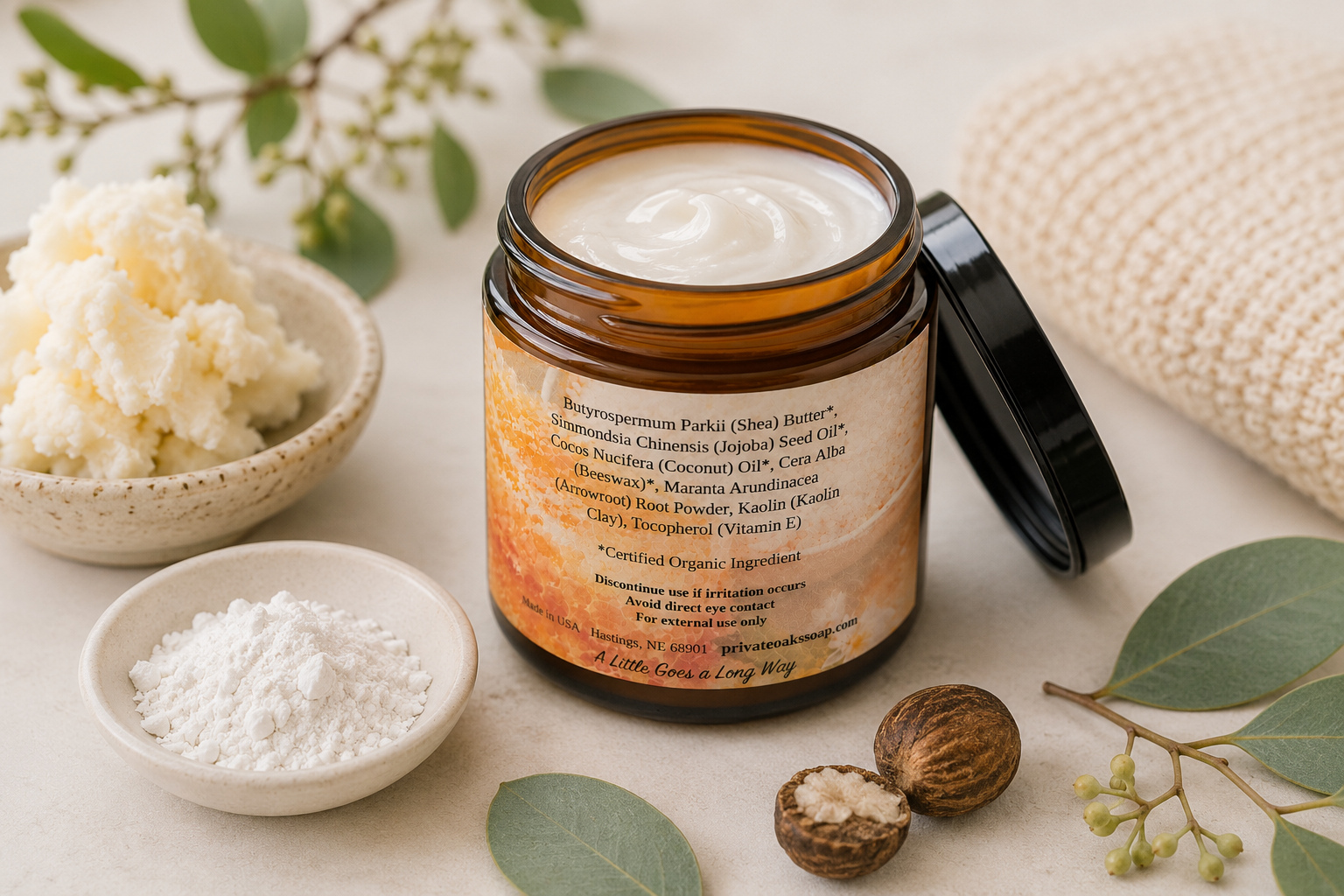
Private Oaks body creams are water-free, and that was a deliberate decision that came out of the research rather than a starting assumption. Every ingredient in both formulas is there because of what it does for your skin, not because of what it does for the stability of the product. No synthetic preservatives because a water-free formula doesn't need them. No emulsifiers because there's no water and oil separation to stabilize. What you're applying to your skin is exactly what it looks like on the ingredient list, nothing more and nothing less.
We developed two formulas because we believe different skin types have fundamentally different needs and a one-size-fits-all approach to moisturization is the same compromise we rejected when we built our soap line. The dry and normal skin formula is built around deep nourishment and barrier repair. The oily and acne-prone formula is built around barrier support, sebum regulation, and anti-inflammatory ingredients specifically chosen for what the research says about acne-prone skin's biology. The shared ingredients tell the story of what both skin types need. The differences between the two formulas tell the story of how we thought about what makes each skin type distinct.
But before we get into the ingredients, we want to tell you how these creams actually came to be.
How These Creams Came to Be
Clayton's oldest son Jax was going through puberty and dealing with the kind of moderate acne that most teenagers navigate. Red, inflamed skin and the occasional breakout that shows up at exactly the wrong time. Clayton found an acne balm on the market that worked remarkably well for him. Rather than just buying more of it, we did what we always do. We looked at the ingredient list and started researching why it was working.
That research led us down a path we hadn't expected. We found the science behind jojoba oil's ability to signal the sebaceous glands to reduce oil production. We found the documented connection between linoleic acid deficiency and acne-prone skin and the role high-linoleic safflower oil plays in addressing that deficiency directly. We found borage oil and its extraordinary concentration of gamma-linolenic acid, the highest of any plant-based oil, and the documented anti-inflammatory pathway that makes it relevant to acne-prone skin specifically. These weren't generic skin-compatible oils chosen because they felt nice. They were ingredients chosen because of what the research says about what acne-prone skin is actually missing.
We built a formula around those ingredients, added the shared base of organic shea butter, organic beeswax, vitamin E oil, white kaolin clay, and arrowroot powder, and had Jax test it.
The results were immediate enough that we knew we were onto something. Within 30 minutes of the first application the redness around his face that had been showing signs of inflammation was visibly reduced. The breakouts he had were less noticeable. He's used it consistently since and the difference in his complexion has been meaningful. Jax's acne wouldn't be considered severe. It falls somewhere in the moderate range. But it was real, it was affecting how he felt about himself the way acne does for most teenagers, and watching it respond that quickly to a formula we built from scratch was the moment Private Oaks went from a soap company to something broader.
The dry and normal skin formula had its own testing story and its own testers. Clayton's wife Chris and their oldest child and only daughter Rowyn, who is 16, became the people we handed that formula to. We were genuinely curious what the younger generation was using on their skin, and Rowyn showed us. She pulled out the creams and lotions she used regularly. Chris did the same. What we found was exactly what we expected but still striking to see laid out in front of us. Both of them were using water-based lotions. Neither of them had paid much attention to what was actually in them. Chris in particular was exactly the person we had been thinking about when we started this whole project, someone who grabs whatever is on the shelf after a shower, applies it, and moves on without a second thought about the ingredient list.
We handed them the dry and normal cream. Both of them were immediately struck by how different it felt from what they had been using. Not greasy despite how much oil was in it. Not heavy. Smooth, absorbent, and genuinely different in texture from anything water-based. Over the following weeks they helped us refine the exact recipe down to the feel and structure you find in the jar today. The cream you are using is not what we started with. It is what Chris and Rowyn told us it needed to be.
That's the story. Not a marketing team deciding what the market needed. Two people who grew up farming, started making soap because of what was in commercial bars, and kept following the research wherever it led. And four real people, Jax, Rowyn, Chris, and Clayton, whose skin told us when we got it right.
What Goes Into Both Formulas
Every ingredient in both Private Oaks body creams was chosen deliberately. The shared ingredients are the foundation that both skin types need. The differences between the two formulas are where the real formulation story lives, and we'll get to those. But the shared ingredients deserve their own explanation first because each one is doing specific and documented work.
Organic Shea Butter
Shea butter is the backbone of both formulas and the ingredient with the strongest and most consistent research behind it of anything we use.
It comes from the nut of the African shea tree, harvested primarily in West Africa. Ours comes from Burkina Faso, the same source we've used in our soap bars since the beginning. We use unrefined organic shea butter specifically because processing shea butter with high heat and chemical solvents destroys up to 75 percent of its bioactive compounds. Unrefined shea retains over 90 percent of its natural nutrient profile. The difference between refined and unrefined shea is not cosmetic. It is chemical.
The research on shea butter is genuinely impressive. A 2025 study published in the Pharmaceutical and Organic Chemistry International Journal found that shea butter reduced transepidermal water loss, which is moisture escaping through the skin, by 37.8 percent after 24 hours, increased skin hydration by 58 percent after 24 hours, and improved skin barrier integrity by 33 percent. Those are meaningful numbers from a peer-reviewed study, not marketing language.
The anti-inflammatory properties come from cinnamic acid esters present in unrefined shea. A study published in the Journal of Oleo Science found that triterpene cinnamates isolated from shea butter demonstrated potent anti-inflammatory activity, with a compound called lupeol cinnamate showing particularly strong effects. For context, these are the same compounds that disappear when shea is refined. This is why the organic unrefined designation matters in our formula and not just on the label.
A 2009 study published in the Journal of Allergy and Clinical Immunology compared shea butter to petroleum-based products for eczema treatment. Shea butter reduced symptom severity from level 3 to level 1 on a standardized scale. Vaseline only improved from 3 to 2. For anyone using our dry and normal skin cream to support eczema-prone skin, that result is worth knowing.
One thing worth knowing before you open the jar for the first time. Because our shea butter is unrefined, it means that it retains its naturally occurring stearic and oleic acid crystals. When you first scoop the cream and apply it you may notice a slightly gritty texture. This is not a defect. It is proof that the shea butter has not been processed to the point where those compounds are removed. Within seconds of rubbing the cream into your skin, body heat and friction melt those crystals completely and what remains is the silky, smooth, hydrating feel the cream is designed to deliver. If you have ever used a refined shea product and wondered why ours feels different at first, that difference is the whole point.
Organic Golden Jojoba Oil
We covered jojoba oil extensively in our acne article and in the origin story above, but it deserves its full explanation here because it plays a different role depending on which formula it's in.
Jojoba is technically a wax ester rather than a traditional oil. Its molecular structure mimics human sebum more closely than any other plant-based ingredient. That mimicry is what makes it valuable across both skin types, but for completely different reasons.
In the dry and normal skin formula, jojoba's sebum-like structure allows it to absorb readily into skin without leaving a greasy residue. It replenishes what dry skin is missing and supports the skin's natural barrier function. In the oily and acne-prone formula, that same structure signals the sebaceous glands that adequate oil is already present, which can naturally reduce overproduction. A clinical study found that jojoba oil reduced sebum secretion by 23 percent after 28 days of regular use on oily and acne-prone skin.
One note on why we use golden rather than clear jojoba oil. Golden jojoba is unrefined, retaining its natural tocopherols, antioxidants, and full complement of wax esters. Clear jojoba has been filtered and refined, removing some of those beneficial compounds in exchange for a more neutral appearance. The same logic that drives our choice of unrefined shea butter drives our choice of golden jojoba oil. The less processed the ingredient, the more of its natural benefit profile reaches your skin.
Organic Beeswax
Beeswax is the structural ingredient in both formulas. It is what gives the cream its consistency, what keeps it from being a liquid oil, and turns it into something you can scoop from a jar and apply to your skin. But its role goes well beyond texture.
A 2023 narrative review published in the Journal of Cosmetic Dermatology by researchers at UC Davis confirmed that beeswax functions simultaneously as three things: an occlusive, a humectant, and an emollient. As an occlusive it creates a semi-permeable barrier on the skin that physically reduces transepidermal water loss. As a humectant it actively attracts and holds moisture. As an emollient it softens and soothes the skin's surface. That triple functionality from a single natural ingredient is genuinely unusual, and it’s one of the reasons beeswax has been used in skincare formulations for thousands of years.
The same review found beeswax effective in managing psoriasis, treating dermatitis, and reducing bacterial overgrowth of natural skin flora. Beeswax contains propolis, a compound produced by bees that has documented antioxidant, antimicrobial, and anti-inflammatory properties.
One note worth making here. Some sources flag unrefined beeswax as potentially comedogenic for oily or acne-prone skin at high concentrations. This is a real concern and one we addressed directly in the formulation. Rather than using a high percentage of beeswax to create a balm-like consistency, we used a lower percentage of beeswax and combined it with white kaolin clay and arrowroot powder to achieve the cream texture we wanted. The result is a formula that has the structural stability of beeswax without the comedogenic risk that comes from using it as the primary thickener. That was an intentional formulation decision and it matters specifically for the acne-prone formula.
Vitamin E Oil
Vitamin E oil, specifically alpha-tocopherol, is doing two jobs in both formulas simultaneously and both of them matter.
The first is preserving the formula itself. Our creams contain high-linoleic safflower oil in the acne-prone formula and other polyunsaturated fatty acids across both formulas. Polyunsaturated fats are prone to oxidation, meaning they can go rancid when exposed to air and light. Vitamin E oil is a natural antioxidant that protects those fatty acids from oxidizing and extends the shelf life of the cream without any synthetic preservatives. This is the ingredient that makes our water-free, preservative-free formula shelf stable. It is doing the job that parabens and phenoxyethanol do in conventional lotions, but through a natural antioxidant mechanism rather than a synthetic chemical one.
The second job is protecting your skin. Vitamin E is one of the most studied antioxidant ingredients in skincare. Applied topically it neutralizes free radicals from UV radiation and environmental damage, supports the skin's natural repair processes, and contributes to collagen maintenance over time. The antioxidant protection is well documented across multiple peer-reviewed studies.
The same logic that drives our choice of vitamin E oil as a natural antioxidant drives our choice of packaging. Our creams come in amber glass jars specifically because amber glass filters out the UV and visible light wavelengths that accelerate oxidation in plant-based oils. Light is one of the primary drivers of rancidity in polyunsaturated fatty acids and the amber jar is the physical barrier that protects the formula from it the same way vitamin E oil protects it chemically. Together they are a two-layer natural preservation system that keeps the cream stable without synthetic preservatives.
For best results store your cream away from direct sunlight and intense heat. A bathroom cabinet or bedroom drawer is ideal. A windowsill or a car is not. Stored correctly, both formulas have a shelf life of 9 to 12 months. If the cream ever develops an off smell, that’s your signal that the oils have begun to oxidize, and it’s time to replace it.
White Kaolin Clay
We covered white kaolin clay in depth in our clays and salts article so we won't repeat the full science here. But its role in a leave-on cream formula is different from its role in a rinse-off soap bar and that difference is worth explaining.
In a soap bar, kaolin clay's ionic charge draws out impurities during the brief time the bar is on your skin. In a leave-on cream, it does something more sustained. It absorbs excess sebum from the skin's surface over time, keeps pores clearer, and creates a balanced skin environment that allows the therapeutic oils in the formula to penetrate more effectively rather than sitting on top of a sebum-clogged surface. A peer-reviewed PMC study confirmed that kaolin can effectively extract surplus oil from the skin, reducing sebum production and decreasing the likelihood of pore blockage even in leave-on applications.
White kaolin clay also has a comedogenic rating of zero. It will not clog pores. For the acne-prone formula specifically, that non-comedogenic confirmation matters.
Arrowroot Powder
Arrowroot powder is the ingredient most people have never heard of and the one that most directly explains why our creams feel the way they do.
It is derived from the root of the Maranta arundinacea plant and has been used in traditional medicine and skincare for centuries. In our formula it serves as a natural texture modifier that absorbs excess surface oil, creates a silky, non-greasy finish, and improves the spreadability of the cream across the skin.
But here is the part that surprised us most when we were researching it. Multiple cosmetic formulation sources confirm that arrowroot powder enhances the absorption of other active ingredients when used in cream formulations. It softens and penetrates the surface layer of the skin, making it easier for moisture and other active ingredients to go deeper rather than sitting on top. In practical terms, this means the shea butter, jojoba oil, safflower oil, and borage oil in our formulas are reaching deeper skin layers more effectively because the arrowroot is preparing the surface to receive them.
Arrowroot powder is also non-comedogenic and non-toxic, with a well-established safety profile in cosmetic formulation. It is the natural alternative to talc, without any of the concerns that have followed talc-based products in recent years.
Here is something worth understanding about arrowroot powder that most brands using it would prefer you not think about too carefully. Arrowroot enhances ingredient absorption regardless of what those other ingredients are. If it helps our organic shea butter and jojoba oil penetrate deeper into the skin, it does the same thing for whatever else is in the formula it appears in. That means a conventional lotion or cream using arrowroot powder alongside synthetic preservatives, undisclosed fragrance compounds, or synthetic emulsifiers is potentially driving those synthetic ingredients deeper into the skin than they would otherwise reach on their own.
This is not a hypothetical concern. It is documented cosmetic chemistry. Penetration enhancers do not discriminate between ingredients they consider beneficial and ingredients that raise concerns. They simply prepare the skin surface to absorb more of whatever is present in the formula. We covered what some of those synthetic compounds are and what they do in our ingredient label article and our chemical article. The reason ingredient quality matters more in a leave-on cream than in a rinse-off soap is exactly this. What you leave on your skin has time to absorb. What absorbs more deeply because of penetration enhancers like arrowroot stays longer. That is the argument for caring about every ingredient in a moisturizer, not just the ones that sound like active ingredients.
How the Powders Work Together
White kaolin clay and arrowroot powder are each doing their own work in the formula, but together they are doing something more interesting than either one does alone.
Kaolin draws out excess sebum and surface impurities through its ionic charge, clearing the pore environment. Arrowroot absorbs surface oil and creates the balanced, breathable skin surface that is the optimal condition for active ingredient absorption. Together they prepare the skin to receive the therapeutic oils in the formula more effectively than those oils could penetrate on their own against a sebum-clogged or debris-covered surface.
This dual preparation system is also why our creams don't feel greasy despite containing shea butter, jojoba oil, coconut oil in the dry and normal formula, and multiple other oils. The powders are actively managing the surface oil balance that would otherwise make an oil-rich cream feel heavy or occlusive on the skin. That's not a texture trick. It's formulation strategy.
The Dry and Normal Skin Formula
The dry and normal skin cream was built around one central question. What does skin that is struggling to retain moisture actually need from a leave-on product?
The answer the research kept pointing to was barrier repair and sustained occlusion. Dry skin loses moisture faster than it can replenish it. The goal of a moisturizer for dry skin is not just to add moisture but to slow the rate at which it escapes. Every ingredient in this formula is doing one or both of those things.
Organic Extra Virgin Coconut Oil
Coconut oil is the ingredient that differentiates the dry and normal formula from the acne-prone formula, and understanding why it's in one and not the other tells you a lot about how we thought about both.
We use extra virgin coconut oil specifically, which is extracted from fresh coconut meat without heat or chemical processing. This is the least processed form of coconut oil available and it preserves the full concentration of lauric acid, natural antioxidants, and medium-chain fatty acids that make coconut oil genuinely beneficial for skin. Refined coconut oil, which is what most commercial products use, is processed with heat and sometimes chemical solvents that strip away some of those naturally occurring compounds. The same principle that drives our choice of unrefined shea butter and golden jojoba oil drives our choice of extra virgin coconut oil. The less processed the ingredient the more of its natural benefit profile reaches your skin.
Extra virgin coconut oil is high in lauric acid, a medium-chain fatty acid with documented antimicrobial properties. It's deeply moisturizing, creates an occlusive barrier alongside the beeswax, and absorbs readily into skin. For dry and normal skin those properties are genuinely beneficial. The lauric acid supports the skin's natural defense against bacteria and environmental pathogens. The occlusive properties work with the beeswax to create the moisture-sealing layer that dry skin specifically needs.
Coconut oil has a comedogenic rating of 4 out of 5, which makes it potentially pore-clogging in leave-on applications for oily or acne-prone skin. That is exactly why it's not in the acne-prone formula. For dry and normal skin that comedogenic rating is not a meaningful concern because the skin is not producing excess sebum to begin with. The occlusive benefit outweighs the comedogenic risk for this specific skin type. We made that call deliberately and we want you to understand why.
Our dry and normal skin cream is available in an unscented natural formula and in scented versions. Our fragrance oils are a blend of naturally derived and lab-created aroma-safe compounds, phthalate-free, paraben-free, and free of heavy metals, used at less than 2 percent of the finished cream. That is a lower concentration than even our soap bars. If you have fragrance sensitivities the unscented natural formula is the honest recommendation. If you want the experience of a scented moisturizer with fragrance handled more carefully than most commercial products would ever disclose, the scented versions are formulated with the same intentionality as everything else we make.
You can find both versions of the dry and normal skin cream at our body creams page.
The Oily and Acne-Prone Skin Formula
The acne-prone formula started with Jax, as you just read, and it was built around a different central question. What does skin that is overproducing oil and dealing with inflammation actually need from a leave-on product?
The answer required us to think differently about moisturization for oily skin. Most people with oily or acne-prone skin avoid moisturizers because they assume adding anything to already oily skin will make things worse. The research says the opposite. Skipping moisturizer on oily skin can actually worsen acne by triggering the sebaceous glands to produce more oil to compensate for the lack of external moisture. The goal is not to add heaviness. It's to provide the right kind of moisture and the right kind of fatty acids to signal the skin that it can stop overcompensating.
High-Linoleic Safflower Oil
People with acne-prone skin have measurably lower levels of linoleic acid in their sebum compared to people without acne. This is documented in peer-reviewed research. When linoleic acid is deficient, sebum becomes thicker, stickier, and more likely to clog follicles. High-linoleic safflower oil is one of the richest plant sources of linoleic acid, typically containing 70 to 80 percent. It directly addresses that deficiency. This isn't a general skin-compatible oil included because it felt nice in testing. It's an ingredient chosen because of what the research says about what acne-prone skin is biochemically missing.
Borage Oil
Borage seed oil contains 20 to 24 percent gamma-linolenic acid, making it the single richest plant-based source of GLA available. Evening primrose oil, its closest competitor, contains only 7 to 10 percent. That concentration difference matters because GLA has documented anti-inflammatory properties that are directly relevant to acne-prone skin. Inflammation is the fourth driver of acne we described in our acne article. A leave-on product with a meaningful anti-inflammatory ingredient addresses that driver at the skin level between cleansing sessions in a way that a rinse-off soap bar simply cannot.
One honest nuance worth stating clearly. The primary mechanism for GLA's anti-inflammatory action involves a conversion process that is more thoroughly documented for oral supplementation than for topical application. The topical research is supportive and growing but less definitive than the oral evidence. We include it because the topical evidence is meaningful and the ingredient is genuinely well-suited to the formula. We want you to know the full picture rather than just the version that makes the product sound better.
We go much deeper on the biochemistry behind both of these oils, including the enzyme bottleneck that makes borage oil specifically valuable for acne-prone skin, in our acne-prone cream article.
No Coconut Oil
The deliberate exclusion of coconut oil from the acne-prone formula is worth restating here because it reflects the kind of formulation thinking most skincare brands don't make visible. Coconut oil's comedogenic rating of 4 out of 5 makes it a meaningful risk in a leave-on formula for oily and acne-prone skin. We use it in the dry and normal formula because the occlusive benefit is appropriate for that skin type. We exclude it here because the pore-clogging risk is not a tradeoff worth making for skin that is already dealing with clogged follicles as a primary driver of breakouts.
Our acne-prone skin cream is also available in an unscented natural formula and in scented versions. The same fragrance philosophy applies here. Our fragrance oils are a blend of naturally derived and lab-created aroma-safe compounds, phthalate-free, paraben-free, and free of heavy metals, used at less than 2 percent of the finished cream. If you have acne-prone skin and known fragrance sensitivities, the unscented natural formula is the honest starting point. If you have acne-prone skin without specific fragrance sensitivity, the scented versions offer the same intentional formula with fragrance handled more carefully than most commercial moisturizers would ever tell you.
You can find both versions of the acne-prone skin cream at our body creams page.
Skincare products are not all the same. Most of what's on the shelf is water, stabilizers, and the chemistry required to keep them from separating, with a relatively small percentage of ingredients doing the actual work your skin needs. We knew that before we built these creams and it shaped every decision we made.
What we built instead is a water-free formula where every ingredient is present because of what it does for your skin. Organic unrefined shea butter with its documented anti-inflammatory and barrier-repair properties. Organic extra virgin coconut oil in the dry and normal formula for deep nourishment and occlusive moisture retention. Organic golden jojoba oil that works differently depending on which skin type it's supporting. Organic beeswax creating the triple action of occlusive, humectant, and emollient. Vitamin E oil protecting both the formula and your skin from oxidative damage. White kaolin clay preparing the skin surface and keeping pores clear. Arrowroot powder creating the silky non-greasy finish and enhancing the absorption of everything else in the jar. And in the acne-prone formula, high-linoleic safflower oil addressing the specific fatty acid deficiency documented in acne-prone skin, and borage oil delivering the highest plant-based concentration of gamma-linolenic acid available.
None of that happens by accident. It happens because we kept asking the same question, what does this specific skin type actually need, and followed the research until we had an answer we could stand behind.
These creams don't treat skin conditions. We want to be clear about that. What they do is support your skin's own biology with clean, intentional ingredients and nothing hidden. Whether you're managing dry skin through a Nebraska winter, dealing with the oily skin and inflammation that comes with hormonal changes, or simply looking for a moisturizer whose ingredient list you can actually understand, we built these for you.
If you have questions about which formula is right for your skin, start with the skin condition articles in The Grove. The eczema, rosacea, psoriasis, and acne articles each explain which of our products fit that skin type and why. If you want to see the full ingredient list for both formulas in one place, our ingredients page has everything documented transparently.
Both formulas, unscented and scented, are available now at our body creams page.
That's always been the point of Private Oaks. Not the most products. Not the most marketing. The most intentional ingredients we could put in a jar, with an honest explanation of why each one is there.