.svg)
Menu
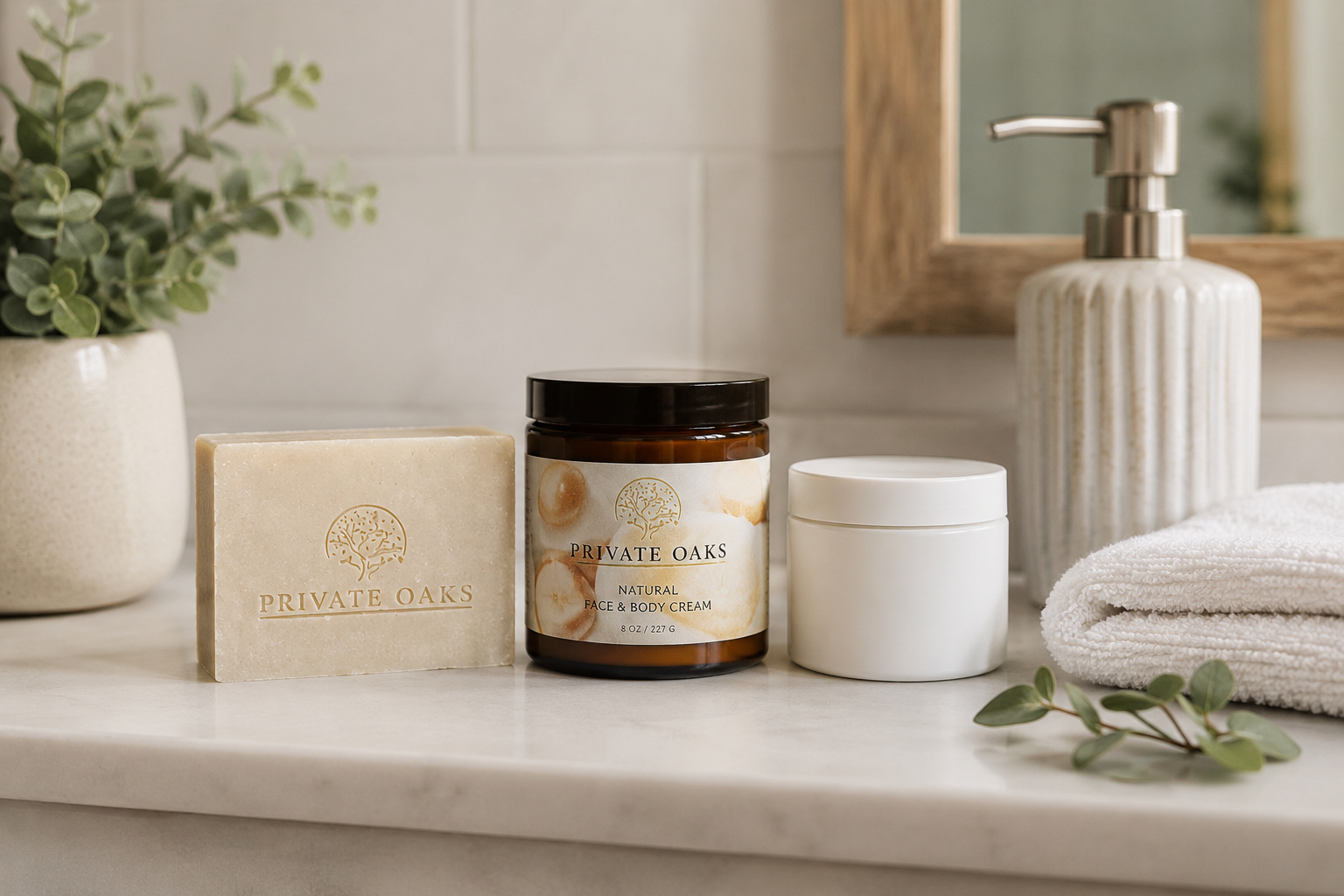
If you have read through The Grove you have probably noticed that we recommend our Unscented bar for eczema, rosacea, psoriasis, and acne-prone skin. You may also use CeraVe for one or more of those same conditions. That raises a reasonable question. Are these products competing with each other or can they work together?
They are doing fundamentally different things for your skin and understanding that difference is genuinely useful. CeraVe is built around ceramides, the lipid molecules that form your skin's natural barrier, and the science behind that approach is strong. Private Oaks is built around water-free organic oils and a completely different ingredient philosophy. Neither one is the complete picture on its own. Together they address skin health from complementary directions that most people have never thought to combine.
That is what this article is about.
What Is CeraVe and Why Do Dermatologists Recommend It?
CeraVe was founded in 2005 by a team of researchers who noticed something consistent across multiple chronic skin conditions. Eczema, psoriasis, rosacea, acne, and chronic dry skin all share one underlying problem regardless of their different causes and presentations. The skin barrier is compromised. Moisture escapes the skin allowing irritants, allergens, and bacteria to get in far too easily. The conditions look different on the surface but the barrier dysfunction underneath them is the same problem.
CeraVe was built around a single answer to that problem. Replenish ceramides.
Ceramides are waxy lipid molecules that occur naturally in the outermost layer of your skin. They make up approximately 50 percent of the skin's lipid content and function as the mortar between skin cells, holding the wall together and regulating what passes in and out. People with eczema, psoriasis, and chronically sensitive skin have measurably lower ceramide levels than people without those conditions. That deficiency is not a consequence of their skin condition. In many cases it is a contributing cause of it. Replenishing ceramides from the outside while the skin works to restore them from the inside is the scientific foundation that CeraVe is built on and it's a well-documented approach supported by peer-reviewed research.
A 2025 multicenter study evaluated ceramide-containing skincare regimens on 312 patients with atopic dermatitis, psoriasis, and xerosis over four weeks. All three groups showed meaningful clinical improvement. A study cited across multiple dermatology sources found that a ceramide-containing routine used for four weeks reduced atopic dermatitis severity by over 61 percent in a 312-patient cohort. This research is published clinical data.
CeraVe also uses a patented delivery system called MVE Technology that encapsulates ceramides in a multi-lamellar structure and releases them slowly over 24 hours rather than depositing them all at once. This matters because one of the documented challenges with topically applied ceramides is that they can accumulate in skin surface grooves rather than distributing evenly throughout the stratum corneum. The slow-release mechanism is an engineering response to a real formulation problem, not just a marketing feature.
The formula is fragrance-free, SLS-free, paraben-free, and non-comedogenic. It has earned the National Eczema Association Seal of Acceptance. It's developed with dermatologists and clinically tested. When Dr. Teo Soleymani recommended it on the Huberman Lab podcast, which we covered in detail in our dermatologist article, he was not making an uninformed recommendation. He was pointing to a product with a specific and well-supported mechanism for skin barrier repair. That recommendation makes complete scientific sense and we're not going to pretend otherwise.
What's in CeraVe?
Understanding what CeraVe is made of matters for two reasons. It tells you why it works, and it tells you what it requires to work that your skin may or may not want.
The full ingredient list for CeraVe Moisturizing Cream reads: Water, Glycerin, Cetearyl Alcohol, Caprylic/Capric Triglyceride, Cetyl Alcohol, Ceteareth-20, Petrolatum, Potassium Phosphate, Ceramide NP, Ceramide AP, Ceramide EOP, Carbomer, Dimethicone, Behentrimonium Methosulfate, Sodium Lauroyl Lactylate, Sodium Hyaluronate, Cholesterol, Phenoxyethanol, Disodium EDTA, Dipotassium Phosphate, Tocopherol, Phytosphingosine, Xanthan Gum, Ethylhexylglycerin.
Water is the first ingredient by a significant margin. That means CeraVe is a water-based formula, the same category as the lotions we spent an entire article distinguishing our creams from in our body cream article. Water as the primary ingredient requires the formula to include synthetic emulsifiers to keep the oil and water components from separating, and synthetic preservatives to prevent bacterial and mold growth in that water-rich environment.
Ceteareth-20 and Behentrimonium Methosulfate are the emulsifiers. They hold the formula together. Phenoxyethanol is the synthetic preservative. It's one of the gentler options available in cosmetics and its safety profile at concentrations up to 1 percent is considered acceptable by regulators. Carbomer and Xanthan Gum are synthetic stabilizers that control texture and viscosity. Disodium EDTA is the same chelating agent we covered in our ingredient label article. Petrolatum and Dimethicone are petroleum-derived occlusive ingredients that physically seal moisture into the skin.
None of those ingredients are in our body creams. Not because they're categorically dangerous at the concentrations CeraVe uses them, but because our water-free formula doesn't need any of them. When there's no water in a formula, there's nothing for bacteria and mold to grow in, so synthetic preservatives become unnecessary. When there's no water and oil separation to stabilize, emulsifiers become unnecessary. The shorter ingredient list in our creams isn't a compromise. It's a consequence of a different starting point.
The ceramides themselves are worth understanding in more detail. CeraVe uses three specific types, Ceramide NP, Ceramide AP, and Ceramide EOP, also known as ceramides 1, 3, and 6-II, in ratios designed to mirror the skin's natural lipid composition. Ceramide EOP in particular has a uniquely long fatty acid chain that allows it to bridge lipid layers in a way other ceramides can't, and measurably low levels of it have been found specifically in people with eczema and psoriasis. These are synthetic ceramides, meaning they're manufactured rather than extracted from natural sources. The research is clear that synthetic ceramides achieve clinical efficacy comparable to natural ceramides and are more stable in a formula. The synthetic origin doesn't meaningfully compromise their effectiveness.
Hyaluronic acid appears as Sodium Hyaluronate, a salt form that penetrates more easily into the skin than larger hyaluronic acid molecules. It's a well-documented humectant that attracts and holds moisture at the skin's surface. Cholesterol is present alongside the ceramides because research shows ceramides work best in combination with cholesterol and fatty acids, which are the other two major components of the skin's natural lipid barrier. CeraVe's formula is built around that specific ratio deliberately.
The picture that emerges is a formula engineered specifically for clinical barrier repair. Every ingredient is there for a reason. The synthetic ingredients are necessary because of the water-based format. The ceramide complex is genuinely well-designed. The delivery mechanism is real science. This is a product built to do one thing very well, replenish a compromised skin barrier with the specific lipids it's missing.
How They Work Together
The most useful way to think about CeraVe and Private Oaks is not which one is better. It is what each one does that the other doesn't, and how using both gives your skin more than either one alone.
CeraVe's core products are designed to replenish the specific lipids a compromised skin barrier is missing. The ceramide complex, the hyaluronic acid, the cholesterol, they work together to rebuild what the barrier has lost. For anyone managing eczema, psoriasis, rosacea, or chronic dryness, that targeted replenishment is genuinely valuable and the clinical research behind it is strong.
Where Private Oaks fits alongside that is in the daily cleansing and moisturizing steps that happen around CeraVe in your routine. Our Unscented bar is a gentle, SLS-free, fragrance-free cleanser made with organic oils that doesn't strip the skin barrier before you apply anything else. If you're using CeraVe as your primary treatment moisturizer, what you cleanse with beforehand matters. Washing with a cleanser containing SLS or harsh surfactants disrupts the barrier you're trying to repair. Our Unscented bar removes surface debris and excess sebum without that disruption, leaving your skin in a better state to absorb and benefit from whatever you apply afterward.
Our dry and normal skin cream tells a different story alongside CeraVe. CeraVe's moisturizer is a water-based formula delivering synthetic ceramides in a precisely engineered ratio. Our dry and normal skin cream is a water-free formula delivering organic shea butter, organic extra virgin coconut oil, organic golden jojoba oil, organic beeswax, vitamin E, white kaolin clay, and arrowroot powder. No water, no synthetic preservatives, no emulsifiers. The two products are not duplicating each other. CeraVe is replenishing ceramide structures the barrier is missing. Our cream is providing whole plant-derived fatty acids, occlusives, and humectants from organic sources that support what the skin is already doing on its own. Used together, one as a targeted ceramide treatment and the other as a clean organic leave-on moisturizer, they're addressing skin health from two genuinely different angles.
For oily and acne-prone skin our Unscented, Smoked Leather, and Forest Fantasy bars with French green clay alongside our acne-prone skin cream built around high-linoleic safflower oil and borage oil offer a clean, natural option that approaches acne-prone skin from a completely different direction than a ceramide-based approach. For the full science behind why those specific oils were chosen, our acne article covers it in depth.
The point is not to replace something that's working. It's to give your skin more options built around cleaner ingredients for the parts of your routine where that matters to you.
A Note on CeraVe's Cleanser Line
Not all CeraVe products are formulated the same way and that distinction is worth knowing. The CeraVe Hydrating Facial Cleanser is a relatively simple and gentle formula. Its primary cleansing agents are Behentrimonium Methosulfate and Sodium Lauroyl Lactylate, both of which are genuinely milder than SLS, and it contains no SLS at all. For anyone looking for a gentle drugstore cleanser that's genuinely mild, that's worth knowing.
The CeraVe Hydrating Cream-to-Foam Cleanser is a significantly more complex product. It contains multiple PEG compounds, Chlorphenesin as an additional preservative, Sodium Benzoate, and a considerably longer ingredient list overall. PEG compounds are a category of penetration-enhancing ingredients that have raised documented concerns in cosmetic chemistry literature. The Cream-to-Foam Cleanser is a meaningfully different product from the basic Hydrating Cleanser and treating all CeraVe products as identical misses an important distinction worth knowing.
If you're considering CeraVe as part of your routine, the Hydrating Facial Cleanser is the simpler and gentler option between the two cleansers. Our Unscented bar is a different tool approaching cleansing from a different ingredient philosophy, and the two sit comfortably alongside each other in the same routine.
What This Means for Your Routine
At Private Oaks we're not asking you to choose. We're built on a different ingredient philosophy and made for people who want clean organic options for the daily parts of their skincare routine that work alongside whatever else they're doing for their skin.
If CeraVe is working for you, keep using it. What we offer sits alongside it, not instead of it. We have cleansers that don’t undo barrier work, leave-on moisturizers built from water-free organic ingredients for the moments when that philosophy matters to you, and for acne-prone skin, creams addressing the specific fatty acid deficiencies that ceramides alone don't cover.
The more you understand about what each product actually does, the better equipped you are to build a routine that genuinely works for your skin. That's always been the point of The Grove. Not to tell you what to buy, but to give you enough information to decide for yourself.