.svg)
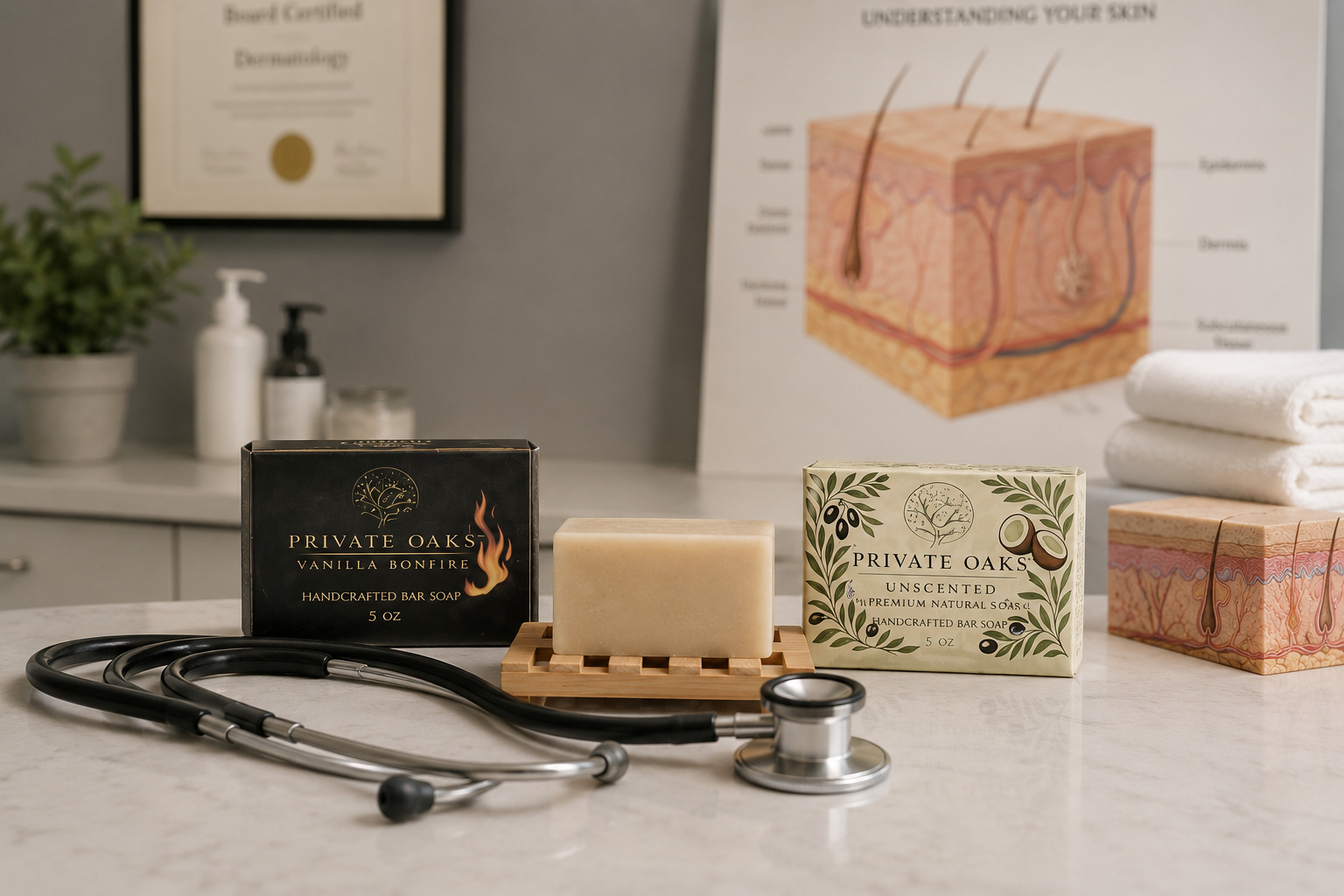
Is Your Soap Actually Good for Your Skin? A Dermatologist Weighs In.
A Stanford neuroscientist and a double board certified dermatologist sat down for three hours and talked about skin. I listened to the whole thing. Some of what they said confirmed everything we've built Private Oaks around. Some of it was genuinely surprising, including a recommendation for an inexpensive bar of Dove soap. I want to share all of it honestly, because that's the only way this blog is worth reading.
I was genuinely surprised when Dr. Teo Soleymani told Dr. Andrew Huberman on his podcast, The Huberman Lab, that regular Dove white bar soap is what he uses for himself and his family and recommends to patients for their babies. I understand the reasoning. That bar has few ingredients, minimal scent, and is generally safe for sensitive skin. He went on to state that there's not a shred of evidence that anything more expensive works better than anything more cost-effective. That's a direct quote, and I'm not going to pretend it doesn't apply to us, because it might, depending on who you are and what your skin needs.
Here's the honest distinction though. Dove is a mild, inexpensive option that is genuinely better than many commercial alternatives. But it isn't a cold process bar made with organic oils that retains glycerin and is superfatted. It's a different tool for different people, and understanding that difference is what this section is about.
Dr. Soleymani says the best skincare products are mild, fragrance-free, free of stabilizers and preservatives, and non-comedogenic. He also noted that bar soap tends to have fewer stabilizers, allergens, and preservatives than gels and body washes. That is something we've said from the beginning and it was genuinely validating to hear it from a double board certified dermatologist.
Dove's sensitive skin bar reflects many of those principles. Its primary surfactant is sodium lauroyl isethionate, which is milder than SLS and less likely to strip the skin barrier. It contains calendula flower extract, a documented anti-inflammatory ingredient, and its overall formula is minimal by commercial standards. For people with sensitive skin who want an accessible, affordable, widely available option, Dr. Soleymani's recommendation makes sense.
Our Unscented bar is built around a different approach. It's a cold process bar made with organic olive oil, coconut oil, and shea butter. The saponification process retains the naturally occurring glycerin inside the bar. We superfat our formula, meaning a small percentage of oils remains unsaponified and stays in the bar as skin conditioning agents. It contains no synthetic surfactants, no preservatives, no stabilizers, no detergents, and no heavy metals. Our scented bars follow the same formula with fragrance added at under 4 percent of total ingredients, well within industry safe-use guidelines and generally well tolerated by people with mild or no fragrance sensitivities. Our fragrance oils are a blend of naturally derived and lab-created aroma-safe compounds, phthalate-free, paraben-free, and free of heavy metals, and we have full SDS documentation for every fragrance we use. For anyone with significant fragrance allergies, our Unscented bar is the honest recommendation.
These are different products built on different philosophies. One is optimized for accessibility and wide availability. The other is optimized for ingredient integrity and skin nourishment. Dr. Soleymani is right that price alone doesn't determine quality. What matters is understanding what's in the bar you're using and why it's there. That's true whether you're reaching for Dove or Private Oaks.
If you want to see exactly what's in every Private Oaks bar, where each ingredient comes from, and why it's there, our ingredients page has all of it documented transparently.
Also, we cover exactly what those synthetic surfactants are called on ingredient labels and what they mean in our ingredient blog.
Who Are These Two People?
If you haven't encountered the Huberman Lab podcast yet, it's worth knowing what it is before we go further. Dr. Andrew Huberman is a tenured professor of neurobiology and ophthalmology at Stanford University School of Medicine, where he directs the Huberman Lab. His research focuses on brain development, neural plasticity, and the neuroscience of stress and visual perception. He's published over 75 peer-reviewed articles in journals including Nature, Science, and Cell, and has been awarded the Cogan Award for the most significant discoveries in the study of vision. In 2021 he launched the Huberman Lab podcast, which consistently ranks as the number one health and science podcast in the world on both Apple Podcasts and Spotify.
I'll be honest about something. Huberman has received some criticism from scientists for occasionally overstating certainty where ambiguity exists and for straying outside his core expertise of neuroscience into broader health topics. I think that's a fair criticism worth acknowledging. What I can say is that when he brings in a guest who is the genuine expert in the specific field being discussed, the quality of the conversation is exceptional. Episode 190 is a good example of that.
Dr. Teo Soleymani is that expert. He's a double board certified dermatologist and fellowship trained Mohs micrographic surgeon who completed his residency at Stanford and served as a clinical professor at the David Geffen School of Medicine at UCLA. He's the founder of California Dermatology and Mohs Surgery Specialists in Pasadena, California. Mohs micrographic surgery is the gold standard treatment for skin cancer, and Dr. Soleymani pioneered the introduction of advanced intra-operative immunostaining techniques at UCLA that significantly improved outcomes for patients with complex and rare skin cancers. He's one of only a handful of surgeons in the world fellowship trained in both Mohs micrographic surgery and facial plastic and reconstructive surgery simultaneously.
When a dermatologist of that caliber sits down for nearly three hours to talk about skin health, basic skincare, and what actually works, it's worth paying attention. The episode is titled "How to Improve and Protect Your Skin Health and Appearance," it's Episode 190 of the Huberman Lab, released August 19, 2024, and it runs about two hours and 46 minutes. It's available on Spotify, YouTube, and at hubermanlab.com. I'd encourage you to listen to the whole thing yourself rather than just taking my word for any of it.
What Your Skin Actually Is and How It Works
Before getting into what products work and what doesn't, Dr. Soleymani started with something more fundamental: what skin actually is and how it functions. I found this part genuinely fascinating and it changed how I think about everything we do at Private Oaks.
Your skin is the largest organ in your body. Most people know that. What most people don't think about is that it's also one of the most dynamic. Dr. Soleymani explained that you have completely brand new skin approximately every 28 days. The stem cells in the lowest portion of the epidermis continuously generate new skin cells that migrate upward, mature, and are eventually shed from the surface. The same way your gut lining replaces itself every 28 days, so does your skin. This means the surface you're washing every morning is, within a month, going to be entirely replaced by new cells generated from below.
This has a practical implication that took me a moment to fully appreciate. If your skin is constantly regenerating, then the products you put on it, and the ones you don't, accumulate over time. Good habits compound. Bad habits compound too. The bar of soap you use every day is not a one-time event. It's a monthly cycle of contact with the organ that replaces itself completely every 28 days.
The skin has three layers worth understanding. The epidermis is the outermost layer, where turnover happens and where most of what we put on our skin makes contact. The dermis sits beneath it and is where most of the biological activity happens — blood vessels, nerve endings, hair follicles, and sweat glands all live here. Beneath that is the subcutaneous fat layer. Dr. Soleymani pointed out that the dermis is where the real long-term damage from chronic stress and environmental exposure accumulates, which is why skin health is not just about what's on the surface.
Stress and Your Skin
Dr. Soleymani explained that skin is directly connected to the nervous system. That connection means stress shows up in your skin faster than almost anywhere else in your body. In the short term, stress triggers a fight-or-flight response that constricts blood vessels in the skin, shunting blood to the muscles instead. That's why people look pale or gaunt when they're acutely stressed. In the longer term, chronic stress elevates cortisol, and elevated cortisol breaks down collagen, elastin, and the quality of the dermis and subcutaneous fat over time. It accelerates aging from the inside out.
The encouraging flip side is that because skin turns over every 28 days, improvements in stress levels can show up in your skin relatively quickly. Dr. Soleymani said this is why people tend to have a visible glow after a vacation. The skin that grew during a lower-stress period is now on the surface. You can't quantify that in a lab, he said, but it's real.
What Goes On Your Skin Matters More Than Most People Realize
Dr. Soleymani noted that over-cleansing is one of the most common skincare mistakes Americans make, particularly people with dry skin. Stripping the skin's natural oils disrupts the skin microbiome, the community of beneficial bacteria that live on the skin's surface and play a protective role against infection and inflammation. Harsh surfactants, including the ones we discussed in our chemical blog, damage this microbiome and compromise the skin barrier. Every time you wash with a product that strips your natural oils, you're disrupting a system that has been doing its job without your help for your entire life.
This is the argument for gentle, non-stripping cleansers. And it's the argument our entire formula is built around. Cold process soap made with organic oils and retained glycerin doesn't strip. It cleanses the surface, leaves the glycerin behind as a humectant to hold moisture against the skin, and gets out of the way so the skin's own biology can do what it's designed to do. We covered the specific mechanism of how harsh surfactants damage the skin barrier and increase permeability to other chemicals in detail in our chemical blog.
There's one more ingredient worth mentioning in this context. The Dead Sea salt in most of our bars contains a high concentration of magnesium, and magnesium has been specifically shown in peer-reviewed research to improve skin barrier function and reduce inflammation. When Dr. Soleymani talks about protecting the skin's natural barrier from over-cleansing and harsh products, Dead Sea salt's magnesium content is doing supportive work on exactly that front. We covered the full science behind Dead Sea salt and our other clays and minerals in our clays and salts blog.
That's not a sales pitch. It's the science Dr. Soleymani described, applied to the product we make. For the full picture on what daily cleansing does to the microbial community living on your skin, our microbiome article goes into the detail this article only touches on.
What Happens to Dead Skin Cells and Why It Matters
Remember that 28-day turnover cycle. As new skin cells are continuously generated from the stem cells in the base of the epidermis and migrate upward, the old cells accumulate on the surface before being shed. Most of the time this process happens on its own without any help. But the cells that linger on the surface longest are the ones most exposed to UV radiation, environmental pollutants, and oxidative stress. They're also the ones most likely to carry mutations from that exposure. Helping the skin shed those cells efficiently isn't just a cosmetic concern. It's a health one.
Dr. Soleymani addressed this directly and it's one of the more surprising parts of the episode if you've never thought about skincare through a cancer prevention lens. There are three levels of intervention worth understanding, from the most clinical to the most accessible.
Laser Resurfacing — The Clinical Option
Laser resurfacing comes in two forms and Dr. Soleymani explained the distinction clearly.
Non-ablative resurfacing works by targeting the deeper layers of skin without burning or removing the outermost surface. The downtime is minimal compared to its alternative, and Dr. Soleymani recommends it annually or every other year. The results go beyond cosmetic improvement. A Harvard study cited in the episode found that non-ablative fractionated laser resurfacing, with Fraxel being one of the more well-known devices, reduced skin cancer risk by approximately 20 percent by removing harmful cell mutations before they can progress. That's a meaningful clinical outcome for a procedure most people think of as purely cosmetic.
Ablative resurfacing is the more aggressive option. It literally vaporizes the top layer of skin, which sounds alarming but is a controlled clinical procedure. The recovery takes approximately two weeks and the risks are higher, which is why its popularity has declined relative to non-ablative options. The upside is that its effects can last approximately five years before retreatment is needed. Dr. Soleymani noted it's riskier but also more effective for significant skin damage or aging.
Both forms of resurfacing accelerate the skin's natural renewal process. They force a more complete and faster turnover of the epidermal layer, replacing older potentially damaged cells with new ones generated from below.
Retinoids — The Prescription Acceleration Option
This is the section of the episode I found most clarifying, because the retinoid versus retinol distinction is genuinely confusing and most over the counter marketing doesn't help.
Retinoids are prescription-strength compounds, including tretinoin, adapalene, and tazarotene, that accelerate skin cell turnover from the natural 28-day cycle down to approximately 7 to 9 days. At that accelerated rate they reduce the accumulation of pre-cancerous and cancerous cell mutations, stimulate the growth of new collagen, increase elastin production, and improve overall skin appearance and structure. Dr. Soleymani is direct about their value: he considers prescription-strength retinoids one of the most evidence-backed interventions available for skin health and cancer prevention.
Retinol, which is what you'll find in over the counter skincare products, is a different story. Retinol is the inactive precursor to retinoic acid. In the concentrations available without a prescription it is not biologically active in a meaningful way. Dr. Soleymani noted that the shelf stability of over the counter retinols is also poor, with a shelf life of roughly one year, meaning you often don't know the actual potency of what you're buying. His recommendation is to see a dermatologist and get a prescription-strength retinoid rather than spending money on over the counter retinol products that may not deliver what they promise.
This is one of those areas where we have no product connection to make, and we're not going to force one. If this part of the episode resonates with you, talk to a dermatologist. That's what Dr. Soleymani recommends and it's the right answer.
Daily Exfoliation — The Accessible Option
Dr. Soleymani was honest about where over the counter exfoliation fits relative to clinical treatments. He noted that over the counter exfoliants are useful, particularly after a workout when you're sweaty and your pores are open, but that you shouldn't expect the same depth of benefit you'd get from laser resurfacing. That's a fair and accurate distinction.
What daily exfoliation does accomplish, though, is meaningful. Gentle physical exfoliation removes the accumulated dead skin cells from the surface, keeps pores clearer, and supports the skin's natural shedding process between those deeper cellular renewal cycles. Done consistently and gently, it's one of the simplest and most accessible things you can do to support skin health every day.
This is where our soap sleeve and exfoliating bars fit naturally into the conversation. Our soap sleeves are woven cotton sleeves that fit over a bar of soap, providing gentle physical exfoliation across the full surface of your skin with every shower. It's not microdermabrasion. It's not a Fraxel laser. But it's daily gentle exfoliation that helps lift environmental debris, dead skin cells, and surface buildup while you're already doing something you do every single day.
Several of our bars also contain fine exfoliating sand that provides a mild physical scrub alongside the cleansing and clay benefits. Our Sandalwood Bourbon and Vanilla Bonfire bars both incorporate this element for gentle daily exfoliation. Our The Resort bar takes a different approach, using Hawaiian black lava salt which provides both mineral detoxification through its activated charcoal content and gentle surface exfoliation from the salt crystals themselves.
Dr. Soleymani's point is that the depth of intervention should match your skin's needs. Clinical laser resurfacing for significant concerns. Prescription retinoids for accelerated turnover and cancer prevention. Daily gentle exfoliation for consistent maintenance. Those aren't competing options. They're a spectrum, and most people's daily skincare sits at the accessible end of it. That's exactly where our products live and we're comfortable with that.
Common Skin Conditions: What Dr. Soleymani Says
A significant portion of Episode 190 covers four of the most common skin conditions people deal with daily. I want to share what Dr. Soleymani said about each one because this information is genuinely useful and hard to find explained this clearly outside of a clinical setting. I'll also be honest about where our products fit and where they don't, because some of these conditions require medical treatment that a bar of soap cannot provide.
Acne
Dr. Soleymani explained that acne develops from three interacting factors: overproduction of sebum driven by hormonal activity, which acts as food for bacteria; the proliferation of that bacteria in the pores; and the immune response that creates the red, inflamed lesions most people recognize as acne. Effective acne treatment needs to address all three factors simultaneously, which is why over the counter products that only target one of them often produce disappointing results.
Diet plays a documented role. High glycemic index foods, meaning sugary and heavily processed foods that spike blood glucose, drive inflammatory responses that worsen acne. Dairy has also been linked to acne in clinical studies, particularly in teenagers. Dr. Soleymani noted that patterns of eating that lower blood glucose tend to improve acne outcomes.
Where Private Oaks fits: Our Unscented bar with French green clay is the honest recommendation for acne-prone skin because French green clay carries the strongest ionic charge of our clays and does the deepest detoxifying work on congested pores. It's also fragrance-free, which eliminates the risk of fragrance compounds triggering contact dermatitis on already inflamed skin. Our soap won't treat the hormonal or bacterial drivers of acne. But it can support a clean, non-stripping cleansing routine that doesn't make things worse, which is more than most commercial bars can honestly claim.
For a much deeper look at acne, what actually causes it, the hormonal and dietary connections, and where our products honestly fit, read our acne article.
Rosacea
Rosacea comes in four distinct forms according to Dr. Soleymani. The first presents as persistent redness and flushing of the cheeks. The second resembles adult acne with pustules. The third involves enlargement of the nose. The fourth affects the eyes. Many people don't realize that what they're experiencing is rosacea because the forms present so differently.
Common triggers that worsen rosacea include alcohol, spicy foods, heat, stress, and immune dysregulation of the skin. Treatment depends significantly on which form you're dealing with and typically involves a combination of trigger avoidance and clinical intervention.
Where Private Oaks fits: Rosacea-prone skin is sensitive skin almost by definition. Fragrance compounds, harsh surfactants, and anything that disrupts the skin barrier can trigger or worsen flares. Our Unscented bar is the only bar we'd honestly recommend for someone managing active rosacea. Its French green clay, organic oils, and complete absence of fragrance, preservatives, and synthetic surfactants make it the gentlest option in our lineup. If rosacea is a significant issue for you, see a dermatologist. Dr. Soleymani's point throughout the episode is that some skin conditions genuinely require clinical management and lifestyle changes alone won't fully resolve them.
For a much deeper look at rosacea, its four subtypes, its triggers, and where our products honestly fit, read our rosacea article.
Eczema
Dr. Soleymani described eczema as a prominent skin condition driven primarily by the immune system, with three main underlying causes. The first is a genetic defect in the skin barrier that allows environmental allergens and irritants to penetrate more easily than they should. The second is exposure to environmental allergens or triggers. The third is an aberrant immune response to those triggers that creates the characteristic inflammation, itching, and skin breakdown associated with eczema.
Moisturizing the skin consistently is one of the most important non-pharmaceutical interventions for eczema because it supports the barrier function that is genetically compromised in many eczema sufferers. Avoiding known environmental triggers is the other primary tool.
Where Private Oaks fits: This is one we want to be careful about. Eczema-prone skin is often fragrance-sensitive, so our scented bars are not the right choice for active eczema. Our Unscented bar, with its organic oils, retained glycerin, and superfatted formula, is the gentlest option we make. The glycerin's humectant properties support skin hydration and the superfatted oils leave a conditioning film on the skin after rinsing. That said, eczema is a medical condition and if it's significantly impacting your quality of life, a dermatologist can offer treatments well beyond what any soap can provide. For a deeper look at eczema, what causes it, what triggers it, and where our products honestly fit, read our eczema blog. We covered the skin barrier science behind eczema in more depth in our clays and salts blog when we discussed how Dead Sea salt magnesium supports barrier repair.
Psoriasis
Psoriasis is an autoimmune condition where the immune system drives abnormally rapid skin cell turnover, causing thick, scaly plaques to form on the skin's surface. It's not simply a skin condition. It's a systemic immune condition that happens to manifest visibly in the skin.
Dr. Soleymani noted that anti-inflammatory diets have shown meaningful improvement in psoriasis outcomes, making it one of the conditions most responsive to lifestyle intervention alongside clinical treatment. Phototherapy using UV light has been an effective treatment for decades. Newer targeted immune system drugs have significantly improved outcomes for moderate to severe cases.
Where Private Oaks fits: Similar to eczema, psoriasis requires medical management for anything beyond mild presentations. The diet and lifestyle conversation is relevant and worth having with your doctor. For daily cleansing, our Unscented bar's gentle, non-stripping formula supports rather than disrupts the skin barrier. For mild presentations in people without fragrance sensitivities, the Rhassoul clay in our Coffee Buzz and Sandalwood Bourbon bars may offer additional benefit given Rhassoul's documented anti-inflammatory mineral properties and its reputation as a conditioning clay that leaves skin softer rather than tighter. But we'd encourage anyone managing psoriasis to work with a dermatologist rather than rely on skincare changes alone.
For a much deeper look at psoriasis, what triggers it, and where our products honestly fit, read our psoriasis article.
Sunscreen: What Dr. Soleymani Actually Said
This section of the episode generated significant discussion after it aired and I want to present it as carefully and accurately as possible because it's easy to take out of context.
Dr. Soleymani did not say sunscreen is useless. What he said is more nuanced and more interesting than that. He noted that skin cancers arising in sun-damaged skin behave differently than the most lethal skin cancer types, and that genetics and the immune system play significant roles in determining who develops the most dangerous forms. He also stated that no sunscreen study has been shown to reduce the risk of basal cell carcinoma, which is the most common type of skin cancer. That is a specific and documented observation, not a blanket dismissal of sun protection.
His hierarchy for sun protection, from most to least preferred, is worth knowing: physical barriers first, meaning shade, hats, long sleeves, and clothing, which he noted have been shown to be more effective than topical sunscreens for several reasons. Mineral sunscreens second. Chemical sunscreens last, and best avoided if possible.
The reasoning behind his preference for mineral over chemical sunscreens connects directly to the chemical blog we wrote earlier in The Grove. Studies submitted to the FDA found that chemical sunscreen ingredients absorb into the blood plasma at concentrations one to five times above the threshold defined by the FDA as safe. Some of these chemical compounds have demonstrated the ability to disrupt endocrine function. Dr. Soleymani also noted it's plausible that some of these chemicals can cross the blood-brain barrier, though that remains unknown. This is the same endocrine disruption concern we covered when discussing phthalates and agricultural chemicals in our chemical blog. The mechanism is the same. Chemicals absorbing through skin into the bloodstream at concentrations that raise concern, with regulatory agencies moving slowly to address it.
Mineral sunscreens containing zinc oxide or titanium dioxide are considered safe at concentrations up to 25 percent and do not penetrate deeply into the skin the way chemical sunscreens do. Dr. Soleymani recommends SPF 30 or greater, and noted that the higher the zinc content the better the protection, though higher zinc concentrations apply more visibly white on the skin.
Where Private Oaks fits here is indirect but real. The same concern about chemicals absorbing through skin that applies to chemical sunscreens applies to everything you put on your body. It's the argument we've made from the beginning. Your skin is your largest organ and its most absorbent areas are the ones most in contact with your soap every single day. Choosing products with clean, transparent ingredients across your entire skincare routine matters. Sunscreen is one part of that picture. Your soap is another. We covered the skin absorption science in detail in our chemical blog if you want to go deeper on that.
Dr. Soleymani also mentioned a supplement called polypodium leucotomos as an additional internal layer of UV protection. Polypodium is a tropical fern extract with documented antioxidant properties that help protect the skin from UV-induced damage from the inside out. It's particularly useful for fair-skinned individuals, people with conditions like melasma, or anyone who can't consistently reapply topical sunscreen throughout the day. It doesn't replace topical protection but adds a meaningful second layer of defense.
I'll be transparent here. Dr. Soleymani co-founded a supplement called Sun Powder with Dr. Michael Abrouk, a Harvard-trained dermatologist, that contains polypodium leucotomos alongside astaxanthin, nicotinamide, and hyaluronic acid. I personally use it. I'm not mentioning it because we have any partnership or commercial relationship with them. We don't. I'm mentioning it because it's the product the doctor who developed it uses himself, the science behind it is documented in peer-reviewed journals, and there are enough supplement knockoffs in the market that I'd rather point you directly to the real thing than have you guess. You can find it at drinksunpowder.com. Private Oaks has no affiliation with Sun Powder or Sol Sciences.
CeraVe and Sensitive Skin
Dr. Soleymani mentioned CeraVe by name in the episode as a good option for people with oily skin, alongside Dove for sensitive skin. It's worth addressing directly because we hear from people regularly who tell us their sensitive skin has finally found relief with CeraVe and they're hesitant to switch to anything else. That hesitation is completely reasonable and we respect it.
CeraVe is built around a genuinely smart concept. Its name comes from ceramides, the waxy lipid molecules that make up approximately 50 percent of the skin's natural barrier. People with eczema, psoriasis, and chronically sensitive skin often have measurably lower ceramide levels than people without those conditions. CeraVe's formula replenishes those ceramides using a patented slow-release delivery system, contains no fragrance, no SLS, and no parabens, and has earned the National Eczema Association Seal of Acceptance for several of its products. For someone with a genuinely compromised skin barrier, it's a thoughtful and clinically informed product. Dr. Soleymani's recommendation makes sense.
The honest distinction between CeraVe and Private Oaks is that they're designed to do different things. CeraVe is engineered around synthetic ceramides and barrier repair for compromised skin. Private Oaks is built around organic oils, retained glycerin, and natural mineral ingredients for people who want genuinely clean ingredients without synthetic surfactants or preservatives. One is optimized for clinical barrier repair. The other is optimized for ingredient integrity and daily nourishment. For people with severe barrier dysfunction, CeraVe may genuinely be the better starting point. For people who want clean, organic ingredients and whose skin tolerates them well, Private Oaks is the honest choice. Both can coexist in a thoughtful skincare routine. A gentle cleanser and a ceramide moisturizer are not mutually exclusive.
We go deeper on CeraVe, what's actually in it, and where our products fit alongside it in our CeraVe article.
Closing
Dr. Soleymani and Dr. Huberman spent nearly three hours on skin because skin deserves that much attention. It's your largest organ, it replaces itself every 28 days, and what you put on it accumulates over time in ways most people never consider. The takeaways from this episode aren't complicated. Use gentle, fragrance-free cleansers. Don't over-cleanse. Protect yourself from UV exposure with physical barriers and mineral sunscreen. Consider prescription retinoids if your skin warrants it. Eat an anti-inflammatory diet. Manage your stress. And pay attention to what's actually in the products you use every day.
We built Private Oaks around most of those principles before we ever listened to this episode. Hearing a double board certified dermatologist arrive at the same conclusions from a clinical direction was genuinely validating. It was also humbling in places, including the Dove recommendation, which reminded us that the best product for someone is the one that works for their specific skin without causing harm.
If this blog sent you to listen to the full episode, good. That was the point. Dr. Soleymani and Dr. Huberman did the work. We just wanted to share it honestly and tell you where we fit in the picture.
You can find Episode 190 of the Huberman Lab, "How to Improve and Protect Your Skin Health and Appearance," on Spotify, YouTube, and at hubermanlab.com.
If you want to explore Private Oaks products, our full collection is at our products page. And if you want to understand every ingredient we use, where it comes from, and why it's there, our ingredients page has all of it documented transparently.