.svg)
Natural. Clean. Pure. None of These Words Mean What You Think They Mean.
The word natural is doing an enormous amount of work in your skincare routine. It's on your cleanser, your moisturizer, your body wash, your shampoo. It implies safety, purity, environmental responsibility, and health. Spoiler, it legally means none of those things.
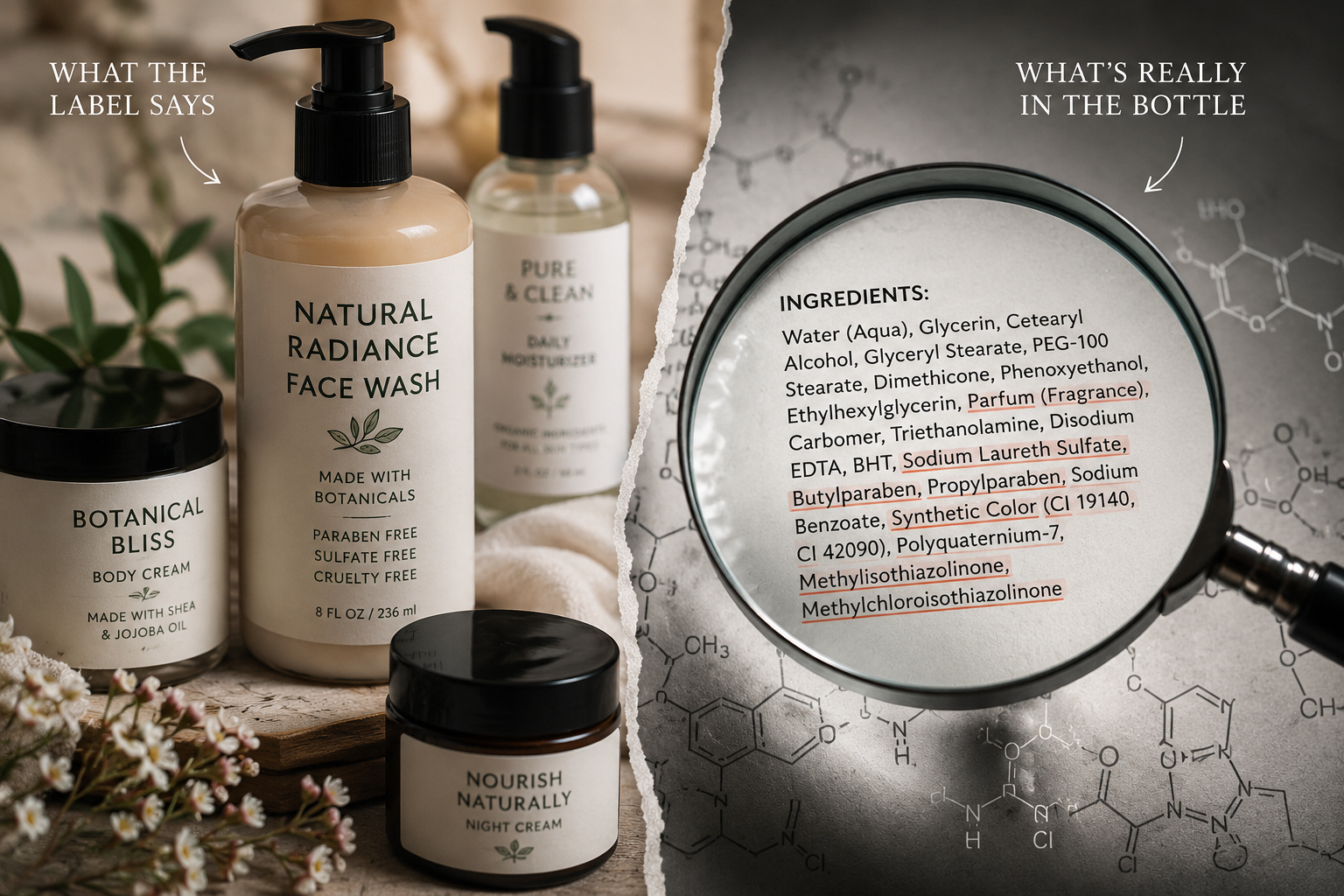
Neither does clean, pure, non-toxic, nor green. Not one of those words has a legal definition in the United States when it appears on a cosmetic or personal care product. Any brand can print any of them on any product without changing a single ingredient, meeting any regulatory standard, or submitting to any third-party verification. The word is the claim, the claim is the marketing, and that marketing is unregulated.
This isn't a fringe concern, either. Nearly one third of all beauty products sold in the United States are now labeled clean. The clean beauty market is growing at double digits annually and is projected to reach tens of billions of dollars globally by the end of the decade. Consumers are paying a significant premium for products marketed as cleaner, safer, and more natural than conventional alternatives. Most of them have no idea that the words driving those purchasing decisions are legally meaningless.
Alan Levinovitz, an associate professor of religious studies at James Madison University and author of the book “Natural: How Faith in Nature's Goodness Leads to Harmful Fads, Unjust Laws, and Flawed Science,” spent years studying why humans trust the word natural so completely. We’ve found his conclusion compelling. He argues that natural has become the secular world's replacement for God. Not metaphorically but structurally. The same cognitive mechanism that leads people to trust divine authority leads them to trust natural authority. The label becomes holy, and the question of whether it means anything stops being asked.
He put it directly in an interview with The Nation. He noticed that naturalness was a central feature of how people who are fastidious about what they eat and put on their skin justify their choices, and he realized that there was actually something much larger going on. A hidden theology, he called it, in which nature was replacing God in every aspect of our culture. He discussed these arguments at length with Joe Rogan on episode 1504 of the Joe Rogan Experience in July 2020. That episode is worth three and a half hours of your time if this topic interests you the way it interests us.
This article is about what happens when that hidden theology meets a lightly regulated industry. What clean beauty is, what it’s allowed to hide, what the regulatory gap between the US and EU tells you about the ingredients in your products right now, and what genuinely transparent skincare actually looks like when a brand decides to skip the theology entirely and just show you what's in the jar.
What Clean Beauty Actually Is
The clean beauty movement started from a legitimate place. Consumers looked at ingredient labels they couldn't read, asked questions the industry wasn't answering, and decided they wanted something different. That frustration was and is completely valid. The cosmetics industry in the United States is lightly regulated, ingredient transparency has historically been poor, and the concerns driving people toward cleaner alternatives are grounded in real documented issues with conventional personal care products.
The problem is how the industry responded to that frustration. Rather than increasing transparency or submitting to independent safety standards, it gave consumers a new word. Clean. And then it put that word on products without defining it, regulating it, or requiring any evidence that the product behind the label was meaningfully different from what came before.
Clean beauty refers to products formulated without ingredients considered potentially harmful or controversial, typically things like parabens, phthalates, sulfates, and synthetic fragrance. Of the terms consumers encounter most often: natural, clean, and organic, only organic has any real certification behind it. Clean and natural are essentially whatever the brand says they are.
The FDA's position on this is unambiguous. The agency states plainly that terms like clean, natural, and healthy have no legal meaning in the context of cosmetic labeling and that a company using them isn't making a claim the government has verified. Two products can both say clean on the front label and share almost no ingredients in common. Both are using the word correctly because there is no wrong way to use a word that means nothing.
Retailers have tried to fill that regulatory gap with their own standards. Clean at Sephora is the best known, a private program whose seal indicates a product is formulated without more than 50 ingredient categories. It's a genuinely useful filter for consumers navigating Sephora's shelves specifically, but it’s still a retailer's criteria, not law. It applies only to products sold through that retailer, changes when the retailer decides to change it, and tells you nothing about products sold anywhere else.
Almost one third of beauty products are now labeled clean, and that number is predicted to increase 12 percent by 2027. Every one of those products is operating under a definition the brand wrote for itself.
The Organic Exception
Organic is the one word in this space that actually means something because the USDA regulates organic certification under the National Organic Program. A product certified organic by a USDA-accredited certifier has met a specific and independently verified standard. Oregon Tilth, which certifies the organic ingredients we use at Private Oaks, is one of the most respected USDA-accredited organic certifiers in the country. That certification is specific, verifiable, and legally meaningful in a way that clean, natural, and pure are not.
However, even organic has limits worth understanding in the context of beauty products. The USDA's organic certification was designed for agricultural products including food. When applied to cosmetics, organic certification covers the agricultural ingredients in a formula, but it does not guarantee that the finished product contains no synthetic ingredients, no synthetic preservatives, or no synthetic processing aids. A product can be certified organic and still contain synthetic compounds that are allowed under organic certification standards. Many brands label beauty products organic without any USDA certification at all, which is technically permissible if the organic claims are limited to specific ingredients rather than the finished product.
The practical lesson is that certified organic by a named certifier is meaningful. Organic without a named certifier is a claim worth verifying before trusting.
The Gap Nobody Talks About
Here’s the number that changes how you read every clean beauty label you’ve ever seen. The FDA has banned or restricted approximately 11 cosmetic ingredients in the United States. The European Union has banned or restricted over 1,700. As of 2026 that EU list has grown to over 2,500 prohibited or restricted substances.
That gap isn’t a rounding error, it’s a policy philosophy difference that has been building for decades, and it shapes what is legally allowed to be in every personal care product on American shelves today. Ingredients that cannot be sold in a moisturizer in Paris or Berlin are sitting in products in the skincare aisle of every American drugstore right now. Some of them are in products labeled clean.
The United States operates under a precautionary approach that requires evidence of harm before an ingredient is restricted. The EU operates under a precautionary principle that restricts ingredients when there is reasonable cause for concern, before definitive harm is established. Both approaches have tradeoffs. The US approach allows innovation and avoids restricting ingredients that may prove harmless. The EU approach removes potential risks earlier, sometimes before the full evidence base exists. What the gap in banned ingredients tells you isn’t that European products are perfect or that American products are dangerous, it tells you that the word safe means something different depending on which regulatory system defined it.
What MoCRA Changed and What It Didn't
MoCRA, the Modernization of Cosmetics Regulation Act, was signed into law in December 2022 and fully took effect in December 2023. It’s the first significant update to federal cosmetics oversight since 1938. That context matters because the legislation governing what goes into your shampoo was last meaningfully updated 85 years before MoCRA passed. Before MoCRA, companies were’t required to register their facilities with the FDA, weren’t required to submit their product formulations for review, and the FDA had no mandatory recall authority for cosmetics. All of that changed with MoCRA.
What MoCRA didn’t do is define clean, it didn’t create a legal standard for natural, pure, or non-toxic, and it didn’t close the gap between American and European banned ingredient lists. The oversight got meaningfully stronger, but the marketing language stayed empty.
MoCRA also added a new requirement for fragrance allergen disclosure, which would be significant given what a single word on an ingredient label can legally hide. That requirement exists in law, but as of August 2026 the FDA still hasn’t published the specific list of allergens requiring disclosure, meaning the requirement is real but the implementation is still pending. We will cover the fragrance loophole in much more detail in a dedicated article because it deserves more space than a paragraph.
California Is Moving Faster
In the absence of federal action on specific ingredients, states have begun moving independently. California's Toxic-Free Cosmetics Act prohibited 24 ingredients effective January 1, 2025, all of which were already banned by the European Union. A second California law adds 26 more ingredients to the prohibited list effective January 1, 2027. Colorado, Maryland, Minnesota, Washington, Connecticut, Maine, and Vermont have implemented or are implementing similar PFAS prohibitions in cosmetics.
The practical consequence of this state-by-state patchwork is one most consumers never consider. The same product brand may be formulating differently for California than for the rest of the country. A product purchased in Nebraska may contain ingredients that cannot legally be sold in the California version of the same product. There’s no requirement to disclose which formulation you are purchasing. The label looks identical, but the ingredient list may not be.
This is the regulatory environment in which every clean beauty claim is made. No federal definition of clean, an 11 to 2,500 gap in banned ingredients compared to the EU, a fragrance allergen disclosure requirement that exists in law but not yet in practice, and a state-by-state patchwork creating different safety standards for the same product depending on where you buy it.
When a brand calls its product clean in this environment, it’s making a marketing claim against no standard, in a regulatory system that hasn’t caught up with the claims being made, while operating under ingredient permissions that are significantly more permissive than those of every other developed economy.
When Free-From Doesn't Mean Safe
The free-from claim is the backbone of clean beauty marketing. Paraben-free. Sulfate-free. Fragrance-free. Phthalate-free. These phrases appear on labels so frequently that they've become shorthand for safe, clean, and trustworthy. The problem is that free-from tells you only what isn't in the product, but tells you nothing about what is.
The name for this in cosmetic chemistry is regrettable substitution. An ingredient with documented concerns is removed from a formula and replaced with a different ingredient that has its own concerns but hasn't yet accumulated the same level of consumer awareness. The product gets the free-from claim, but the underlying concern doesn't go away. It just gets renamed.
Parabens are the clearest example. Parabens are synthetic preservatives that were widely used in personal care products for decades before studies raised concerns about their potential endocrine-disrupting properties. The clean beauty movement made paraben-free one of its earliest and most recognizable claims. Brands reformulated. Labels changed. Consumers felt reassured.
What replaced parabens in most formulas was phenoxyethanol, methylisothiazolinone, and a range of other synthetic preservatives. Phenoxyethanol is now the most commonly used preservative in personal care products marketed as paraben-free. It's considered safer than parabens by most regulatory bodies at concentrations up to 1 percent, however the European Union has restricted its use in products applied to the face of children under 3 years old and in products applied to broken or damaged skin. Methylisothiazolinone is more concerning. The EU found it to be a significant skin sensitizer and has banned its use in leave-on cosmetics entirely. It's still permitted in the United States.
A peer-reviewed study found that products labeled as green, natural, or organic contained parabens at rates comparable to conventional products. The label and the formula can be completely disconnected. Free-from claims are not independently verified. There's no third party checking whether the paraben that was removed stayed removed or whether what replaced it is meaningfully safer.
Sulfate-free follows the same pattern. Sodium lauryl sulfate, which we've covered extensively in our microbiome article and skin pH article for its effects on the skin barrier and microbiome, is replaced in sulfate-free formulas with other surfactants that can have comparable skin reaction profiles. Sodium lauryl sulfoacetate, sodium cocoyl isethionate, and cocamidopropyl betaine are common substitutes. Some are genuinely gentler. Some are not. The sulfate-free label doesn't distinguish between them.
The fragrance loophole is in a category of its own, and we cover the full picture in our fragrance article. For now the short version is this: fragrance-free doesn't mean chemical-free or unscented, it means the product doesn't contain what the manufacturer is calling fragrance. A product can be labeled fragrance-free and still contain essential oils, botanical extracts, and naturally derived aroma compounds that are documented skin sensitizers. The fragrance-free claim is about labeling conventions, not about the absence of aromatic compounds.
Our own Unscented bar is a useful illustration of exactly this point. It contains no fragrance oils of any kind. It's as close to truly fragrance-free as a cold process soap made with organic oils can be, and yet it has a natural aroma. Organic shea butter, organic olive oil, and organic coconut oil each carry their own subtle scent profiles from the unrefined plant material they come from. Our natural unscented creams are the same. No fragrance oils, but organic shea butter, organic beeswax, and organic coconut oil all have naturally occurring aromas that are present in the finished product. We're not hiding that. We're telling you because it's true and because fragrance-free on our label means exactly what we just described, not the absence of all aromatic compounds, but the absence of added fragrance oils.
That's what honest fragrance-free looks like. Most brands using the term aren't explaining it this clearly because explaining it clearly would require them to disclose more about their formulas than their marketing strategy allows.
The practical question every free-from claim should prompt isn't what did they take out, it’s what did they put in instead and why is that better.
What Natural Actually Means. And What It Doesn't.
Here’s where the clean beauty conversation gets philosophically interesting and where Alan Levinovitz's work becomes directly relevant to what you're reading on a skincare label.
Natural has no legal definition in cosmetic labeling. We've established that, but the more interesting question is whether it has a coherent meaning at all when you examine it carefully. Levinovitz spent years doing exactly that examination, and his conclusion is that natural isn’t a scientific category. It's a theological one.
His argument, laid out in “Natural: How Faith in Nature's Goodness Leads to Harmful Fads, Unjust Laws, and Flawed Science” and discussed at length on episode 1504 of the Joe Rogan Experience in July 2020, goes deeper than marketing criticism. He points out that the problem with deifying nature is that it gives a false sense of scientific objectivity to what might actually be reflexive preference, cultural habit, or simple unfamiliarity with synthetic processes. When consumers reach for the products labeled natural over the ones that aren’t, they're often not making a safety decision based on evidence. They're making a faith decision based on feeling, and the beauty industry has built a multi-billion dollar market on that feeling.
He put it directly in an interview with The Nation. He noticed that naturalness was a central feature of how people justify their choices about what they eat and put on their skin, and that there was a hidden theology at work in which nature was replacing God in every aspect of culture. The consequence for consumers is that natural on a label triggers an emotional response that bypasses critical evaluation. A study on consumer psychology found that framing food or cosmetic products as natural not only significantly increased purchase intent but also resulted in a more favorable overall attitude toward the brand. That persuasive power comes from what researchers call System 1 thinking, the fast automatic cognitive process in which people substitute the difficult question, is this product scientifically safe and effective, with the simpler and more emotionally resonant question, does this sound natural.
Here’s the part of the natural conversation that most natural beauty brands would prefer you didn't think about too carefully.
Everything is natural. Technically. Completely. Without exception.
Every element on the periodic table occurs in nature. Every compound humans have ever synthesized was derived from elements that exist in the natural world. Sodium hydroxide, the lye used to make cold process soap, is derived from salt and electricity. Petrochemicals are derived from ancient biological matter compressed over millions of years. Synthetic fragrance compounds are derived from petrochemical precursors that come from the earth. The distinction between natural and synthetic is a distinction about processing, not about origin. All raw materials originate from the natural world. What humans do with them afterward is what creates the natural versus synthetic distinction, and processing, as the history of human civilization demonstrates, can make things safer or more dangerous regardless of their natural or synthetic origin.
This is precisely why natural, pure, and clean resist any stable legal definition. If everything originates from the natural world and the only meaningful distinction is in the processing, then natural becomes a judgment about which processing methods are acceptable and which are not. But who decides that? Under what standard? Verified by whom? The clean beauty industry has answered those questions by letting each brand decide for itself, which is the same as not answering them at all. You cannot define a word that means everything to everyone and nothing to regulators. So, the industry stopped trying and started printing it on labels instead.
Levinovitz illustrated this with vanilla. Natural vanilla is extracted from orchids through a meticulous four-step process involving killing, sweating, drying, and conditioning the vanilla beans. Synthetic vanillin is produced in a laboratory. Both produce the same compound. The natural label on one and the artificial label on the other tells you nothing about which is purer, safer, or more beneficial. It tells you only about the origin of the raw material and the processing method used to derive it.
The same logic applies to your skincare. Poison ivy is natural. Arsenic is natural. Formaldehyde is produced naturally by the human body as a byproduct of normal metabolism. Lead occurs naturally in soil. The natural origin of an ingredient tells you nothing meaningful about its safety profile at the concentration used in a formula. What matters is the specific ingredient, the specific concentration, the specific application, and the specific evidence about what it does in that context. Natural is a shortcut that bypasses all of that specific thinking in favor of a theological assumption that nature is inherently good.
That assumption is what the clean beauty industry is selling, and it’s extraordinarily effective at selling it. One third of all beauty products are now labeled clean or natural, and consumers are paying a premium for the assumption without the evidence behind it.
The Price Fallacy
The natural equals good assumption has a companion fallacy that is equally pervasive in the clean beauty market. Expensive equals better.
A friend of ours recently received a gift. A 2 oz body balm made of raw organic unrefined shea butter, organic unrefined sweet almond oil, organic unrefined apricot kernel oil, and premium organic essential oils of lavender and cedarwood. Certified organic by Oregon Tilth. A genuinely clean, genuinely simple, genuinely organic product. The price was $25 for 2 oz.
Our dry skin body cream contains organic golden jojoba oil, raw organic unrefined shea butter, organic extra virgin coconut oil, organic yellow beeswax, arrowroot powder, white kaolin clay, and vitamin E oil. Also certified organic by Oregon Tilth for its organic ingredients. 8 oz for $18.
We're not making this comparison to attack another brand. We're making it because the price disparity illustrates something important about how the clean and natural beauty market operates. Premium pricing has become a signal of premium quality in the same way natural has become a signal of safety. Neither signal is regulated and neither requires proof, but both exploit the same cognitive shortcut. Paying more feels like doing more, the same way choosing natural feels like choosing safer.
The actual determinant of product quality is the ingredient list and the formulation decisions behind it. Not the price, not the label, and not the font on the packaging or the color of the jar. What's in it, why each ingredient is there, and what the evidence says it does for your skin. That information is available on every product you buy, and most brands are counting on the fact that you won't look.
We built Private Oaks around the idea that genuinely clean, genuinely organic, genuinely transparent skincare shouldn't require a luxury price point to be accessible. Affordable doesn't mean lower quality, it means we'd rather earn your trust with what's in the jar or box than charge you for the story on the front of it.
What to Look For
If clean, natural, pure, and non-toxic are legally meaningless, and if free-from claims tell you only what was removed rather than what replaced it, and if price tells you nothing about ingredient quality, then what does a consumer use to evaluate a personal care product?
The ingredient list. Every time. Without exception.
It's the only place on a product where the law requires specific truthful disclosure. The FDA mandates that cosmetic ingredients be listed in descending order of concentration under their INCI names, the International Nomenclature of Cosmetic Ingredients, a standardized naming system that applies globally. Every ingredient in a formula must appear on that list. The front of the package is marketing. The back of the package is the closest thing to a regulated truth claim the product contains.
We wrote an entire article on how to read that list in our ingredient label article. The short version is that the first three ingredients make up the majority of the formula. Water as the first ingredient means the product is primarily water. If the ingredients you are paying a premium for appear near the bottom of the list, they are present in trace amounts. The presence of a beneficial ingredient on the label doesn't tell you it's present at a meaningful concentration.
For the full story on what body wash is, what replaces sulfates in sulfate-free formulas, and what the complete ingredient architecture looks like, our body wash article covers it in depth.
Beyond the ingredient list, what’s worth looking for specifically are named third-party certifications, certified organic by Oregon Tilth means something specific and verifiable, certified organic by USDA means something, a Leaping Bunny certification means something,and EWG Verified means something. A brand saying our products are organic or our formula is clean without naming a certifier means nothing that a regulator has verified.
Specific exclusion policies rather than vague free-from claims and a brand that publishes a specific list of ingredients they don't use and explains why is doing more than a brand that prints paraben-free on the label. Explanation requires knowledge. A label requires only a printer.
Full ingredient transparency. Can you find the complete ingredient list before you buy? Is it published clearly on the product page and not buried or obscured? Does the brand explain what each ingredient does and why it's in the formula? Transparency costs nothing to provide and most brands that have something to hide don't provide it.
Honest acknowledgment of limitations. A brand willing to tell you what its products can't do is more trustworthy than one that implies they can do everything. We've built The Grove around exactly that principle. Our soap raises skin pH, and we've said so in multiple articles. Our fragrance oils contain some lab-created aroma compounds, and we've documented that. Our acne-prone cream doesn't treat acne, and we've stated that clearly. Limitations disclosed are the mark of a brand that knows what it's selling. Limitations concealed are the mark of a brand that knows its marketing.
What This Means for How We Think About Private Oaks
We're not a clean beauty brand. We've deliberately avoided that label, and now you understand why. Clean means whatever we say it means, and we're not interested in a word that empty.
What we are is a brand that uses certified organic ingredients where available, certified by Oregon Tilth, publishes our full ingredient list on every product page, maintains safety data documentation for our fragrance oils, acknowledges the limitations of our products in multiple articles, and prices our products at what the ingredients actually cost to make rather than at what the market will bear for a clean label.
That's not a marketing position. It's a formulation philosophy and an editorial one. Every article in The Grove exists because we believe consumers make better decisions with accurate information than with reassuring labels. The clean beauty industry is built on reassuring labels. We'd rather build something else.
If you want to understand what's in our products and why each ingredient is there, our ingredients page has every ingredient documented with sourcing information. Our Grove articles cover the science behind each one. The information is there, and we’d rather you use it than trust us on our word.
That's the difference between transparency and marketing. One of them invites scrutiny. The other depends on you not looking too closely.