.svg)
Menu
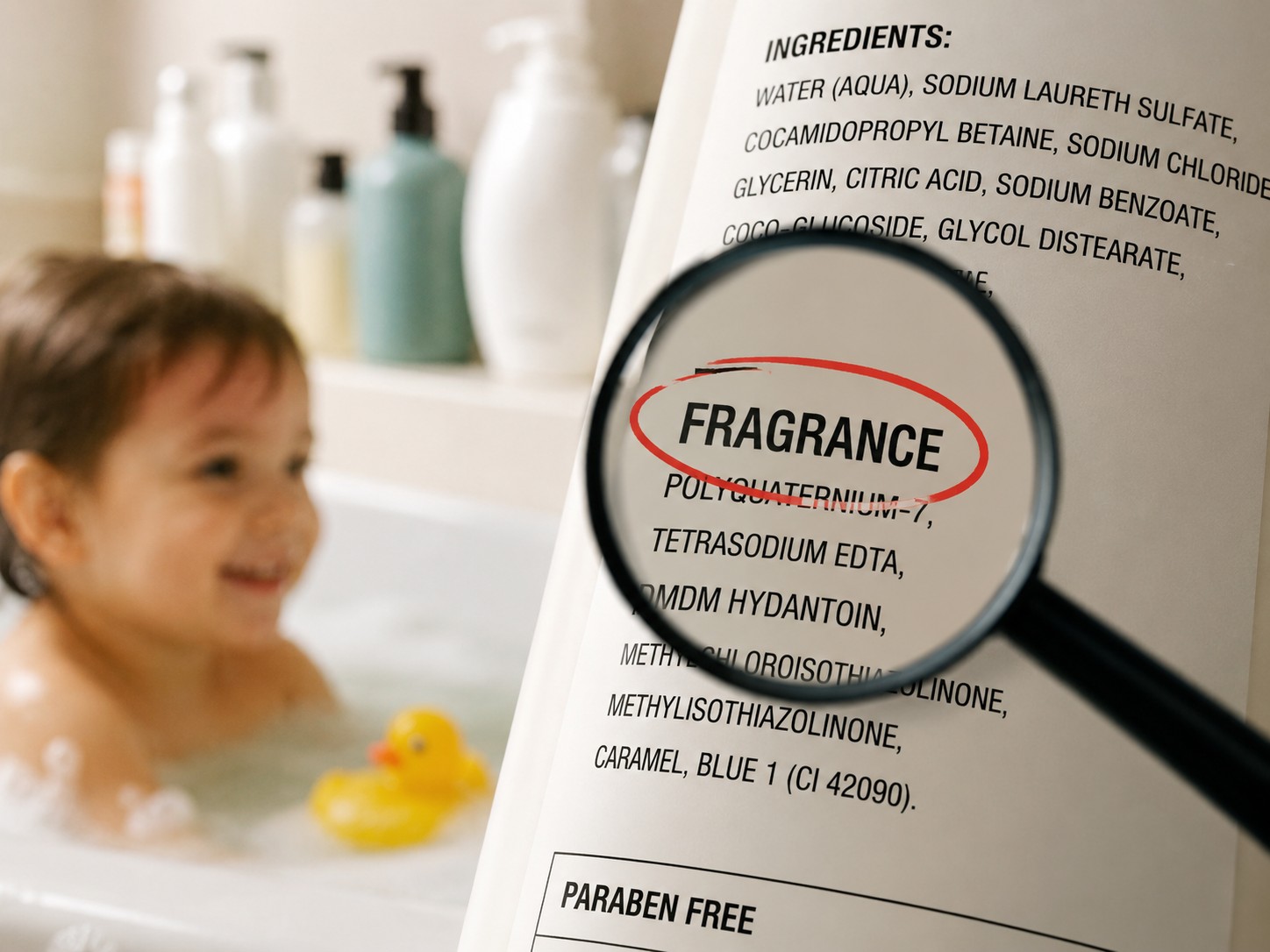
Flip over any personal care product in your bathroom right now and find the ingredient list. Somewhere on it, probably toward the middle or the end, you'll see it. One word. Fragrance. That word is doing more work than every other ingredient on the list combined, and it's the only one the law doesn't require anyone to explain.
There are 3,691 ingredients that can legally hide behind that word on a US personal care product label. That number comes from the International Fragrance Association's own 2025 Transparency List, the fragrance industry's voluntary disclosure of what its members use to create scent. 3,312 of those ingredients are fragrance compounds used for odor or to cover up unpleasant smells. 379 are functional ingredients like antioxidants, preservatives, solvents, and stabilizers that support fragrance stability and performance. Any combination of them can appear in a formula, but none of them have to appear on the label. You'll see one word, but the formula behind it can contain dozens.
This isn't a conspiracy theory. It's a legal structure that’s been in place since 1973 and has never been meaningfully changed. The word fragrance on an ingredient list is a trade secret exemption written into federal law, lobbied for by the fragrance industry, and maintained through decades of resistance to disclosure requirements that every other developed economy has since moved past. The FDA acknowledges on its own website that it doesn't have the legal authority to compel disclosure of fragrance ingredients. The industry largely regulates itself through voluntary guidelines created by its own research arm, and as of August 2026 American consumers still have no legal right to know what specific compounds are in the fragrance in their shampoo, body wash, moisturizer, or soap.
This article is about that word, what it legally means, what it can hide, what the research says about what's often behind it, and what genuine fragrance transparency actually looks like when a brand decides to stop hiding behind it.
How One Word Became a Legal Shield
The fragrance trade secret exemption didn't happen by accident. It was built deliberately over decades through a specific legal framework that the fragrance industry lobbied hard to create and has lobbied harder to keep.
The foundation is the Fair Packaging and Labeling Act, which requires cosmetics sold in the United States to list all ingredients in descending order of concentration. That sounds like full disclosure, however, there’s a catch buried in the same law. The FPLA explicitly states that its regulations cannot be used to force companies to reveal trade secrets. Fragrance formulations were successfully argued to qualify as trade secrets and have been protected under that provision ever since.
The 1979 Uniform Trade Secrets Act reinforced that protection at the state level. Forty-seven states, Washington D.C., Puerto Rico, and the US Virgin Islands have adopted this framework, meaning fragrance formula protection isn't just federal law, it’s embedded in state law across virtually the entire country.
The result is a system where a single word on a label legally satisfies the same disclosure requirement that every other ingredient must meet with its full chemical name. Sodium cocoyl isethionate, a mild synthetic cleansing agent and surfactant derived from coconut oil commonly found in sulfate-free washes and baby products, has to be listed as sodium cocoyl isethionate. The 47 aroma compounds mixed into a proprietary blend get to be listed as fragrance. Same law but wildly different standards.
Who Is the IFRA and Why Does It Matter
The International Fragrance Association represents approximately 90 percent of global fragrance suppliers. It’s the industry trade organization that sets voluntary safety guidelines for fragrance ingredients through its IFRA Standards program. Those standards are developed by its own research arm, the Research Institute for Fragrance Materials, known as RIFM. The safety assessments RIFM produces are used to justify which ingredients are permitted and at what concentrations.
There’s no independent government body reviewing those assessments in the United States. The FDA doesn’t approve fragrance ingredients before they enter the market. The IFRA sets its own limits, its members follow those limits voluntarily, and the finished products go on shelves. The Breast Cancer Prevention Partners described this plainly in a 2025 report: the fragrance industry regulates itself through voluntary safety guidelines created by its own research arm with no peer review to guard against bias.
That doesn't mean every IFRA standard is wrong or that every fragrance ingredient is dangerous. Many are assessed rigorously and used safely. What it means is that the safety framework for the ingredients behind the word fragrance is a voluntary industry program rather than an independent regulatory process. The difference matters when you're deciding how much weight to give the assurance that a fragrance is safe.
MoCRA and the Disclosure That Hasn't Happened
The Modernization of Cosmetics Regulation Act signed into law in December 2022 added a fragrance allergen disclosure requirement to federal law for the first time. That was a genuine and meaningful step. MoCRA gives the FDA authority to establish which specific fragrance allergens must be individually named on cosmetic labels and at what concentration thresholds.
The FDA was supposed to propose that list by June 2024, but as of September 2026 it still hasn't. The requirement exists in law. The implementing regulations that would make it enforceable don’t. Until the FDA finalizes that rulemaking, US manufacturers can still legally list fragrance as a single ingredient with no individual allergen disclosure required.
In the European Union the situation is different and the contrast is stark. The EU has required individual disclosure of specific fragrance allergens for years. As of July 31, 2026 a new EU regulation expanded mandatory allergen disclosure from the original 26 specifically named substances to more than 80 substances and substance groups. Any of those allergens present above defined concentration thresholds must be individually named on the product label. For leave-on products the threshold is 0.001 percent. For rinse-off products it's 0.01 percent.
The practical consequence is one most consumers have never considered. The same product with the same fragrance formula must individually name its allergens on a label sold in Germany and can hide them all behind the word fragrance on a label sold in Nebraska. Same formula, same potential for allergic reaction, but different information available to the consumer depending on which side of the Atlantic they're shopping on.
What's Actually Behind the Word
The IFRA Transparency List tells you what ingredients the fragrance industry uses. It doesn't tell you what's in any specific product. That's the point of the trade secret protection, but the list of what's possible is worth understanding because it includes compound categories that the peer-reviewed research has been studying for decades and the findings are not reassuring across the board.
Here are the five categories that appear most consistently in the research.
Phthalates
Phthalates are synthetic plasticizers added to fragrance formulas to help scent last longer on skin. The two most common in personal care products are diethyl phthalate and dibutyl phthalate. They work by physically docking onto hormone receptors in the body because the molecular structure of phthalic acid closely mimics the structure of steroid hormones like estrogen and testosterone. Once docked they act as either weak mimics or blockers of normal hormone signaling depending on the specific compound.
A peer-reviewed meta-analysis published in PMC in 2024 confirmed that phthalate metabolites are associated with sperm DNA damage, declining sperm concentration, and disrupted male reproductive hormone levels. A 2024 study published in Cosmetics journal analyzed ten commercially available name-brand perfumes and found that all ten showed significantly inhibited aromatase activity, the enzyme responsible for the final step in estrogen biosynthesis, with phthalates identified as among the primary compound groups responsible.
The good news for our customers is that our fragrance oils are phthalate-free. We maintain SDS documentation for every fragrance oil we use that confirms this, but phthalate-free is not the default in the industry. It's an exception that requires deliberate sourcing decisions and documentation to back up. A product listing fragrance without that documentation has given you no basis to assume phthalates aren't present.
Dr. Shanna Swan, a professor of environmental medicine and public health at Mount Sinai and one of the world's leading reproductive epidemiologists, has spent decades documenting the reproductive health consequences of phthalate exposure from personal care products specifically. We covered her research, her book Count Down, and her appearances on Joe Rogan in depth in our chemical article because her work is the most comprehensive public account of what phthalates in everyday products are doing to human reproductive health. The short version is that phthalates in personal care products including fragrance formulas don't always have to be labeled and companies are allowed to include them without informing consumers. Her words, not ours.
Synthetic Musks
Synthetic musks including galaxolide and tonalide are among the most widely used fragrance compounds in the world. They give products that warm, soft, skin-close scent that lingers for hours. They've also been detected in human biological samples including breast milk and in environmental samples including waterways and aquatic organisms. We covered the aquatic persistence of synthetic musks in our outdoor soap article.
A 2024 review published in a peer-reviewed endocrinology journal examined galaxolide and related synthetic musks in the context of endocrine activity including their interactions with nuclear receptors and steroid signaling pathways. The research demonstrates exposure and biological activity. What it hasn't yet established with the same certainty as phthalates is a definitive causal mechanism in humans at normal use concentrations. The honest position is that synthetic musks are persistent, they accumulate in biological tissue, and the research on their hormonal activity is ongoing and worth following.
Volatile Organic Compounds
Volatile organic compounds including styrene, toluene, and various aldehydes are present in many fragrance formulas. A 2022 systematic review published in PMC identified these as among the most common pollutants found in perfumes and colognes and documented their association with asthma, allergies, cardiovascular effects, and central nervous system effects in occupationally exposed populations. Concentration and duration of exposure matter significantly for these compounds and the evidence is stronger for occupational exposure than for typical consumer use, but they're in the formula whether or not they're on the label.
Parabens
Parabens are synthetic preservatives that are recognized endocrine disruptors, meaning they mimic estrogen in the body. They penetrate skin and accumulate in tissue over time. A 2025 narrative review published in Frontiers in Toxicology confirmed that parabens share with phthalates the capacity to stimulate cell proliferation in estrogen-sensitive tissues and that even low-dose chronic exposure has been associated with measurable biological effects due to their bioaccumulative properties. A 2022 PMC systematic review found parabens among the most significant contaminants in aromatic products and identified them as the most common allergen associated with contact dermatitis in children aged 5 to 15 in 43 percent of cases studied.
Our fragrance oils are paraben-free. Again, documented by SDS, not just claimed on a label.
Allergens — Including the Ones in Natural Ingredients
Fragrance is the most common cause of cosmetic allergic contact dermatitis. The American Contact Dermatitis Society notes that more than 160 fragrance chemicals have been reported to cause contact allergy and that in patients tested for suspected contact dermatitis the frequency of fragrance sensitization may reach 20 to 25 percent. A 2019 to 2020 study by the North American Contact Dermatitis Group found fragrance allergen positivity rates of 12.8 percent for Fragrance Mix I and 11.1 percent for linalool hydroperoxides in the patients they patch tested.
The most frequently documented fragrance sensitizers include linalool hydroperoxides, limonene hydroperoxides, cinnamal, isoeugenol, geraniol, eugenol, and oakmoss absolute. Those names may not mean much until you know where they come from. Linalool is naturally occurring in lavender. Limonene is naturally occurring in citrus. Eugenol is naturally occurring in clove. Oakmoss absolute comes from lichen. These are not synthetic laboratory compounds. They're naturally derived aroma chemicals that oxidize on skin exposure to form hydroperoxides that are among the most potent documented fragrance sensitizers in clinical dermatology.
This is the nuance that most natural fragrance marketing skips entirely. Natural doesn't mean hypoallergenic. Essential oils can contain multiple listed EU allergens in a single ingredient. A lavender essential oil contains linalool. A citrus extract contains limonene. A product using these compounds, whether as part of a synthetic fragrance blend or as named essential oils, is delivering documented allergens to the skin. The EU requires individual disclosure of these compounds above defined concentration thresholds precisely because of this research. The US doesn’t yet require it.
Several of our own scented bars contain these same naturally occurring allergen compounds. Linalool is present in lavender essential oil which means our Twisted Lavender bar carries it. Limonene appears in citrus and many botanical fragrance compounds. Oakmoss absolute is present in Forest Fantasy. These compounds also appear in fragrance blends used in Vanilla Bonfire, The Resort, and other scented bars in our lineup. Our SDS documentation for each fragrance oil identifies these compounds specifically which is why we can tell you they're there.
The point isn't that these compounds make our bars dangerous. At our usage rates of less than 4 percent of the cured bar the concentrations are well within documented safe-use guidelines and the majority of people use our scented bars without any reaction. The point is that this is what fragrance transparency actually looks like. Knowing which specific aroma compounds are present, understanding which ones carry documented sensitization risk, and being able to tell you rather than hiding everything behind a single word on a label. If you have known sensitivities to linalool, limonene, or oakmoss specifically, our Unscented bar eliminates the variable entirely. That's the choice we want you to be able to make with full information rather than marketing language.
Natural Fragrance. Two Words That Mean Less Than You Think.
Natural fragrance is something of an oxymoron. Natural implies transparency, botanical origin, and safety. Fragrance is a legally protected trade secret. Put them together and you get a phrase where the first word is doing marketing work and the second word is doing legal concealment work. The reassurance of natural is attached to something that by definition cannot be fully disclosed.
If you've been avoiding products with fragrance on the label and reaching instead for ones that say natural fragrance, you've made a reasonable choice based on reasonable assumptions. The assumptions, though, are worth examining.
Natural fragrance as a labeling term refers to aroma ingredients derived from plant sources through physical extraction methods like distillation, cold pressing, and solvent extraction. Under that definition a natural fragrance blend can contain dozens of individual aromatic compounds derived from botanical sources. None of those individual compounds have to be named on the label. The word natural is doing the same concealment work as the word fragrance. It's telling you about the origin of the ingredients, but it’s telling you nothing about which ones are present, at what concentrations, or whether any of them are documented allergens.
Some products skip the word fragrance entirely and list essential oils individually by their botanical names: lavender essential oil, sweet orange essential oil, eucalyptus essential oil. That's meaningfully more transparent than natural fragrance or fragrance because at least you know specifically what aromatic ingredients are present, but individual essential oil listings don't solve the allergen problem. Again, lavender essential oil contains linalool, sweet orange and other citrus oils contain limonene, and eucalyptus contains eucalyptol, a documented respiratory irritant at high concentrations. A product listing its aromatic ingredients by their botanical names is being more honest about what's in the formula, but it’s still delivering documented allergens to your skin. Knowing the oil is there is better than not knowing, but knowing which specific compounds that oil contains and at what concentrations is the standard that genuinely protects people with sensitivities.
The EU's expanded allergen list, now requiring disclosure of more than 80 specific fragrance compounds, specifically added many naturally occurring aroma chemicals found in essential oils. Linalool from lavender. Limonene from citrus. Geraniol from rose. Eugenol from clove. These are natural compounds that must be individually named on EU cosmetic labels above defined concentration thresholds because the dermatology research on their sensitization rates is clear enough that regulators decided consumers had a right to know they were there. A product sold in the US with the same natural fragrance formula doesn't have to name any of them.
Natural fragrance is not a regulated term in the United States. There's no legal definition that distinguishes it from fragrance on a cosmetic label. A brand can call its fragrance blend natural fragrance if the aromatic compounds came from plant sources and the single word natural changes nothing about the disclosure requirements. You still don't know what's in it. You know only that its ingredients were extracted from plants rather than synthesized in a laboratory. Given what we know about the documented allergens in botanical fragrance compounds, that distinction provides less protection than most consumers assume when they reach for the natural option.
When the Stakes Are Higher: Children, Developing Bodies, and the Shower
The fragrance loophole is a consumer transparency problem for adults, but for children it becomes something more specific. A developmental exposure concern during windows when the body is most sensitive to disruption.
Your skin is your largest organ. It's also the primary route through which fragrance compounds enter the body during bathing. Children's skin has a higher surface area relative to their body weight than adults, a thinner and less developed barrier function, and less metabolic capacity to process and eliminate absorbed compounds. What goes on a child's skin during bath time absorbs more efficiently than the same product on adult skin. A 2024 study reported by NPR found that recent use of hair and skin care products is directly linked to measurably higher levels of phthalates in children's urine. The compounds in those products are getting into their bodies.
The system most at risk from that absorption is the endocrine system, but it isn't the only system developing during these critical windows. The endocrine system is the network of glands and organs that produces, stores, and secretes the hormones governing growth, development, reproduction, metabolism, and immune function. It isn't fully formed at birth. It develops through a series of precisely timed hormonal sequences that continue through puberty and into early adulthood. Endocrine-disrupting chemicals, including phthalates and synthetic musks documented in fragrance formulas, can mimic, block, or alter those hormonal signals. During the critical developmental windows of infancy and early childhood, the endocrine system is most sensitive to that kind of interference because its developing structures depend on those signals arriving at the right time, in the right amounts, without chemical impostors interfering.
The fetal period and the first two years of life represent the most critical windows, and early childhood through puberty remains a period of elevated vulnerability. The American Academy of Pediatrics has specifically identified endocrine-disrupting chemicals as a significant pediatric health concern. The EU's restriction on phenoxyethanol in products applied to children under three reflects exactly this science. The research doesn't give us a clean age cutoff at which fragrance exposure becomes categorically safe for children because the endocrine system continues developing for years. What it does give us is a clear direction. The younger the child the more conservative the approach to fragrance exposure should be.
There's also the immune system dimension. Children's immune systems are still learning what to respond to and what to tolerate. Repeated early exposure to documented allergens like linalool, limonene, and other fragrance compounds during those calibration years can prime the immune system toward sensitization rather than tolerance. Fragrance is already the most common cause of cosmetic allergic contact dermatitis in adults. Early childhood is when many of those sensitivities are first established.
The shower adds another variable. Hot water increases skin permeability by temporarily swelling the stratum corneum, creating better conditions for compound absorption. Steam carries volatile aroma compounds directly into the respiratory tract in an enclosed space. A child in a hot bath or shower with a fragranced product is absorbing through their skin and inhaling simultaneously. For children with asthma or developing respiratory systems, the inhalation pathway matters as much as the dermal one.
We make one recommendation for children specifically. Our Unscented bar. No fragrance of any kind means no fragrance loophole, no potential endocrine-disrupting compounds from aroma chemicals, no documented allergens from fragrance sources, and no aromatic compounds entering the steam of a warm bath. The natural scent of the organic oils is present, as we discussed earlier in this article, but nothing has been added for scent purposes and nothing is hiding behind a trade secret exemption. For young children whose endocrine systems, immune systems, and skin barriers are still developing, that's not a minor consideration. It's the point.
What Genuine Fragrance Transparency Looks Like
If natural and fragrance both provide limited disclosure, what does meaningful fragrance transparency actually look like?
Full individual ingredient disclosure is the gold standard and it's what the EU is moving toward with its expanded allergen list. When a brand can tell you specifically which aroma compounds are in its formula and at what approximate concentrations, you have enough information to make an informed decision about whether those compounds are appropriate for your skin and your sensitivities.
Short of full disclosure, documented exclusions backed by SDS documentation are the most meaningful available transparency in the US market. Phthalate-free confirmed by SDS means no phthalate plasticizers. Paraben-free confirmed by SDS means no paraben preservatives. Heavy metal-free means no lead, mercury, arsenic, or cadmium. These are verifiable claims about specific compound categories that have been removed from the formula. They're not comprehensive but they're real and they're backed by documentation rather than marketing language.
IFRA compliance means the fragrance formula follows the International Fragrance Association's voluntary standards for safe ingredient use rates. It's an industry standard not a government one, and it's self-regulated rather than independently verified. But IFRA compliance at least means someone has checked the formula against a set of documented limits rather than putting it together with no reference standard at all.
The Unscented option is the only way to sidestep the fragrance question entirely. No fragrance means no fragrance loophole. No aroma compounds means no potential allergens from that source. It doesn't mean no scent at all since organic oils have their own subtle natural aromas as we covered in our clean beauty article, but it means nothing is being added for scent purposes and nothing is being hidden behind a trade secret exemption.
What This Means for How You Read a Label
The next time you pick up a personal care product, the ingredient list is still the most useful place to look, but now you know that one entry on that list is playing by different rules than every other entry on it.
If you see fragrance or parfum, you're looking at a trade secret. You don't know what's in it. You know only that it's there.
If you see natural fragrance, you know the aroma compounds came from plant sources. You still don't know which ones or whether any of them are documented allergens for your specific sensitivities.
If you see specific compound names like linalool, limonene, geraniol, or eugenol listed individually, you're looking at a brand that has chosen to disclose beyond what US law requires. That's worth noticing.
If you see fragrance-free, you know the manufacturer hasn't added any ingredient they're calling fragrance. You might still be getting aroma compounds from essential oils or botanical extracts listed by their botanical names, so fragrance-free isn't the same as scent-free, but it means the trade secret exemption isn't in play.
And if you see unscented with a genuinely transparent ingredient list and SDS documentation behind the formula, you're as close to full fragrance transparency as the current US regulatory environment allows.
We built our Unscented bar for exactly that reason. For our scented bars we made the decision to source fragrance oils that are phthalate-free, paraben-free, and free of heavy metals, and to maintain the SDS documentation that backs those claims up. We use them at less than 4 percent of the cured bar for soaps and less than 2 percent of finished creams. We've told you that our bars carry documented allergen compounds and why. We can't publish the full individual ingredient list of our fragrance oils because that information is proprietary to our suppliers under the same trade secret framework this article describes. That's not us protecting a competitive advantage. Our scent profiles aren't trademarked and can't be under current US law. The full compound list we simply can’t disclose. What we can do is document what we've excluded, be transparent about what we know is present, and point you to the SDS documentation that backs those claims up.That's not a perfect answer, but in a regulatory environment where fragrance disclosure is still a work in progress, it's the most honest one we have.
The word fragrance has been on your products for your entire life. It'll be on them for the foreseeable future. The US regulatory framework that allows it to stay there without explanation isn't changing quickly and the industry that benefits from it isn't pushing for change.
What has changed is how much you know about what it means. That knowledge doesn't require you to throw out everything in your bathroom or avoid every scented product. It requires you to ask a different question when you pick up a new product. Not does this smell good or does this say natural, but what’s behind that word and does the brand using it have any documentation to back up what they're claiming about it.
The ingredient list is still the most regulated piece of information on any product you buy. Everything on it except one word had to be disclosed by name. That word is fragrance. Now you know why.
If you want to understand the broader regulatory context for why fragrance disclosure is still unfinished business in the United States, our clean beauty article covers the full picture of what clean, natural, and pure legally mean and don't mean on a personal care product label. Our ingredient label article covers how to read everything else on that list.
That's The Grove. Not a catalog. A library.