.svg)
Menu
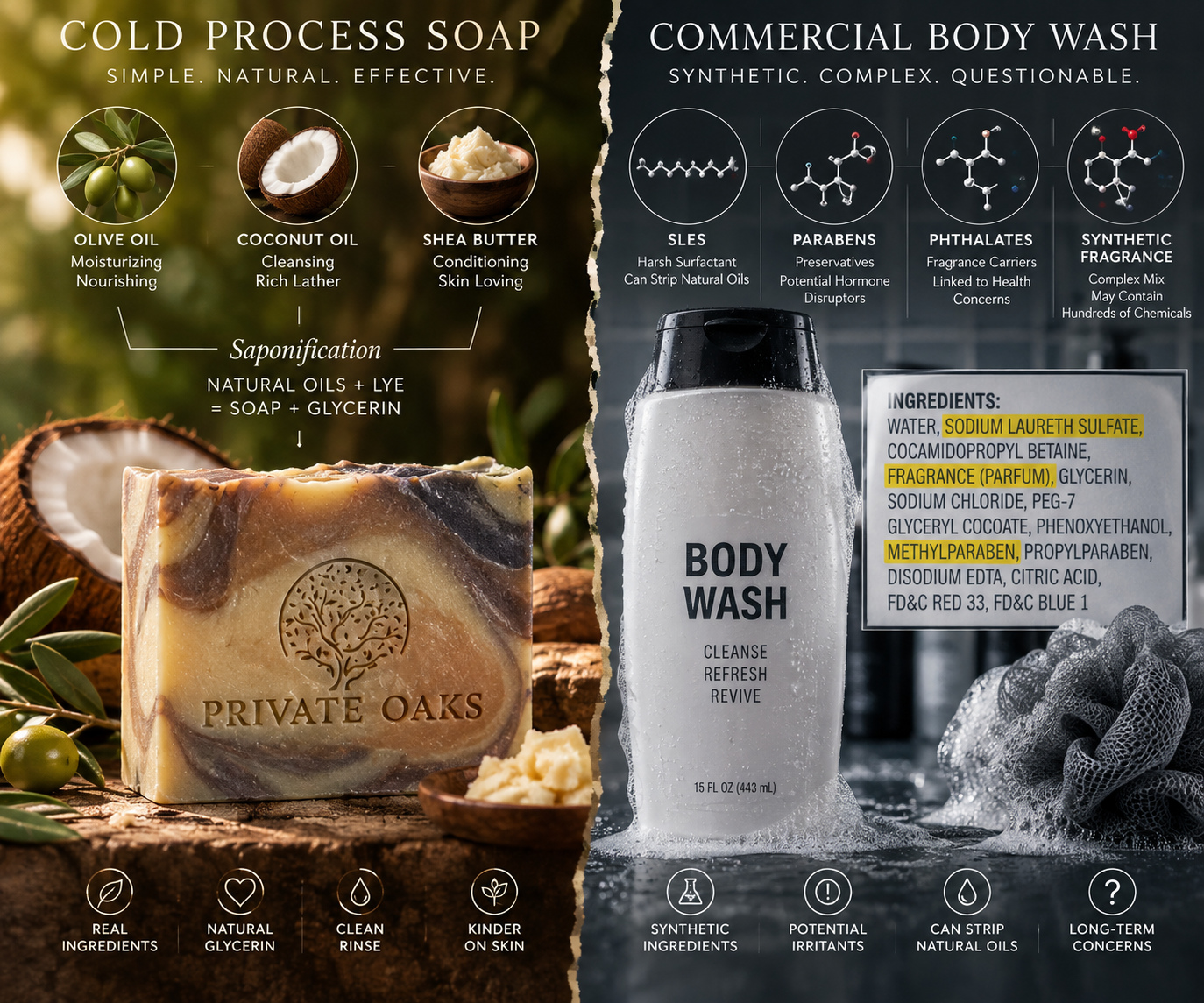
Most people assume bar soap and body wash are the same product in different formats. One is solid, one is liquid, both clean your skin. That assumption is dead wrong, and the personal care industry has never been particularly interested in explaining it.
The gap between what people assume and what is true is wider than you'd expect. A woman I met in Hong Kong who specifically seeks out natural products had no idea that body wash wasn't natural. A farmer I know who understands agricultural chemical exposure, knowledgeable in fertilizer contact, and wears personal protective equipment every day uses body wash without ever connecting those two pieces of knowledge. These aren't unusual people. They're the majority, and the reason they don't know isn't because they haven't looked. It's because nobody told them, and the label wasn't designed to.
This article covers body wash. What’s in it, why it requires the ingredients it does, and what the difference between it and true soap means for your skin, your wallet, and the environment. Some of it may surprise you. Some of it may make you look at the bottle in your shower differently. All of it is information the personal care industry would prefer you didn't think too hard about.
What Body Wash Is
True soap has a specific chemical definition. It's made by combining fats or oils with an alkali, typically sodium hydroxide, through a process called saponification. That reaction produces fatty acid salts that lift dirt and oil from the skin and rinse away with water. The result is a product with a short, readable ingredient list, retained natural glycerin as a byproduct of the reaction, and no need for preservatives because there's no water in the formula to support bacterial growth.
Body wash isn’t made this way. It's a water-based synthetic detergent formula. The cleansing agents are industrial surfactants derived from petroleum or plant feedstocks through chemical manufacturing processes that have nothing to do with saponification. The word soap doesn’t appear on any body wash labels because legally it can't. The FDA defines soap specifically as a product whose cleansing action comes from saponified fats or oils. Products that don't meet that definition cannot be marketed as soap. They're regulated as cosmetics instead, therefore, body wash is a cosmetic, not a soap, and the regulatory category it falls into tells you more about what's in it than the marketing on the front of the bottle ever will.
The reason this distinction matters isn't semantic, it’s chemical. Water as the primary ingredient in body wash creates a cascade of formulation requirements that drive the rest of the label. A water-based formula is vulnerable to bacterial and mold growth, so it requires synthetic preservatives. Water and oil don't mix, so it requires synthetic emulsifiers to hold the formula together. The formula needs a stable texture and viscosity, so it requires thickeners and stabilizers. The surfactants that replace soap need to foam adequately, so secondary surfactants and foam boosters are added. Each ingredient category exists primarily to solve a problem created by starting with water rather than building a formula around saponified oils.
Bar soap made from saponified plant oils need none of these requirements. No water means no preservatives. No oil and water separation means no emulsifiers. The saponification reaction itself produces the cleansing agents, the lather, and the retained glycerin without needing any of the downstream chemistry that water-based formulas require.
That’s the chemical logic of how each product is produced.
What the Label Is Telling You
Most body wash labels follow the same architecture. Understanding what each ingredient category is doing is the most useful thing you can take from this article into your next shopping trip.
Water is always first. It's the dominant ingredient by a significant margin, typically 60 to 80 percent of the formula by weight. This is why body wash requires everything that follows.
Sodium Laureth Sulfate, or SLES, is usually second. This is the primary synthetic surfactant in most commercial body washes. It's created by taking Sodium Lauryl Sulfate, the harsher and more documented skin barrier disruptor, and treating it with ethylene oxide in a process called ethoxylation to make it milder. SLES lathers effectively and rinses cleanly in both hard and soft water, which is a genuine performance advantage over cold process soap we'll address directly later.
Sodium Lauryl Sulfate, or SLS, appears in some body wash formulas in place of the milder SLES version. A peer-reviewed study published in the International Journal of Cosmetic Science found that 0.5 percent SLS applied for 24 hours reduced both barrier protection and beneficial microbial communities on the skin in healthy women. Commercial body washes typically contain it at 10 to 15 percent. We covered SLS and the skin microbiome in detail in our microbiome article.
Cocamidopropyl Betaine, often abbreviated as CAPB, is the secondary surfactant and foam booster. It’s derived from coconut oil through synthetic processing, it’s milder than SLS, and it’s used to reduce irritation from the primary surfactants. The American Contact Dermatitis Society named it Allergen of the Year in 2004, with contact sensitization rates of 3 to 7 percent in general populations. Reactions primarily result from manufacturing impurities rather than pure CAPB.
Sodium Chloride is table salt. It's a thickener in surfactant-based formulas. It has zero function for your skin. It's there because it turns a thin, runny surfactant solution into a gel texture consumers associate with quality.
Glycerin is one of the more genuinely useful ingredients in a body wash. It’s a humectant that attracts moisture to the skin surface. It’s also worth noting that cold process soap naturally retains glycerin as a byproduct of saponification. Commercial soap manufacturers typically remove that glycerin from bar soap to sell separately to the cosmetics industry, then add a controlled amount back into body wash formulas.
Phenoxyethanol is the preservative, and it’s required because of the water. It’s considered safe at concentrations up to 1 percent by most regulatory bodies, but the EU restricts its use in products applied to the face of children under three. It’s present in body wash specifically because a water-free formula like cold process bar soap doesn't need it.
Fragrance is the trade secret. One word on the label with potentially dozens of undisclosed compounds behind it including phthalates, synthetic musks, and documented allergens. We covered this in full in our fragrance article.
Synthetic colorants appear as CI numbers: Red 40, Blue 1, Yellow 5. No function for your skin and present entirely for visual marketing appeal.
Citric Acid adjusts pH downward after the alkaline surfactants have pushed it up. This is part of why body wash typically sits closer to the skin's natural pH range than cold process soap does, which we'll address in a later section.
What “Naturally Derived” Means
Look at the back of almost any body wash marketed as “natural” and you'll find language like “plant derived cleanser" next to ingredients like cocamidopropyl betaine. That description is technically accurate. CAPB does start from coconut oil, but what the label omits is that the coconut oil goes through multiple synthetic chemical processing steps before it becomes CAPB. The starting material is plant based, but the finished ingredient is a synthetic compound manufactured in an industrial chemical process that doesn’t exist in nature.
“Naturally derived” has no legal definition. We covered this in our clean beauty article. A brand can describe an ingredient as “naturally derived” if it started from a natural feedstock at any point in its production chain regardless of how many synthetic processing steps followed. The coconut in cocamidopropyl betaine is real, the plant derived cleanser description isn’t wrong, but the impression it creates, that you are washing with something close to nature, is significantly more flattering than the chemistry behind it warrants.
Sodium Cocoyl Isethionate also starts from coconut fatty acids. It then undergoes a synthetic industrial process called esterification with isethionic acid to produce the finished surfactant. Same story. Coconut in, synthetic compound out.
Sodium Lauroyl Sarcosinate is derived from lauric acid found in coconut and palm oils combined with sarcosine through a synthetic chemical reaction. Plant origin, industrial synthetic product.
Sodium Cocoyl Glutamate starts from coconut oil and glutamic acid and goes through industrial chemical synthesis to reach the finished ingredient. Often described on labels as “amino acid derived” or “plant derived.” Both descriptions are technically defensible, however, neither one tells you that the finished ingredient is a synthetic compound that required a manufacturing facility to produce.
The pattern is consistent across the “naturally derived” category. A recognizable plant somewhere in the production chain, a synthetic industrial process between that plant and the finished ingredient, and a label description that highlights the plant and omits the process. “Naturally derived” isn’t a lie, it’s a carefully chosen truth that leaves out the part that would change how you read the label.
This isn’t unique to any one company. It's the standard language across the entire natural body wash category. The “naturally derived” label is doing the same work as the word “clean” does on a bottle. It implies something the ingredient list doesn’t actually deliver.
The Ingredient That Isn't on the Label
Everything covered in the label decoder above is at least disclosed. You can find each of those ingredients listed by name if you look. This one is different. It's a manufacturing contaminant that isn’t listed on any body wash label because it isn’t an intentionally added ingredient. You can’t find it by reading the label because it doesn't have to be there, and it’s present in a significant percentage of body wash products on the market right now.
1,4-Dioxane is classified as a likely human carcinogen by the US Environmental Protection Agency and as a probable human carcinogen by the International Agency for Research on Cancer. It’s included on California's Proposition 65 list of chemicals known or suspected to cause cancer or birth defects. Research shows it readily penetrates the skin, and Canada has banned it from cosmetics entirely.
It gets into body wash through the same process that makes SLES milder than SLS. Remember the ethoxylation step we described earlier, where sodium lauryl sulfate is treated with ethylene oxide to produce the gentler sodium laureth sulfate? That ethylene oxide processing leaves behind trace amounts of 1,4-Dioxane as a byproduct. The same contamination applies to any ingredient with the prefix PEG, the suffix -eth, or the terms polyethylene, polyethylene glycol, or polyoxyethylene in its name. These are all ethoxylated ingredients, and they all carry the potential for 1,4-Dioxane contamination.
In testing of 80 household products including body washes, shampoos, and baby products, 65 of them, 81 percent, contained detectable levels of 1,4-Dioxane. The contamination is not a secret in the industry. 1,4-Dioxane can be removed through a manufacturing process called vacuum stripping that is effective and not particularly expensive, however, many manufacturers choose not to take that step.
The Nuance
The FDA, Health Canada, and the EPA's own risk evaluation have concluded that the concentrations of 1,4-Dioxane typically found in consumer personal care products don’t present an unreasonable health risk at normal use levels. New York State disagreed strongly enough to pass a law in 2022 limiting 1,4-Dioxane in consumer products to 2 parts per million, which forced reformulation of many products sold there. Several other states have followed with similar legislation.
The honest position is this. 1,4-Dioxane is a documented likely carcinogen. It’s present in a large percentage of body wash products and other cosmetic products. It penetrates the skin, it’s not on the label, and whether the concentrations found in typical consumer products represent a meaningful cancer risk at normal use is genuinely debated between regulatory agencies with different risk tolerances. What isn’t debated is that the contamination exists, that it can be removed and often isn't, and that consumers have no way to know whether the product they're using has been vacuum stripped or not because nothing on the label tells them.
How do you identify products that may contain it? Look for SLES, sodium laureth sulfate, and any ingredient containing the prefix PEG or the suffix -eth. Those are your markers. Their presence doesn't confirm 1,4-Dioxane contamination, but it signals the ethoxylation process that creates it.
Cold process and hot process bar soaps contain none of these ethoxylated ingredients. Saponification chemistry doesn't involve ethoxylation regardless of whether heat is applied during the process, so 1,4-Dioxane contamination from manufacturing isn't a concern that applies to any true bar soap made from saponified fats or oils.
The Bar Soap Bacteria Myth
If you've ever hesitated to buy a bar soap because you were worried about bacteria growing on it or transferring from the bar to your skin, you've encountered one of the most persistent and most thoroughly debunked myths in personal hygiene. The science on this has been clear for sixty years, and the industry that benefits most from you believing it has never been particularly motivated to correct it.
In 1965 the US Armed Forces conducted a study specifically designed to test whether bacteria transfers from bar soap to skin during washing. Researchers deliberately contaminated bar soap surfaces with bacteria at levels dramatically higher than anything you'd encounter in normal use. The result was that bacteria did not transfer to the skin of people washing with those bars in any meaningful quantity. The wash action itself, soap plus water plus friction, removes surface microbes faster than they can colonize the skin. This study has been replicated multiple times since with consistent results. Shared bar soap in household use doesn’t transfer pathogens to the people using it.
The reason this myth has such staying power is straightforward. It appeared at exactly the moment the personal care industry was trying to convince consumers to switch from bar soap to liquid body wash and later to antibacterial products. The suggestion that bar soap is unhygienic because it sits in a wet environment and might harbor bacteria was commercially useful to brands selling alternatives. The research never supported it, and the marketing didn't need it.
What Actually Harbors Bacteria in Your Shower
Here’s the irony the bacteria myth obscures. The applicator most people use with body wash is significantly more hospitable to bacterial growth than a bar of soap.
Shower poufs, the plastic mesh puffs used to lather body wash, are made from bunched synthetic polyolefin material that traps moisture, dead skin cells, and soap residue in their mesh structure. Unlike bar soap which dries between uses and self-rinses during washing, a shower pouf stays damp for hours, sometimes days, between uses. The median lifespan of a shower pouf in the US is approximately three months. Research has documented that shower poufs can harbor significant bacterial populations including potential pathogens when not replaced or cleaned regularly. The same goes for loofahs and bath sponges.
Bar soap's surface dries between uses. The wash action rinses its surface during every use. Any bacteria that land on a bar of soap during use are removed with the next rinse rather than trapped in a mesh structure that stays wet. The bar that someone worried about bacteria would put down and replace with body wash is demonstrably less hospitable to bacterial growth than the pouf they're using to apply that body wash.
The Soap Sleeve Question
Our cotton soap sleeve is worth addressing here specifically since the bacteria question applies to any fabric that contacts a bar of soap regularly.
Cotton is more breathable and dries more effectively between uses than the synthetic polyolefin mesh of a shower pouf. The sleeve also gets rinsed thoroughly with soap every single use rather than accumulating residue over weeks of use the way a pouf does. That said, a cotton sleeve is not sterile and benefits from periodic washing in hot water to maintain it properly. We recommend washing it regularly the same way you'd wash any cotton item that contacts skin daily.
A cotton soap sleeve in good condition and washed regularly carries less bacterial accumulation risk than a synthetic shower pouf that goes months between replacements. It's also doing something a pouf never does, helping the soap do its job more effectively through gentle exfoliation while using less product per wash.
Where Body Wash Has a Genuine Advantage
This series has always presented limitations alongside benefits, and this article is no different. Body wash has one documented performance advantage over bar soap that deserves to be stated.
Commercial body washes are typically formulated at pH 5 to 7, significantly closer to the skin's natural acidic range of 4.1 to 5.8 than bar soap. Cold process soap runs at pH 8.5 to 9.5 after a standard 45-day cure. We covered exactly what that means for the acid mantle, the skin's natural pH defense system, and how long recovery takes in our skin pH article.
The pH gap is real and it matters specifically for people with significantly compromised skin barriers. Eczema, rosacea, psoriasis, and acne-prone skin all involve some degree of existing barrier dysfunction. For those skin conditions a cleanser that doesn’t push the skin's pH upward is meaningfully less disruptive than one that does. A dermatologist recommending a pH-balanced cleanser for a patient with atopic dermatitis is giving sound advice, and that recommendation often points toward body wash or syndet bars rather than traditional cold process soap.
However, there are two things worth knowing alongside that advantage.
First, the pH benefit of body wash is delivered alongside everything else in the formula. The synthetic surfactants, the preservatives, and the potential 1,4-Dioxane contamination. The pH is better, but the rest of the formula is more complex and, in some categories, more concerning than a simple saponified oil bar. Whether the pH advantage outweighs those tradeoffs is a calculation that depends on your specific skin, your specific sensitivities, and how much weight you give to each factor.
Second, cold process soap's pH limitation is not fixed across all bar soap formats. Syndet bars, which are solid cleansers made with synthetic detergent chemistry rather than saponification, can be pH-balanced to 4.5 to 5.5 in a bar format. They don't trigger the calcium stearate hard water reaction, and they don't have the alkaline pH limitation. They also typically contain many of the same synthetic surfactants and preservatives as liquid body wash in a concentrated solid form. The choice between syndet bars and cold process soap involves the same tradeoffs as the choice between body wash and cold process soap. The format changes, but the ingredient categories largely don't.
For anyone with healthy skin and no diagnosed skin condition, the temporary pH disruption from cold process bar soap is not a significant concern. The acid mantle recovers within hours for healthy skin with an intact barrier. The question of whether the rest of what's in your body wash is preferable to that temporary pH shift is what this article is designed to help you answer for yourself.
What You're Paying to Ship
Body wash is 60 to 80 percent water. That water has to be packaged, transported, and delivered to you before you can use any of the 20 to 40 percent of the formula that actually does something for your skin. The environmental and economic consequences of that are more significant than most people think about while standing in the shower aisle.
A standard 16-ounce bottle of body wash contains roughly 3 to 6 ounces of cleaning and conditioning ingredients. The rest is water, packaged in plastic, and shipped in trucks across the country. A 5-ounce bar of cold process soap contains essentially 5 ounces of cleaning and conditioning material. There’s no water in the finished product, no plastic bottle, and, typically, ships in cardboard with paper packaging at a fraction of the weight.
The ETH Zurich Institute of Environmental Engineering studied the full lifecycle of bar soap versus liquid soap and found that bar soap cuts greenhouse gas emissions by approximately one third compared to liquid soap. Liquid soap requires five times more energy for raw material production and nearly twenty times more energy for packaging production. Making liquid detergents produces approximately ten times the greenhouse gas emissions of making simple bar soap.
Over 1.4 billion plastic body wash bottles are used annually in the United States. The majority end up in landfills or marine environments. Pump dispensers, which are made from multiple different plastic resins bonded together, are almost never recyclable even when the bottle itself is. The pouf used to apply most body wash adds another 30 grams of synthetic polyolefin plastic waste approximately every three months per user.
The Heat and Plastic Problem
This is where the shipping story becomes a skin health story.
Plastic releases chemical additives more readily under heat. Phthalates, plasticizers, and other compounds migrate from plastic container walls into the liquid contents when temperatures rise. Body wash shipped in plastic bottles across the country in summer heat, inside enclosed trailers where temperatures can reach 130 to 150 degrees Fahrenheit, experiences this migration during transit. The liquid body wash is in direct contact with the plastic container throughout that journey.
A 2025 ScienceDirect review confirmed that when heated, plastics release toxic additives including phthalates and BPA into their contents. A 2024 review in the Journal of Exposure Science documented over 1,800 food contact chemicals known to migrate from plastic packaging into contents under various conditions including elevated temperatures. The same migration mechanism applies to personal care products in plastic containers.
Dr. Shanna Swan, professor of environmental medicine and public health at Mount Sinai and author of Count Down: How Our Modern World Is Threatening Sperm Counts, Altering Male and Female Reproductive Development, and Imperiling the Future of the Human Race, has spent decades documenting the reproductive health consequences of phthalate exposure specifically from personal care products. She discussed this directly on episodes 1638 and 2476 of the Joe Rogan Experience, noting that phthalates in personal care products don't always have to be labeled and that companies are allowed to include them without informing consumers. That observation applies equally to phthalates intentionally added to fragrance formulas and to phthalates migrating from the plastic containers those formulas are shipped in. We covered her research in depth in our chemical article.
We can't cite a peer-reviewed study that specifically measured phthalate migration from body wash bottles during shipping because that specific study doesn't appear to exist publicly. What we can say accurately is that the mechanism is documented, the conditions during shipping create elevated migration risk, and the liquid formula inside the bottle is in prolonged contact with the plastic throughout transit. The concern is documented even if the body wash specific measurement isn't.
We ship our bars in cardboard boxes with paper packing materials rather than plastic bubble wrap. That isn't a coincidence. It's a deliberate choice that reflects the same ingredient philosophy that drives everything else about how we formulate and package our products.
Costs Per Wash
The price comparison between bar soap and body wash looks straightforward at the shelf, but it becomes more interesting when you factor in what you're really paying for.
A 16-ounce bottle of mid-range commercial body wash costs approximately $8 to $10. That bottle is 60 to 80 percent water, meaning roughly 3 to 6 ounces of that purchase price is buying cleaning agents. Research suggests consumers use approximately seven times more product per washing session with body wash than with bar soap, partly because pump dispensers are calibrated generously and partly because liquid product is harder to portion than a bar.
A 5-ounce Private Oaks bar at $6 contains essentially 5 ounces of saponified organic oils, retained glycerin, Dead Sea Salt, and clay with no water diluting the formula. Bar longevity varies significantly depending on how the bar is stored between uses, how many people are sharing it, and individual usage habits. A bar stored on a draining soap dish that dries completely between uses will last considerably longer than one sitting in standing water. What doesn't change regardless of how quickly you go through it is that every ounce you paid for is doing something for your skin rather than filling space with water. A commercial body wash at $8 to $10, used at seven times the per-wash volume of a bar, delivers far less actual cleaning material per dollar than the shelf price suggests. The 60 to 80 percent water you paid to purchase, to package in plastic, to ship across the country in a heated truck, and to eventually dispose of in a landfill contributes nothing to the cleansing, but you’re paying for it anyway.
The cost per wash calculation always favors concentrated bar soap over water-diluted liquid body wash when adjusted for actual cleaning ingredient content and usage rate. That's true of our bars, and it's true of most quality bar soap generally.
What to Do With All of This
This article wasn't written to tell you to throw out your body wash. It was written to give you the information the personal care industry never volunteered and the label was never designed to provide.
Body wash and bar soap aren’t the same product in different formats. One is a water-based synthetic detergent formula that requires preservatives, emulsifiers, and thickeners in the bottle you're holding. The other is a saponified fat or oil formula with a short ingredient list, retained natural glycerin, and no water requiring any of those downstream additions. That’s a fundamental chemical difference that affects what you're putting on your skin, what you're paying for per wash, what you're shipping across the country in a plastic bottle, and what ends up in the environment when you're done with it.
The pH advantage of body wash is real, and for people managing active skin conditions it deserves serious consideration. The 1,4-Dioxane contamination concern is also real and, for people using products with ethoxylated ingredients it deserves the same consideration. The bacteria myth attached to bar soap isn’t real and hasn't been for sixty years. The shower pouf used to apply most body wash is a more hospitable bacterial environment than the bar it replaced. The “naturally derived” language on the back of the bottle describes a starting material, not a finished ingredient. The phthalate migration concern from plastic containers shipped in summer heat is mechanistically documented even without a body wash specific study to cite.
None of this requires a perfect decision, but it requires an informed one.
If you want to understand what's in the specific ingredients we use in our bars and why each one is there, our ingredients page documents everything. Our ingredient label article covers how to read any personal care product label rather than just trusting the front of the bottle. Our microbiome article, skin pH article, and hard water article cover the specific biological mechanisms that determine how any cleanser affects your skin, and our clean beauty article covers the regulatory environment that allows “naturally derived” and “plant based” to mean whatever a brand decides they mean.
The Grove exists because we believe the gap between what people assume and what is true about personal care products is too wide and too consequential to leave unfilled. That's the gap this article was written to close.
That's The Grove. Not a catalog. A library.