.svg)
Menu
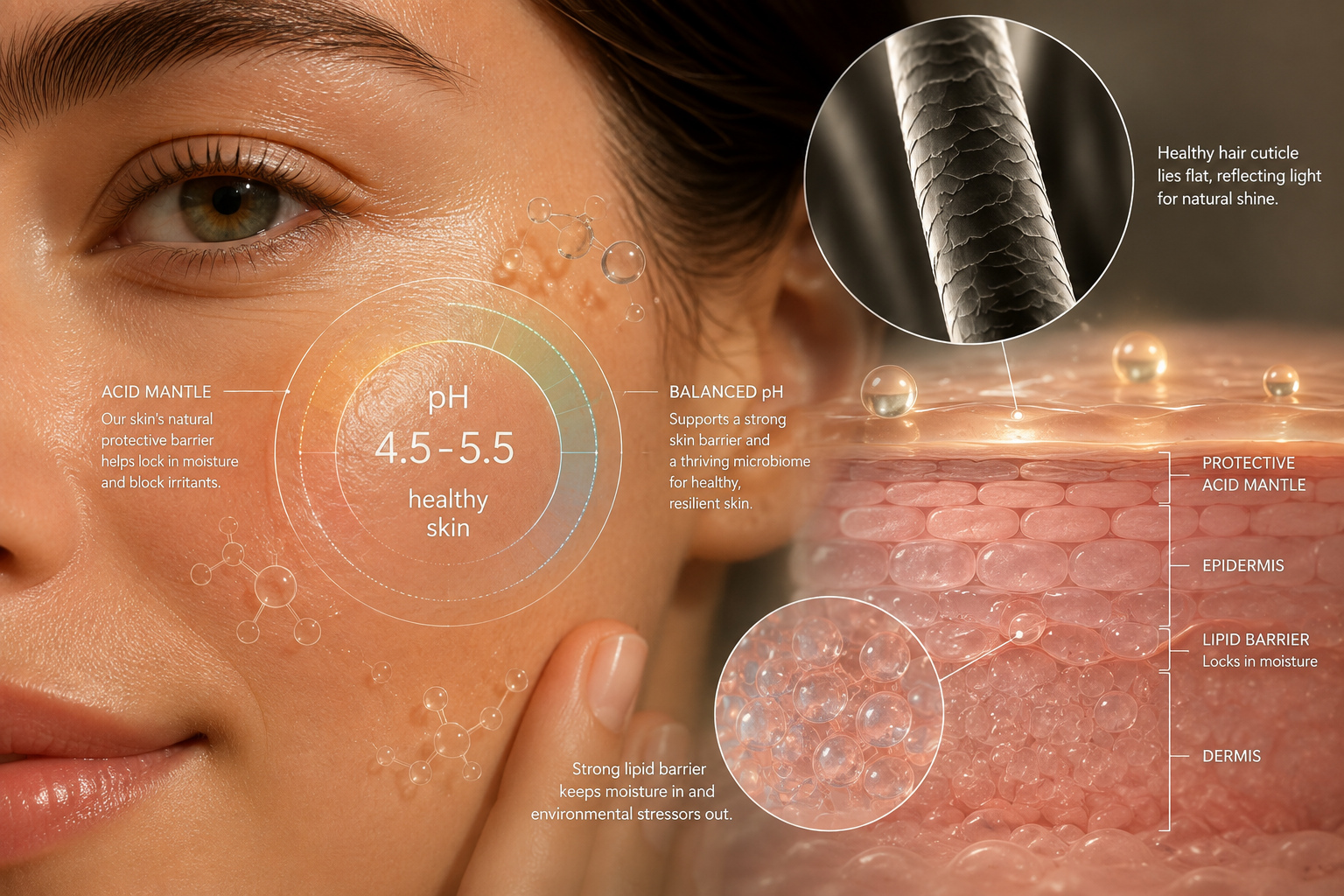
There is a number that determines which bacteria win the fight for your skin. Below that number the beneficial bacteria thrive, the barrier holds, and your skin does its job quietly. Above it the pathogenic bacteria gain the upper hand, the barrier weakens, and the conditions that drive acne, eczema, rosacea, and psoriasis become more likely. That number is pH, and most people have never thought about it once in their lives.
pH is one of the most fundamental factors in skin health, and it's almost entirely absent from mainstream skincare conversations. Products get marketed for what they contain, rarely for what pH they're formulated at. Routines get built around ingredients and almost never around the acid-base environment those ingredients are landing on. The soap most people use twice a day, which has a more significant effect on skin pH than almost any other product in a daily routine, is chosen based on scent, price, and packaging rather than what it's actually doing to the biological system it contacts.
This article is about that biological system. What pH is, what your skin's pH does, why the body maintains dozens of different pH environments simultaneously, and what happens to your skin when the number shifts in the wrong direction. Some of it connects directly to what we've covered across The Grove in the microbiome article, the skin condition articles, and the nutrition article. Some of it is genuinely new. All of it matters more than the skincare industry has bothered to tell you.
What pH Actually Is
pH stands for potential of hydrogen. It's a measurement of how many hydrogen ions are present in a solution, expressed on a scale from 0 to 14. Zero is the most acidic. Fourteen is the most alkaline. Seven is neutral, meaning neither acidic nor alkaline. Every point on the scale represents a tenfold difference in hydrogen ion concentration, which means pH 4 is ten times more acidic than pH 5 and one hundred times more acidic than pH 6.
Most people last thought about pH in a high school chemistry class. What they were never taught is that pH is not just a chemistry concept, it’s a biological control system. Every enzyme in your body has an optimal pH range in which it functions. Every bacterium on your skin has a pH range in which it thrives or struggles. Every structural process in your skin barrier, from ceramide synthesis to moisture retention to pathogen defense, is pH-dependent. The number is not incidental to how your skin works, it’s foundational to it.
The Body Doesn't Have One pH
Labels on alkaline water products often claim their pH matches the body's natural pH or that drinking alkaline water supports the body's pH balance. The body's pH they're referring to is blood pH, which sits at 7.35 to 7.45. That's a real number and it's the most tightly regulated pH in your entire body. If blood pH drops below 6.9 or rises above 7.8 the result is life-threatening. The body uses three simultaneous defense mechanisms to maintain that narrow range: chemical buffer systems in the blood, respiratory control through breathing rate, and renal regulation through the kidneys.
But blood pH is one number in a system that maintains dozens of different pH environments simultaneously, each calibrated precisely for its function. Here’s what that actually looks like across the body:
Blood sits at pH 7.35 to 7.45. Saliva sits at pH 6.5 to 7.5. The stomach runs at pH 1.5 to 3.5, one of the most acidic environments in the body, because that extreme acidity is what kills ingested pathogens and activates the enzymes that break down food. The small intestine runs at pH 7 to 8.5, alkaline, because the pancreas secretes bicarbonate to create the environment digestive enzymes need to function. The large intestine runs at pH 5.5 to 7, more acidic than the small intestine partly because gut bacteria produce short-chain fatty acids through fermentation. Urine ranges from pH 4.5 to 8.0 depending on what the kidneys are excreting. Your skin's surface sits at pH 4.1 to 5.8, one of the most acidic external environments in the entire system.
The body isn’t optimized for one pH. It's running a sophisticated multi-zone system where radically different pH environments are maintained in parallel, each doing a job that requires exactly that chemical range. When a water label tells you its pH matches your body's natural pH, it's giving you one number from a system of dozens and implying it tells you something meaningful. It doesn't.
What no alkaline water product can do is change your blood pH. The stomach's powerful acid at pH 1.5 to 3.5 neutralizes any alkaline substance before it can reach the bloodstream. The lungs and kidneys then compensate for any remaining subtle shift. Diet can change urine pH, which is simply the kidneys doing their job to maintain blood pH stability by excreting excess base. It doesn't indicate anything meaningful about the body's internal environment. The only things that genuinely shift blood pH are kidney disease, respiratory disease, diabetic ketoacidosis, and severe metabolic conditions.
Your skin's pH sits at the far acidic end of this system for reasons that are neither arbitrary nor cosmetic. They're biological, and understanding those reasons is what makes everything else in this article make sense.
The Acid Mantle: Your Skin's Built-In Defense System
The acid mantle was first described in 1928 by two German researchers, Marchionini and Schade, who noticed that the surface of human skin was consistently more acidic than they expected. They coined the term Säuremantel, German for acid mantle, to describe what they were observing. Nearly a century of research has since built on that original observation, and what we now understand about the acid mantle is significantly more sophisticated than what those two researchers could have imagined.
The acid mantle is not a physical layer you can see or feel. It's a chemical environment maintained in the outermost layer of the skin, the stratum corneum, by a mixture of compounds your skin produces continuously. Sebum from oil glands, sweat and amino acids from eccrine glands, lactic acid, and free fatty acids, and breakdown products from a protein called filaggrin that is central to skin barrier function. Together these compounds create and maintain the slightly acidic surface environment that your skin has been operating since long before you started washing it with anything.
The acid mantle serves four documented functions that peer-reviewed research has confirmed across decades of study.
Barrier integrity. The lipid processing enzymes that produce ceramides, fatty acids, and cholesterol to form the skin's waterproof lipid matrix are pH-sensitive. They work optimally in the slightly acidic range of 4.5 to 5.5. When pH rises above this range these enzymes are inhibited and barrier lipid processing slows. This directly delays barrier recovery after any disruption and contributes to increased water loss through the skin. Every time the acid mantle is disrupted the skin's ability to repair itself is temporarily compromised at the enzymatic level.
Lipid homeostasis. The same enzymatic processes that build and maintain barrier lipids require the acidic environment to function correctly. Ceramide synthesis, which we covered in the context of eczema and psoriasis in our skin condition articles and which CeraVe was specifically designed to address, depends on an acidic stratum corneum to proceed normally. When the pH environment that drives ceramide synthesis is disrupted, the barrier lipids it would have produced are simply not made.
Pathogen defense. An acidic environment actively suppresses the growth of pathogenic microorganisms while supporting the beneficial bacteria that form your skin's first line of microbial defense. This is the mechanism behind the opening of this article and we'll cover it in specific detail in the next section.
Immune communication. The acid mantle communicates directly with the skin's immune system to calibrate appropriate responses to potential threats. When the acid mantle is disrupted the immune signaling it normally provides is also disrupted, contributing to the dysregulated immune responses that characterize inflammatory skin conditions.
The Three-Zone Discovery
In 2024 researchers confirmed something about the acid mantle that genuinely changes how it should be understood. The stratum corneum doesn't have one pH, it has three distinct zones arranged from the surface inward, each with a different pH and a different primary function.
The outermost zone maintains a near-neutral pH of approximately 6.7. This zone is uniquely adaptive and can adjust its pH based on external environmental conditions. It's the zone that responds to soap, water, pool chlorine, and any other external pH influence. It's also the zone that recovers first after disruption.
The middle zone sits at approximately pH 5.4. This is where most of the enzymatic barrier work happens. The serine protease enzymes that process ceramides and other barrier lipids operate in this zone, and they require its slightly acidic environment to function. This is why repeated disruption of the outer zone eventually affects barrier function even if the disruption seems temporary at the surface level.
The innermost zone sits at approximately pH 6.0 where it interfaces with living skin cells below. This zone bridges the entirely non-living stratum corneum above with the living tissue below and its pH reflects that transitional role.
This three-zone architecture means that what looks like a simple surface pH measurement is actually capturing the outermost adaptive zone only. The more biologically critical middle zone where barrier lipid synthesis happens is partially buffered from external disruption by the adaptive outer zone, but when that outer zone is disrupted repeatedly and quickly, the buffering capacity is overwhelmed and the effects reach deeper.
This is why the frequency of washing matters as much as what you wash with. One disruption gives the outer zone time to recover before the next. Repeated disruptions in quick succession overwhelm the recovery mechanism and allow the pH shift to reach the enzymatic processes in the middle zone.
The Number That Determines Who Wins
A peer-reviewed study published in the Journal of Medical Microbiology measured the growth kinetics of two bacteria that every person reading this article has on their skin right now. Staphylococcus epidermidis and Staphylococcus aureus. One is a beneficial commensal that actively protects your skin. The other is a pathogen that drives some of the most common and most frustrating skin conditions in the world. What the study found is that pH is the primary variable determining which one gains the competitive advantage.
Staphylococcus epidermidis, the beneficial one, shows relatively stable growth across a wide pH range. It thrives in acidic conditions and maintains its population adequately even as pH rises toward neutral. It's a resilient organism that co-evolved with human skin and adapted to function across the conditions human skin naturally experiences.
Staphylococcus aureus is different. Its growth is strongly pH-dependent in a way that has direct clinical consequences. At the skin's natural acidic pH of 4.1 to 5.8, S. aureus is suppressed. Its ability to colonize, proliferate, and trigger immune responses is significantly reduced in the acidic environment the acid mantle maintains. As pH rises toward neutral and above, S. aureus gains a competitive advantage over S. epidermidis. Its equilibrium bacterial count increases significantly in alkaline conditions, it colonizes more readily, it produces the toxins and enzymes that damage the skin barrier more effectively, and it triggers the inflammatory cascade that characterizes atopic dermatitis and other inflammatory skin conditions.
A 2020 study published in the journal Allergy went further. It found that skin pH-dependent S. aureus abundance is not just correlated with atopic dermatitis severity, it’s predictive of it. The higher the skin pH the more S. aureus and the more severe the eczema that follows. That's a causal direction, and it has significant implications for how skin conditions are understood and managed.
The same pattern holds across conditions. In rosacea, elevated skin pH is associated with Demodex mite overpopulation and the microbial dysbiosis that drives flares. In psoriasis, the disrupted microbiome that characterizes the condition is consistent with an elevated pH environment that favors pathogenic over commensal organisms. In acne, the dysbiosis that allows Cutibacterium acnes to overpopulate in clogged follicles occurs in an environment where pH regulation has broken down at the follicular level.
We covered all four of these conditions and their microbiome connections in detail in our microbiome article and in the individual skin condition articles throughout The Grove. What those articles described from the microbiome perspective, this section is now explaining from the pH perspective. They're the same story told from two different angles. The microbiome and the acid mantle are not separate systems. The acid mantle is the environment that determines who the microbiome is.
This is also why the frequency and aggressiveness of washing matters so much more than most skincare advice acknowledges. Every time the skin's pH is pushed above its natural acidic range, even temporarily, S. aureus gains a window of competitive advantage over S. epidermidis. In healthy skin with an intact barrier the acid mantle recovers relatively quickly and that window closes. In compromised skin the recovery is slower, the window stays open longer, and the cumulative effect of repeated disruption creates a state of chronic pH elevation that looks like sensitive skin but is actually a correctable acid mantle problem.
What's Pushing Your Skin's pH in the Wrong Direction
Understanding what disrupts the acid mantle is more useful than understanding what the acid mantle is because most of the disruption is happening daily, repeatedly, and from sources people never think to question.
Soap
Every bar of soap, including cold process soap made from saponified plant oils like ours, runs at an alkaline pH. This is not a formulation choice, it’s just chemistry. The saponification reaction that creates true soap requires sodium hydroxide, which is strongly alkaline, and the finished product retains that alkalinity. Cold process soap typically sits between pH 8.5 and 9.5 after a standard 45-day cure. Freshly made soap can run as high as pH 12 to 13 at unmolding.
There is a nuance worth understanding here. Extended curing continues to lower pH beyond the standard cure window. The saponification reaction continues slowly for months after the minimum cure ends, consuming remaining traces of free alkali, carbon dioxide in the air reacts with the soap's surface, forming compounds that are less aggressively alkaline than free sodium hydroxide, and water continues evaporating, making the bar denser and releasing alkalinity more slowly during use. The result is a measurable pH drop over time.
A bar at 45 days sits at approximately pH 8.5 to 9.5. At three months it's closer to pH 8.0 to 9.0. At six months closer to pH 7.5 to 8.5. At twelve months some well-made cold process bars approach pH 7.0 to 8.0. These are estimates based on soap chemistry rather than precise clinically established values. Individual bars vary based on formula, water percentage, and storage conditions, but the trend is real, documented, and consistent.
Private Oaks bars are cured for a minimum of 45 days. Many bars customers receive have been curing for two to three months or longer. That additional cure time is doing real chemical work that makes the bar measurably milder than a freshly cured bar. Most commercial bars are manufactured and shipped as quickly as possible. The patience built into our process is a documented quality difference.
Even so, all true cold process soap remains more alkaline than the skin's natural pH range. The skin recovers its pH after washing, but the recovery takes time, and the implications of that recovery window are worth understanding.
Tap Water
Most municipal water supplies maintain a pH between 7 and 8.5 specifically to prevent pipe corrosion. That’s significantly more alkaline than the skin's natural range. A 2006 study in the International Journal of Cosmetic Science confirmed that even brief contact with alkaline water raises skin pH, increases dryness, and disrupts the lipid barrier. This means that even rinsing your face with tap water alone, without any soap, is shifting your skin's pH upward temporarily.
Hard water compounds this effect. Hard water contains high concentrations of calcium and magnesium minerals that are alkaline in solution, bind to surfactants in soap making them harder to rinse completely, and deposit mineral films on the skin surface that can interfere with the acid mantle's ability to reestablish itself. Nebraska has moderately to very hard water across much of the state. If your skin has always felt tight or dry after washing and you've never found a product that fully resolves it, hard water may be part of the explanation rather than your skin type.
For the full picture on what hard water does to your skin barrier, your soap, and your hair, and what you can do about it, our hard water article covers it in depth.
Swimming Pools
Pool water is maintained at pH 7.2 to 7.8 for swimmer comfort and disinfectant efficacy. That's above the skin's natural acidic range, but the pH of the water is only part of the story.
Chlorine and the disinfection byproducts it produces, particularly chloramines that form when chlorine reacts with organic matter including sweat and skin cells, are documented to strip the skin's natural lipid layer, disrupt the acid mantle, and increase transepidermal water loss. A 2024 open access review documented that chronic exposure to chlorine and disinfection byproducts in swimming pools damages the stratum corneum leading to increased water loss. Duration of lifetime swimming pool attendance increases the risk of eczema in children with an odds ratio of 1.71 for more than five years of attendance.
Here’s the nuance worth knowing. The research on chlorine and eczema is not entirely one-directional. The National Eczema Society and multiple clinical sources note that properly maintained pool water has an antiseptic effect similar in concentration to therapeutic bleach baths, which are a recognized clinical treatment for moderate to severe eczema. Some people with eczema improve with regular swimming while others worsen. The individual response depends on baseline barrier integrity, microbiome health, and the specific chemical balance of the pool. Rinsing thoroughly with fresh water immediately after swimming and applying a moisturizer while skin is still slightly damp gives the skin the best chance to begin acid mantle recovery before the disruption compounds.
Hot Tubs
Hot tubs maintain similar pH to pools, 7.2 to 7.8, but add two factors that make the skin impact more significant. Higher water temperature accelerates stripping of natural skin oils and increases transepidermal water loss. Longer soak times mean longer exposure to both alkaline water and disinfectant compounds, typically chlorine or bromine. The combination of heat, prolonged exposure, and chemical disinfectants creates conditions that are consistently more problematic for compromised skin than swimming pools. For anyone managing eczema, rosacea, or psoriasis, hot tub exposure deserves more caution than swimming pools for these combined reasons.
Ocean Water
Ocean water sits at pH 7.5 to 8.5, above the skin's natural range but less alkaline than pool water and without synthetic disinfectant compounds. Ocean water also contains naturally occurring magnesium, sodium chloride, and other minerals that have documented soothing and anti-inflammatory properties for some skin conditions. The Dead Sea salt we covered in our clays and salts article carries these mineral benefits in concentrated form. The ocean experience is generally less disruptive than swimming pools for most people with sensitive skin, though it still represents a pH shift above the skin's natural range and salt water can be drying with prolonged exposure.
The Cumulative Picture
Consider a typical morning for someone managing sensitive or acne-prone skin. They shower with tap water at pH 7 to 8.5. They wash with soap at pH 8.5 to 9.5. They rinse with that same tap water. Their skin's pH has been pushed significantly above its natural range twice in the same two-minute window. If they swim in a pool that afternoon and shower again in the evening the acid mantle has been disrupted four times in a single day without a full recovery window between disruptions.
Each individual disruption may be temporary in healthy skin, but the cumulative effect of repeated disruptions without adequate recovery time is not temporary. It's the mechanism behind what most people call sensitive skin, reactive skin, or skin that just doesn't tolerate products well. In many cases it's a chronic acid mantle disruption problem that has been misidentified as a skin type.
A Note on Hair and pH
Everything covered so far applies to skin. Hair tells a related but meaningfully different story and it's worth understanding specifically because the difference between how skin and hair respond to pH disruption is one of the most practically important distinctions in this entire article.
Healthy hair sits at pH 4.5 to 5.5 in its natural state. The cuticle, which is the outermost protective layer of each hair strand made of overlapping keratin scales, lies flat at this pH. A flat cuticle seals moisture inside the hair shaft, protects the inner cortex, and gives hair its smooth appearance and structural integrity.
When hair is exposed to alkaline pH above 7, those cuticle scales lift and open. The hair shaft swells via osmosis as alkaline conditions penetrate the fiber. Moisture escapes, protein leaches from the cortex, and the raised cuticle edges catch on each other between strands, increasing friction, tangling, and breakage. A study published in the International Journal of Dermatology confirmed that alkaline pH increases the negative electrical charge on the hair fiber surface which amplifies static and strand-to-strand friction. Over repeated alkaline exposure this chips away at the protective cuticle layer progressively. The result is hair that becomes rough, frizzy, dull, and over time structurally weaker.
This happens with cold process soap at pH 8.5 to 9.5. Every wash with an alkaline bar opens the cuticle.
Here’s where hair diverges critically from skin. Your skin has the acid mantle, an active biological system that re-acidifies itself after alkaline exposure through sebaceous gland activity, eccrine gland secretions, and enzymatic processes in the stratum corneum. Recovery takes time but the mechanism exists, and it works in healthy skin.
Hair has no equivalent recovery mechanism. The cuticle doesn’t re-close on its own after alkaline exposure. Without an acidic intervention, meaning an acidic rinse or a pH-balanced conditioner applied after washing, the cuticle remains open, and the damage from each alkaline wash accumulates rather than resolving between sessions. This is why people who wash their hair with bar soap often notice progressive dryness, frizz, and brittleness that worsens over time rather than stabilizing.
This isn’t an argument against bar soap for body use. It's a specific caution about using body soap as a shampoo substitute. A single emergency wash with bar soap won't permanently damage hair, but regular use without an acidic rinse after every wash will produce cumulative damage that’s directly attributable to the pH mismatch rather than any other factor.
If you do use a bar soap on your hair or if you're interested in solid shampoo bars as a format, the distinction matters enormously. A true shampoo bar formulated with syndet, which is synthetic detergent chemistry rather than saponification chemistry, can be pH-balanced to 4.5 to 5.5 at the formulation stage. A cold process soap bar cannot. The chemistry that makes cold process soap what it is also makes it inherently alkaline. Those are different products doing different things, and the pH distinction is the most important difference between them.
An acidic rinse after washing hair with any alkaline product helps close the cuticle and restore the hair's natural pH environment. Diluted apple cider vinegar at roughly one tablespoon per cup of water works effectively for this purpose. It's not a perfect substitute for a pH-balanced shampoo but it significantly reduces the cumulative damage from alkaline exposure.
How Long Does Recovery Actually Take
This is the question that matters most practically and the research gives a more nuanced answer than most skincare content acknowledges.
For healthy skin with an intact barrier, surface pH begins normalizing within 30 minutes to a few hours after washing. Most peer-reviewed sources cite a recovery window of one to four hours for the outermost adaptive zone of the stratum corneum to return to its natural acidic range. That recovery is real and it's why most people with healthy skin don't experience chronic acid mantle problems from daily washing even with alkaline soap.
The picture changes significantly for compromised skin. Eczema, psoriasis, rosacea, acne-prone skin, and skin that has been repeatedly disrupted over time all share a common characteristic: the barrier lipid processing enzymes that drive the skin's natural acidification are working at reduced capacity. When those enzymes are compromised the recovery mechanism is compromised with them. The window between disruption and recovery extends. And if the next disruption happens before recovery is complete, the skin is starting from a more elevated baseline each time.
This is the mechanism behind what chronic skin sensitivity actually is in many cases. Not a fixed skin type. Not an inevitable genetic outcome. A pattern of repeated disruption faster than a compromised barrier can recover from, compounding over time into a state of chronic low-level pH elevation that creates exactly the conditions S. aureus needs to gain the upper hand.
There is a deeper layer to this that the 2024 Journal of Investigative Dermatology three-zone discovery helps explain. Surface pH, which is what recovers within hours, is the outermost adaptive zone only. The middle zone where the enzymatic barrier work happens is partially buffered from external disruption by the adaptive outer zone. But when the outer zone is disrupted repeatedly without adequate recovery time that buffering capacity is eventually overwhelmed and the pH shift reaches the middle zone where ceramide synthesis and barrier lipid processing actually occur. At that point the recovery is not measured in hours. It's measured in the time it takes damaged barrier lipids to be replaced, which for compromised skin can be significantly longer.
The practical implication is not that you should stop washing. It's that the interval between washing events matters. Twice daily cleansing, the standard dermatological recommendation, gives healthy skin adequate recovery time between disruptions. More frequent washing, or multiple pH-disrupting exposures in a single day such as morning washing followed by pool swimming followed by an evening shower, reduces the recovery window in ways that compound over time.
Where to Go From Here
The acid mantle isn’t a skincare trend, it’s a biological system that has been working on your behalf since before the personal care industry existed. Most of what disrupts it is mundane. Soap, water, pools, and time between washing and the next disruption. Understanding that the number matters and what moves it in the wrong direction gives you something actionable that most skincare advice never provides.
A few practical things worth taking from this article.
The soap you use matters but so does how often you use it and how much recovery time you give your skin between sessions. If your skin consistently feels tight, reactive, or intolerant of products you've used before, chronic pH disruption is worth considering as a contributing factor before assuming a permanent skin type.
Hard water is a genuine and underappreciated contributor to acid mantle disruption. If you've moved to an area with harder water and noticed changes in your skin that no product change has resolved, the water itself may be the variable worth addressing.
Swimming pools are not inherently harmful but they are pH-disrupting. Rinsing thoroughly with fresh water immediately after swimming and applying a moisturizer while skin is still slightly damp gives the acid mantle the best conditions to begin recovery.
Hair doesn't recover from alkaline pH exposure on its own. If you're using bar soap on your hair regularly, an acidic rinse after every wash is not optional. It's the only thing preventing cumulative cuticle damage from compounding with each session.
The alkaline water on your grocery store shelf is not doing what the label implies. The body doesn't have one pH. It has dozens, and the number on that label is one of them in a system of many, telling you almost nothing useful about what your skin actually needs.
If you want to understand how the acid mantle connects to the specific skin conditions we cover elsewhere in The Grove, our articles on eczema, rosacea, psoriasis, and acne each address the pH connection for that condition specifically. Our microbiome article covers the bacterial competition that the acid mantle is managing around the clock, and our skin condition series is the full library of what we've learned and verified across many months to years of research and writing.
That's The Grove. Not a catalog. A library.