.svg)
Menu
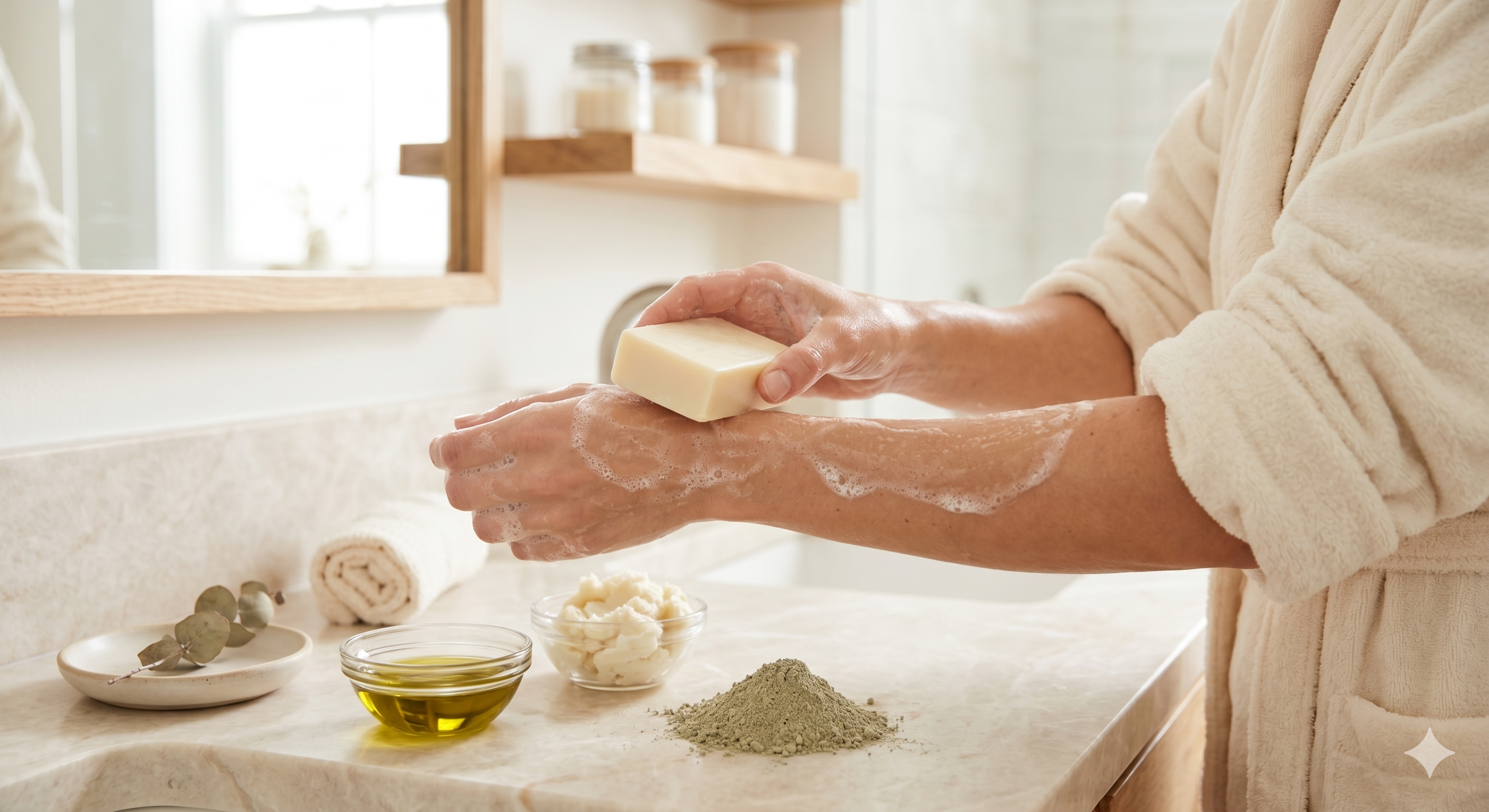
If you have eczema you already know the drill. You find something that seems to help, use it for a few weeks, and then either it stops working or a flare reminds you that nothing is ever fully solved. You've probably read more ingredient labels than most people ever will. You're skeptical of anything that sounds like a sales pitch. Good. That skepticism is going to serve you well in this blog, including when we get to the part where we're honest about a limitation in our own soap that anyone managing eczema deserves to know about.
A Quick Eczema Summary
Eczema affects more than 31 million Americans and is the most common chronic skin condition in the world. Most people describe it as dry, itchy skin that leads to a rash from scratching. Dermatologists sometimes call it the itch that rashes, because the itch comes first and the rash follows.
But eczema is not simply dry skin and that distinction matters. Dry skin is a moisture problem. Eczema is a barrier problem driven by a combination of genetics and an overactive immune system.
Your skin's outermost layer is supposed to act like a brick wall, with skin cells as the bricks and natural oils and lipids as the mortar holding everything tightly together. In people with eczema, that mortar is compromised. Many eczema sufferers carry a genetic mutation that affects a protein called filaggrin, which is responsible for building and maintaining that tight outer layer. When filaggrin is deficient the wall develops gaps. Moisture escapes through those gaps and environmental triggers, allergens, bacteria, and irritants slip in through them. The immune system sees those intruders and overreacts, triggering the inflammation, redness, and itch that define the condition.
The scratching that follows makes things worse by further damaging the barrier, letting in more triggers, and starting the cycle over again. That cycle is what makes eczema so persistent and so frustrating for the people living with it.
There is also a broader pattern worth knowing. About half of people with severe eczema go on to develop asthma and around 75 percent develop hay fever. Researchers call this the atopic march, meaning the same underlying immune and barrier dysfunction that shows up in the skin often shows up in other systems too. If you have eczema and also struggle with seasonal allergies or asthma, that connection is not a coincidence.
What Makes Eczema Worse
Understanding your triggers is one of the most practical things you can do to manage eczema day to day. Everyone's triggers are slightly different but the most commonly documented ones are worth knowing.
Synthetic fragrances are the most frequent culprit in skincare and personal care products. A single fragrance listing on an ingredient label can hide dozens of individual chemical compounds, many of which are documented skin sensitizers. If your skin reliably flares after using a scented product, fragrance is almost certainly the reason. We covered exactly what hides behind that single word on a label in our ingredient blog.
Harsh surfactants, particularly SLS and SLES, strip the skin's natural oils and damage the barrier directly. The same surfactants we discussed in our chemical blog that increase skin permeability to environmental chemicals are also among the most common eczema triggers in daily personal care products.
For the full science on what those surfactants do to your skin's microbial community, our microbiome article covers it in depth.
Hot water feels soothing in the moment but strips natural oils from already compromised skin and can trigger or worsen flares. Lukewarm water and shorter showers are consistently recommended by dermatologists for eczema sufferers. Sweat creates a similar problem, irritating compromised skin through its salt content and trapping heat and moisture in skin folds where eczema commonly appears.
Hard water is another documented environmental trigger worth knowing about. The mineral content in hard water disrupts the skin barrier through a different mechanism than surfactants do but produces similar outcomes, elevated transepidermal water loss, reduced barrier integrity, and worsened eczema symptoms. Our hard water article covers that connection specifically.
Wool and synthetic fabrics cause physical irritation to sensitive skin. The friction and heat they generate can trigger the itch-scratch cycle even without a chemical trigger involved.
Stress is a well-documented eczema trigger that works through the same cortisol pathway Dr. Soleymani described in our dermatologist blog. Elevated cortisol breaks down the skin barrier and drives inflammatory responses. The connection between stress and flares is not imagined. It is biology.
Diet plays a documented role for many eczema sufferers. Dairy and high glycemic foods, meaning sugary and heavily processed foods that spike blood sugar, are the most commonly reported dietary triggers. The connection between gut health and skin health is a real and active area of research. It is not settled science for every individual but it is worth paying attention to in your own experience.
Environmental allergens including dust mites, pet dander, pollen, and mold are common external triggers, particularly during seasonal transitions. Winter is typically the most challenging season for eczema because cold air holds less moisture, indoor heating further dries the air, and skin produces less natural oil in cold temperatures. Summer can also trigger flares through sweat and heat.
The pH Challenge
Here is the part we promised to be straight with you about.
Technically speaking, the best cleanser for eczema is not traditional bar soap at all. This applies to our bars too, and we are not going to pretend otherwise.
Your skin's natural surface is slightly acidic, sitting at a pH somewhere between 4.2 and 5.5. That mild acidity is not accidental. It supports the beneficial bacteria that protect your skin, helps maintain the barrier function that eczema already compromises, and keeps harmful pathogens from taking hold. Traditional bar soap, made through the cold process saponification we use at Private Oaks, runs at a pH of 9 to 10. That is the nature of true soap chemistry. You cannot make cold process soap at a lower pH because the saponification reaction that creates real soap requires lye, which is alkaline by design.
A 2024 study that tested 37 different bar soaps found that every single one had a highly alkaline pH. Not some of them. All of them. Washing with an alkaline product can push your skin's pH up by several units and that effect can persist for hours after rinsing. For skin that is already struggling to maintain its barrier, that pH disruption is a real concern.
What dermatologists typically recommend for active eczema are soap-free cleansers called syndets, short for synthetic detergent, which are formulated at a lower pH closer to your skin's natural range. They clean effectively without the alkalinity problem that traditional soap carries.
So why are we telling you this? Because you deserve to know it. Our Unscented bar has genuine advantages for eczema-prone skin that we will get to in a moment. But those advantages exist alongside this limitation and being honest about both is the only way this blog is worth your time.
For the full science on what skin pH is and why the acid mantle matters specifically for compromised skin, our skin pH article explains it in depth.
Where Our Products Fit Honestly
The Unscented Bar
For people with mild to moderate eczema who want a genuinely natural, fragrance-free rinse-off cleanser made with organic oils, our Unscented bar is a legitimate option. The French green clay does deep detoxifying work on congested pores. The organic olive oil, organic coconut oil, and organic shea butter are documented skin-compatible ingredients. The retained glycerin supports hydration. And the absence of synthetic fragrances, preservatives, SLS, and synthetic colorants removes the most common eczema triggers found in commercial bars.
The caveat is that the pH is alkaline, as all true cold process soap is, and people with severe or active eczema flares should discuss their cleanser choice with a dermatologist. If you are in the middle of a significant flare, start with a syndet and get things under control first.
If you are new to Private Oaks and managing eczema-prone skin, we'd suggest starting with the Unscented bar. Use it for a few weeks and pay attention to how your skin responds. For most people with mild to moderate eczema it will be a noticeable improvement over what they have been using.
A Note on Our Scented Bars
Here's something worth thinking about before you write off scented bars entirely. Many people who believe they have moderate to severe eczema may actually be experiencing significant irritation driven by what is in their current commercial soap rather than by eczema severity alone. Commercial bars typically contain synthetic fragrances with undisclosed compounds at unknown concentrations, SLS or similar harsh surfactants, synthetic preservatives, and stripped glycerin. Any one of those ingredients can trigger or worsen eczema symptoms in sensitive skin.
Our scented bars use fragrance oil at under 4 percent of total ingredients, well within industry safe-use guidelines, and every other ingredient is the same clean, organic formula as the Unscented bar. No SLS. No synthetic preservatives. No stripped glycerin. Our fragrance oils are a blend of naturally derived and lab-created aroma-safe compounds, phthalate-free, paraben-free, and free of heavy metals. For someone whose skin has been reacting to the full chemical load of a commercial bar, our scented bars may be far more tolerable than they expect.
That said, fragrance compounds including naturally occurring ones like limonene and linalool are documented eczema triggers for some people. We covered this in detail in our first blog. If you have a known fragrance sensitivity, the Unscented bar is the right starting point. If you have never specifically reacted to fragrance but have struggled with commercial bars generally, one of our scented bars may work perfectly well for you. Start with Unscented, see how your skin responds, and go from there.
Our Newly Launched Dry and Normal Skin Cream
If there is one product in our lineup that is arguably more important than the soap for eczema sufferers, it is our newly launched dry and normal skin cream. Here’s why.
The most critical non-pharmaceutical intervention for eczema is not what you wash with. It is what you leave on. Consistent moisturization is the single most documented way to support barrier repair and reduce flare frequency outside of prescription treatment. The soap choice matters. The leave-on moisturizer matters more.
We go into the full ingredient story behind this cream, including the research and the formulation decisions, in our body cream article.
If you use CeraVe and are wondering how our products fit alongside it rather than instead of it, we address that directly in our CeraVe article.
Our dry and normal skin cream combines organic shea butter, organic jojoba oil, organic coconut oil, organic beeswax, vitamin E, white kaolin clay, and arrowroot powder in a formula built around barrier support and sustained moisture retention. Shea butter's cinnamic acid has documented anti-inflammatory properties directly relevant to eczema. Jojoba oil's fatty acid profile closely mimics human sebum, supporting the skin's own barrier function. Beeswax creates an occlusive layer that physically reduces transepidermal water loss, which is the moisture escaping through those gaps in the compromised barrier we described earlier. Vitamin E provides antioxidant protection to skin cells under inflammatory stress.
This cream does not treat eczema. We are not making that claim. What it does is support the barrier repair process your skin is constantly trying to accomplish, with clean, organic ingredients and nothing hidden. Used consistently after cleansing, it gives your skin the best possible conditions to do the work it is already trying to do.
For anyone managing eczema, our honest recommendation is to start with the Unscented bar and pair it with our dry and normal skin cream. Give it a few weeks. Pay attention. And if your eczema is significant or not responding, please work with a dermatologist. Some presentations genuinely require clinical management that no soap or cream can provide.
If you made it this far you already know more about eczema than most people who have been managing it for years. You know what is happening at the barrier level, what your most common triggers are, why traditional soap has a pH limitation worth understanding, and what genuinely clean ingredients can and cannot do for your skin.
That knowledge belongs to you now. Use it however it serves you best, whether that means trying our Unscented bar, pairing it with our newly launched dry and normal skin cream, exploring one of our scented bars once your skin settles, or simply walking into a store with the ability to read a label clearly for the first time.
Eczema is genuinely hard to manage. We are not going to pretend a bar of soap and a cream solves it. What we can offer is a product made with clean, organic ingredients, nothing hidden, nothing synthetic, and an honest explanation of exactly where it fits and where it doesn't.
That has always been the point of Private Oaks.