.svg)
Menu
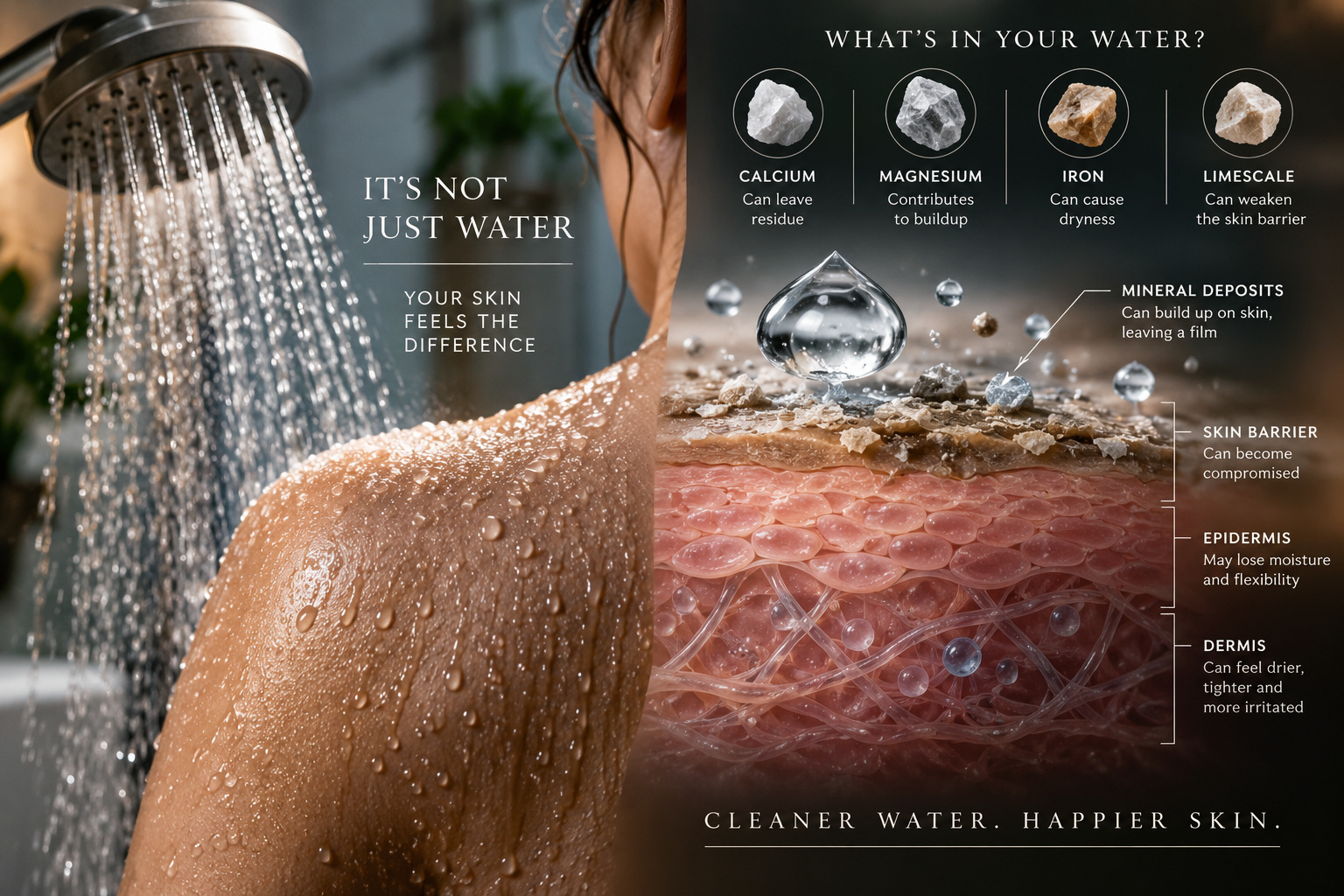
You've tried the gentle cleanser. You've tried the fragrance-free moisturizer. You've tried switching products until your bathroom cabinet looks like a skincare laboratory. Your skin still feels tight after every shower, still looks dull by midday, and still reacts to things it shouldn't. Before you buy anything else, check what's coming out of your tap.
Hard water affects approximately 85 percent of American homes. The Midwest, the Great Plains, Texas, and the Southwest have some of the highest mineral concentrations in the country, which means if you're reading this from Nebraska, there's a good chance your water is working against your skincare routine every single day without your knowledge. Not because of what's in your products, but because of what's in your water before those products ever touch your skin.
This article is about that variable. What hard water is, what it does to your skin barrier, your soap, and your hair, why it's often the explanation behind skin issues that don't respond to product changes, and what you can actually do about it. Some of what's here connects directly to things we've covered in The Grove, specifically the skin pH article and the clays and salts article, and some of it will be genuinely new. All of it is worth knowing if you've ever stepped out of the shower feeling like you need another one.
What Hard Water Is
Water picks up minerals as it travels. Rainwater starts soft, essentially free of dissolved minerals, but as it seeps through the ground and into aquifers it dissolves calcium and magnesium from the limestone, chalk, and dolomite rock formations it passes through. The longer water spends in contact with those formations the more minerals it carries. By the time it reaches your tap it can be carrying a significant mineral load that your shower head delivers directly onto your skin with every wash.
Water hardness is measured in grains per gallon or parts per million. The Water Quality Association classifies water as soft below 3.5 grains per gallon, moderately hard between 3.5 and 7, hard between 7 and 10.5, and very hard above 10.5. To give that scale some context, Papillion, Nebraska reports municipal water hardness of 13 grains per gallon. That's well into the very hard category. Most of Nebraska's municipal water supplies draw from the Ogallala Aquifer, one of the largest groundwater systems in the world, running through limestone formations that produce characteristically hard water across the Great Plains.
Hard water is not unsafe to drink. The minerals it carries, calcium and magnesium, are nutrients the body uses and the World Health Organization notes that hard water may provide a useful dietary source of both. The problem isn’t what you're consuming when you drink it, the problem is what those minerals do when they contact your skin.
The mineral content of hard water is primarily two ions. Calcium, which carries a positive charge and is highly reactive with the fatty acid salts in soap, and magnesium, which also carries a positive charge but behaves differently from calcium in ways that matter significantly for skin. Understanding what these two ions do when they contact your skin and your soap is the foundation for understanding everything else in this article.
How Hard is Your Water?
If you're not sure what your local water hardness is, your municipal water utility is required to publish an annual water quality report that includes hardness data. Most utility websites make these available directly, but if you're on a private well, a simple home water hardness test kit is available at most hardware stores for a few dollars and gives you a reasonably accurate reading in minutes. Knowing your number gives the rest of this article a practical anchor.
What Hard Water Does to Your Soap
This is the section most soap brands never explain and most consumers never think to ask about. What happens chemically when hard water meets soap determines how clean your skin gets, how much residue you're left with, and why that tight, filmy feeling after a shower is not always your skin type or your cleanser.
Soap, whether cold process bar soap made from saponified plant oils or any other true soap, is made up of fatty acid salts. The sodium ion in those salts is what makes soap water-soluble and able to rinse away cleanly. In soft water that's exactly what happens. The soap lathers, surrounds dirt and oil, and rinses away carrying them with it.
In hard water something different happens. The calcium and magnesium ions in the water are positively charged and highly reactive. When they encounter the negatively charged fatty acid salts in soap they displace the sodium ions and form new compounds called calcium stearate and magnesium stearate. These compounds are insoluble. They don't dissolve in water. They don't rinse away. They form the white filmy residue that most people recognize as soap scum on shower walls and glass doors, but that same reaction is also happening on your skin.
The calcium stearate film that forms on your skin during a hard water wash does several things simultaneously. It reduces the soap's ability to lather because the molecules that would normally form the cleaning structures called micelles are now locked into the insoluble compound instead, and it means more soap is needed to achieve the same level of cleaning as it leaves a residue on the skin that doesn't fully rinse away no matter how long you stand under the shower. That residue physically sits on top of the skin barrier, blocking moisturizers from absorbing effectively, and trapping dead skin cells, bacteria, and sebum underneath.
This is why some people feel like they can never get completely clean in hard water. It's not a perception problem, it’s chemistry.
This Is a Genuine Limitation of Cold Process Soap
This is directly relevant to our own products. Cold process soap made from saponified plant oils is particularly affected by hard water because its fatty acid salt structure is exactly what reacts with calcium and magnesium to form calcium stearate. Commercial body washes and liquid cleansers largely switched to synthetic detergent formulas, specifically sulfonate and sulfate-based surfactants like SLS and SLES. Synthetic detergents don't react with hard water minerals in the same way. They lather in hard water and rinse more cleanly.
That's a genuine performance advantage of commercial body washes over cold process bar soap in hard water conditions, and we're not going to pretend it isn't.
What commercial body washes add to solve the hard water problem is worth understanding before you switch. SLS and SLES do lather more effectively in hard water and rinse more cleanly than cold process soap, but hard water doesn't just reduce SLS's effectiveness the way it does with soap. It actually increases the amount of SLS that deposits on the skin. The calcium and magnesium ions in hard water interfere with how completely synthetic surfactants rinse away, leaving more residue on the skin than the same product would leave in soft water. SLS is already a documented skin barrier disruptor in normal conditions, so hard water makes that disruption worse, not better. The product that lathers better in hard water is also leaving more of a problematic ingredient on your skin. That's not an improvement, it’s a different trade-off that most consumers never know they're making.
For cold process soap users in hard water areas, the practical strategies we'll cover later in this article, specifically rinsing thoroughly, moisturizing immediately after showering, and considering a shower filter, address the calcium stearate limitation more directly than switching to a synthetic detergent formula does.
What Hard Water Does to Your Skin
The calcium stearate film we just described is the most immediate effect of hard water on skin, but the deeper problem is what happens to the skin barrier over time when that film is deposited repeatedly, day after day, with every wash.
Your skin's barrier function depends on a precisely maintained environment in the stratum corneum, the outermost layer of skin. We covered this in depth in our skin pH article. The barrier's lipid processing enzymes, the ones that produce ceramides and other structural lipids that hold the barrier together, operate optimally in a slightly acidic environment at pH 4.1 to 5.8. Hard water is alkaline. Municipal water supplies are typically maintained at pH 7 to 8.5 to prevent pipe corrosion. When alkaline water contacts skin repeatedly it pushes the skin's pH upward, inhibiting those enzymatic processes and slowing the barrier's ability to repair and maintain itself.
A December 2025 clinical study confirmed the mechanism directly. Hard water raises skin pH by depositing alkaline calcium and magnesium ions on the skin surface. Elevated pH enhances protease activity in the stratum corneum, accelerating the breakdown of the protein structures that hold skin cells together in the barrier. This leads to reduced synthesis of the lipid lamellae that form the waterproof barrier matrix and increased transepidermal water loss, which is moisture escaping through the skin faster than it's being replenished.
The practical result is skin that feels perpetually dry and tight despite regular moisturizing. The calcium stearate film sitting on top of the skin prevents moisturizers from absorbing effectively, and the barrier disruption underneath means the skin is losing moisture faster than a healthy barrier would allow. Moisturizing helps, but it's working against two simultaneous problems rather than one.
The Eczema Connection
The relationship between hard water and eczema is one of the most consistently documented findings in dermatology research on environmental skin triggers. A systematic review and meta-analysis published in the British Journal of Dermatology analyzed studies on domestic water hardness and atopic dermatitis. The findings confirmed that hard water is associated with increased risk of developing eczema in infancy and early childhood, and that children both with and without filaggrin gene mutations showed greater transepidermal water loss when exposed to high calcium carbonate levels in water.
Filaggrin mutations are the most common genetic risk factor for eczema. The finding that hard water worsens outcomes even in children without this genetic predisposition is significant. It suggests that hard water's barrier disruption is not just amplifying an existing vulnerability, it’s creating one.
For anyone already managing eczema, rosacea, psoriasis, or acne-prone skin in a hard water area, the water itself may be one of the most significant and least addressed triggers in their environment. We covered the specific skin conditions and what affects them in our dedicated articles on eczema, rosacea, psoriasis, and acne. Hard water belongs in that conversation alongside fragrance, SLS, and synthetic preservatives as a documented environmental trigger worth knowing about and addressing where possible.
The Moisturizer Absorption Problem
This is the part of the hard water story that explains a frustration most people have experienced but never connected to their water. You apply a moisturizer after every shower. Your skin still feels dry an hour later. The products aren't working the way they should.
The calcium stearate film deposited by hard water and soap creates a physical barrier on the skin surface that reduces how effectively topical products absorb. Moisturizers applied on top of that film sit on the film rather than reaching the skin beneath it. The barrier disruption underneath is still causing elevated transepidermal water loss that the moisturizer never fully addresses because it can't penetrate to where the loss is occurring.
The type of moisturizer matters more in hard water areas than most product marketing acknowledges. Water-based lotions, which make up the majority of the moisturizer market, are primarily water themselves. We covered this in depth in our body cream article. Most commercial lotions are 60 to 80 percent water. Applying a product that is primarily water to skin that is already struggling to retain moisture and has a calcium stearate film sitting on its surface is asking that product to do more than its formula is designed for. The water in the lotion evaporates and whatever humectants are in the formula may draw some moisture to the surface temporarily, but without an occlusive component to physically seal that moisture in, the transepidermal water loss that hard water's barrier disruption is driving continues underneath.
Water-free formulas behave differently in this context. Without water as their primary ingredient they don't require synthetic emulsifiers or preservatives to remain shelf stable, and their occlusive components create a physical barrier on the skin surface that directly opposes the transepidermal water loss mechanism hard water creates. That physical sealing effect is what makes a water-free cream a more targeted response to hard water skin than a water-based lotion is.
This is why the timing of moisturizer application matters more in hard water areas than in soft water ones. Applying moisturizer immediately after showering while skin is still slightly damp, before the calcium stearate film has fully set, gives the product its best chance of reaching the skin rather than sitting on top of the mineral residue. It's not a perfect solution, but it meaningfully improves absorption compared to waiting until skin is completely dry.
Our body creams are water-free formulas with an occlusive beeswax layer that physically reduces transepidermal water loss and a fatty acid profile that supports barrier repair. For anyone managing skin that consistently feels dry despite regular moisturizing in a hard water area, a water-free leave-on cream applied while skin is still slightly damp after showering addresses the barrier disruption mechanism more directly than a water-based lotion does.
Not All Hard Water Is the Same. The Magnesium Story.
Here’s something the hard water conversation almost never addresses. Not all hard water affects skin equally. The total mineral content matters but the ratio of calcium to magnesium within that mineral content matters just as much, and understanding why explains something genuinely surprising about the Dead Sea Salt in our soap bars.
The research on hard water and eczema, specifically a systematic review led by researcher Zarif Jabbar-Lopez, identified a pattern that most water hardness discussions overlook entirely. Magnesium supports the protective skin barrier. When water contains more magnesium than calcium, meaning the calcium to magnesium ratio is below 1, the overall effect on the skin barrier is measurably less damaging than when calcium dominates. The calcium ion is the primary disruptor while the magnesium ion is partially protective. They're not the same problem wearing different names.
The most striking illustration of this is the Dead Sea. Dead Sea water is extraordinarily mineral-rich, far harder than any municipal tap water in the United States. By every standard measure of water hardness it should be terrible for skin, and yet Dead Sea bathing has documented therapeutic benefits for eczema, psoriasis, and other inflammatory skin conditions that have been studied in peer-reviewed dermatology literature for decades. The explanation is the mineral ratio. Dead Sea water contains approximately 17,600 milligrams per liter of calcium and approximately 45,900 milligrams per liter of magnesium. The magnesium concentration is more than two and a half times the calcium concentration. That ratio is the reason Dead Sea water behaves so differently from the hard tap water causing barrier disruption in your shower.
What This Means for Our Soap
Every bar in our lineup contains Dead Sea Salt except The Resort, which uses Black Hawaiian Salt instead. When someone at a craft fair hears that and nods politely without quite understanding why it matters, this is what we wish we had time to explain.
Dead Sea Salt isn’t just salt. Its mineral composition is fundamentally different from table salt, sea salt, or the calcium-dominant mineral content of hard tap water. The high magnesium concentration in Dead Sea Salt means that when our bars lather on your skin, the mineral content being deposited during that wash includes a meaningful proportion of magnesium alongside the sodium from the soap itself. That magnesium is the same mineral that research identifies as partially protective for the skin barrier, the same mineral present in dramatically higher concentrations in the therapeutic waters of the Dead Sea, and the same mineral that standard water softeners remove alongside calcium when they do their ion exchange process.
We covered the specific benefits of Dead Sea Salt and the other clays and minerals in our bars in our clays and salts article. The hard water context gives those benefits a specific and meaningful frame. In an environment where your tap water is delivering calcium-dominant mineral content with every wash, a bar that introduces magnesium alongside its cleansing action is doing something commercially available body washes and most other soap bars aren’t.
We're not claiming our bars reverse hard water's effects. The calcium stearate reaction still happens and the pH disruption from the bar's alkalinity still happens, but the Dead Sea Salt contributes a mineral that the research identifies as supportive of barrier function in the same wash that's also creating some disruption. That's a more nuanced story than most soap brands tell about their ingredients, and it's an accurate one.
The Water Softener Nuance
This is where the magnesium story connects to something many people with water softeners have noticed without being able to explain. Standard ion exchange water softeners work by passing hard water through a resin bed charged with sodium ions. The calcium and magnesium ions in the hard water are attracted to the resin and swap places with the sodium ions, which pass through into the softened water instead. The result is water that no longer contains the minerals causing soap scum and barrier disruption.
Most people who install water softeners notice an immediate and dramatic improvement in how their skin feels after showering. Soap lathers more efficiently. The tight filmy feeling disappears. Skin retains moisture more effectively. Those improvements are real and documented and they happen because the calcium ion driving the calcium stearate reaction and the alkaline pH disruption is no longer present in the water.
What most water softener owners don't know is that the ion exchange process removes magnesium alongside calcium. The softened water that comes out of the system contains sodium instead of either mineral. That means the partially protective magnesium that research identifies as beneficial for skin barrier function is gone along with the problematic calcium. For most people this is still a net improvement because the calcium's disruptive effects outweigh the magnesium's protective ones in typical hard water, but for people managing eczema who installed a water softener expecting dramatic symptom improvement and didn't get it, the removal of magnesium is one possible part of the explanation. Two clinical studies on water softeners and eczema found limited direct improvement in atopic dermatitis symptoms, which the researchers partially attributed to this magnesium removal effect.
The practical implication is that a water softener is a meaningful improvement for most hard water skin concerns, but it's not a complete solution for everyone, and the reason it falls short for some people is rooted in the same magnesium calcium ratio that explains why Dead Sea water is therapeutic while hard tap water is not.
What Hard Water Does to Your Hair
The skin barrier has an active recovery mechanism. After alkaline water disrupts its pH the acid mantle reacidifies itself through sebaceous gland activity and enzymatic processes in the stratum corneum. That recovery takes time but the mechanism exists. We covered it in detail in our skin pH article.
Hair has no equivalent recovery mechanism. That distinction is the most important thing to understand about hard water and hair because it changes how the damage accumulates and what it takes to address it.
Healthy hair sits at pH 4.5 to 5.5. The cuticle, the outermost protective layer of each hair strand made of overlapping keratin scales, lies flat at this pH. A flat cuticle seals moisture inside the hair shaft, protects the inner cortex where the hair's structural protein lives, and gives hair its smooth appearance and tensile strength. Hard water's alkalinity pushes hair pH upward, causing those cuticle scales to lift and open. Once open the cuticle doesn't close on its own. It requires an acidic intervention to return to its natural flat position.
The calcium stearate reaction that creates soap scum on your skin is happening on your hair too. When hard water meets shampoo or bar soap the same insoluble calcium and magnesium stearate compounds form and deposit on the hair shaft with every wash. Over time this mineral film accumulates layer by layer. It roughens the cuticle surface, increases friction between strands, blocks moisture from penetrating, and makes hair feel dull, coarse, and difficult to manage no matter how much conditioner is applied.
A 2024 study published in the International Journal of Trichology found that exposure to hard water for just 30 days made hair fibers measurably weaker and more breakage-prone compared to soft water. A scanning electron microscopy study published in the International Journal of Dermatology measured the difference directly. Mean hair thickness in the hard water group was 72.78 micrometers versus 78.14 micrometers in the distilled water group after 30 days. That is measurable thinning of the hair shaft from mineral deposition alone.
The Important Distinction on Hair Loss
Hard water causes hair breakage and apparent thinning. It does not cause follicular hair loss. That distinction matters because the two have very different causes and very different solutions.
True hair loss involves the follicle itself being damaged or destroyed. Androgenetic alopecia, telogen effluvium, thyroid disorders, hormonal changes, and nutritional deficiencies all affect the follicle and require clinical evaluation and treatment. Hard water does none of these things. The damage from hard water sits on the hair shaft and the scalp surface, not inside the follicle. The hair shaft becomes rougher, weaker, and more prone to mid-shaft breakage. That breakage can look like thinning because hair appears shorter, less dense, and more fragile even though the follicle is still alive and producing hair normally.
This distinction matters practically because hard water hair damage is largely reversible. The mineral buildup on the shaft can be removed with chelating or clarifying treatments. The cuticle can be closed with acidic rinses. The follicle is unaffected. If you've noticed what looks like thinning after moving to a hard water area or after a change in your water source, breakage from mineral accumulation is a significantly more likely explanation than follicular hair loss and it responds to completely different interventions.
If you're experiencing significant or sudden hair loss rather than breakage, that warrants a dermatologist visit regardless of your water hardness. Hard water is not the explanation for that.
Hair and the Soap Question
The same honest limitation we addressed for skin applies to hair. Cold process bar soap at pH 8.5 to 9.5 opens the hair cuticle with every wash. In hard water conditions the calcium stearate reaction compounds that effect by depositing an insoluble mineral film on the hair shaft alongside the pH disruption. The cuticle opens and a mineral film accumulates simultaneously.
If you use our bars on your hair regularly, an acidic rinse after every wash is not optional. Diluted apple cider vinegar at approximately one tablespoon per cup of water applied after washing and rinsed out closes the cuticle and restores the hair's natural pH environment. We covered this in the hair section of our skin pH article. In hard water areas that acidic rinse is doing double duty, addressing both the pH disruption from the soap and helping to prevent mineral buildup from accumulating on the shaft.
For regular hair washing in hard water a pH-balanced shampoo formulated at 4.5 to 5.5 performs meaningfully better than bar soap because it doesn't open the cuticle and doesn't trigger the calcium stearate reaction to the same degree. That includes properly formulated solid shampoo bars made with syndet chemistry rather than saponification, which can achieve the right pH balance in a bar format. That's an honest recommendation even though it means pointing you toward a product category we don't currently make.
What You Can Do About It
Hard water is not something most people can change. You live where you live and the water comes from where it comes from, however, the effects of hard water on skin and hair are not fixed outcomes. There are practical interventions at every budget level that meaningfully reduce the damage and several of them require nothing more than changing when and how you apply products you're already using.
Water Softeners
A whole-house ion exchange water softener is the most comprehensive solution available. By replacing calcium and magnesium ions with sodium the softener eliminates the calcium stearate reaction entirely. Soap lathers properly, the mineral film stops accumulating on skin and hair, and the alkaline pH disruption from calcium and magnesium ions is removed. Most people who install a water softener notice an immediate and significant improvement in how their skin and hair feel after showering.
The limitation worth knowing, which we covered in the magnesium section, is that ion exchange softeners remove magnesium alongside calcium. For most people this is still a meaningful net improvement, but for people managing eczema who expected dramatic symptom relief and didn't get it, the magnesium removal is one possible explanation worth discussing with a dermatologist.
Water softeners are a significant investment ranging from several hundred to several thousand dollars depending on system size and installation requirements. They also require ongoing salt replenishment and periodic maintenance. For homeowners in very hard water areas they often pay for themselves over time through reduced soap usage, extended appliance lifespan, and reduced plumbing scale buildup. For renters they're typically not practical.
Shower Filters
For renters, apartment dwellers, or anyone not ready to commit to a whole-house system, a shower filter is the most accessible entry point. KDF-based shower filters are most effective at reducing hard water minerals at the point of use. Vitamin C-infused filters are particularly effective at neutralizing chlorine and chloramines. Shower filters don't soften water to the same degree as a whole-house ion exchange system, but they meaningfully reduce the mineral load that contacts skin and hair with every shower.
Most shower filters cost between twenty and fifty dollars and install in minutes without tools. Filter cartridges require replacement every few months depending on water hardness and usage. For renters dealing with hard water skin and hair issues a shower filter is often the single most impactful change available within a tight budget and without landlord approval.
Timing Your Moisturizer
This costs nothing and works better than most people expect. Applying a leave-on moisturizer immediately after showering while skin is still slightly damp, before the calcium stearate film has fully set, gives the product its best chance of reaching the skin rather than sitting on top of the mineral residue. In hard water areas this timing difference is more significant than in soft water areas because the film sets quickly and creates a more substantial absorption barrier.
For the reasons we covered in the moisturizer absorption section, a water-free cream applied at this moment addresses the transepidermal water loss that hard water's barrier disruption drives more effectively than a water-based lotion does. Both of our body creams, the dry and normal skin formula and the acne-prone skin formula, are water-free formulas with occlusive beeswax layers and fatty acid profiles that support barrier repair. Applied while skin is still slightly damp after a hard water shower they're doing the most useful thing a topical product can do in that situation, physically reducing the transepidermal water loss that the hard water just made worse.
Acidic Rinses
A diluted apple cider vinegar rinse at approximately one tablespoon per cup of water applied after washing and rinsed out helps restore both skin and hair to a more acidic pH after hard water exposure. For hair specifically it closes the cuticle that alkaline water and soap have opened, reduces the friction and breakage that follows cuticle lifting, and helps prevent mineral buildup from accumulating as quickly on the shaft.
For skin the acidic rinse addresses the pH disruption component of the hard water problem. It doesn't remove the calcium stearate film, but it helps the skin's acid mantle reestablish itself more quickly after disruption.
Apple cider vinegar rinses are not for everyone. The smell is noticeable even after rinsing and some people find it irritating if the concentration is too high. Start diluted and adjust from there.
Lukewarm Rather Than Hot Water
Hot water increases skin permeability, accelerates the stripping of natural skin oils, and creates steam that carries aromatic compounds into the respiratory tract in enclosed shower spaces. In hard water areas hot water also accelerates mineral deposition on the skin. Switching to lukewarm water doesn't eliminate the hard water problem, but it reduces the rate at which minerals absorb and gives the soap's fatty acids a slightly better chance of rinsing away before the calcium stearate reaction fully develops.
Rinsing Thoroughly
More thorough rinsing in hard water areas reduces the amount of calcium stearate residue left on skin and hair. This sounds obvious but most people rinse for the same amount of time regardless of water hardness. In hard water areas a longer and more thorough rinse meaningfully reduces the residue load even if it can't eliminate the reaction entirely.
The Variable You Might Have Been Missing
If you've been cycling through products without solving a persistent skin issue, the variable that changes everything might not be in your bathroom cabinet. It might be coming out of your tap.
Hard water affects approximately 85 percent of American homes and most of the people living in those homes have never been told what it does to the soap they're using, the barrier they're trying to maintain, or the moisturizer they're applying on top of a mineral film that's blocking it from working. The skin condition articles across The Grove cover fragrance, SLS, synthetic preservatives, pH disruption, and the skin microbiome as environmental factors worth understanding. Hard water belongs in that conversation with the same specificity and the same evidence behind it.
You don't need to solve it perfectly. A shower filter, a timing change on your moisturizer, an acidic rinse for your hair, and an understanding of why your cold process soap lathers better in soft water than hard water get you most of the way there without a plumber or a significant investment.
The rest is knowing that the tight, filmy feeling after every shower that you've been attributing to your products for years might have had nothing to do with your products at all.
If you want to understand what your water is doing to your skin's pH environment specifically, our \skin pH article covers the acid mantle, the three-zone stratum corneum discovery, and why the number matters more than most skincare conversations acknowledge. Our \microbiome article covers what daily cleansing does to the microbial community that lives on your skin and manages its defense. And our \clays and salts article covers the specific minerals in our bars and what the research says they contribute to skin during the brief contact time of a wash.
That's The Grove. Not a catalog. A library.