.svg)
Menu
Most skin conditions are about what gets into your skin from the outside. Psoriasis is different. It starts on the inside. The immune system misfires, sends the wrong signals, and drives the skin into overdrive. What shows up on the surface is the result of something happening deep in your biology that no soap, cream, or cleanser can fix at the root. We want to say that clearly before anything else here, because we think it's the most important thing to understand about psoriasis and the most important thing to understand about what our products can and cannot do for it.
Here is the part that changed how we think about this condition when we first learned it. Your skin normally replaces itself every 28 days. We covered that in our dermatologist article. In psoriasis that same process happens in 3 to 5 days. The immune system is ordering the skin to produce new cells ten times faster than normal. Those cells pile up faster than the body can shed them and the result is the thick, scaly, inflamed plaques that most people recognize as psoriasis. That single fact explains more about this condition than most people learn in years of managing it.
We're not a medical company. We make soap and skincare products with clean, organic ingredients. What we can offer is an honest look at what psoriasis actually is, what the research says about daily skincare, and where we genuinely fit into the picture without overstating it.
What Psoriasis Looks Like
Psoriasis doesn't look the same on everyone, which is one reason it can take so long to diagnose correctly. There are several distinct forms and knowing which one you're dealing with matters for how it's managed.
Plaque psoriasis is by far the most common, affecting somewhere between 80 and 90 percent of people with the condition. If you've ever seen what most people picture when they hear the word psoriasis, raised red patches covered with silvery white flaky skin, that's plaque psoriasis. It most commonly appears on the elbows, knees, scalp, and lower back, though it can show up anywhere.
Guttate psoriasis looks different. Instead of large patches it shows up as small drop-shaped spots scattered across the trunk and limbs. It often appears suddenly, frequently after a strep throat infection, and is most common in children and young adults. It sometimes clears up on its own, which makes it one of the more manageable forms.
Inverse psoriasis shows up in skin folds, the armpits, groin, and under the breasts. Rather than the scaly patches of plaque psoriasis it appears as smooth, shiny, red skin. Friction and moisture make it worse, which makes it particularly uncomfortable in warm weather or during physical activity.
Pustular psoriasis is rare, affecting only about 3 percent of people with psoriasis. It appears as white bumps filled with fluid surrounded by red skin. Despite how it looks it isn't infectious. The fluid isn't pus in the traditional sense. It's a product of the immune system, not a bacterial infection.
Erythrodermic psoriasis is the most severe form and fortunately the rarest. It covers most of the body with intense redness and widespread shedding of skin. This form is a medical emergency that requires immediate clinical attention, not a skincare adjustment.
One thing worth understanding about all of these is that they aren't always fixed categories. Someone who has had plaque psoriasis for years might develop guttate spots after an illness, or experience a pustular flare triggered by stress or a medication change. Psoriasis responds to what's happening inside your body and those internal conditions change over time.
One More Thing Worth Knowing
Psoriasis doesn't always stay on the skin. About 30 percent of people with psoriasis develop psoriatic arthritis at some point, a condition that causes joint pain, swelling, and stiffness that can range from mild to debilitating. The joints most commonly affected are the fingers, toes, wrists, knees, and lower back. Psoriatic arthritis can develop before, during, or after skin symptoms appear, which means some people are managing joint problems without knowing they're connected to their psoriasis. Research also links psoriasis to higher rates of cardiovascular disease, metabolic syndrome, and inflammatory bowel disease. This isn't meant to alarm anyone. It's meant to make clear that if you have psoriasis and are also dealing with unexplained joint pain or other systemic symptoms, those connections are worth raising with your doctor. Psoriasis is a whole-body condition that happens to show up most visibly on the skin.
What Makes Psoriasis Worse
Psoriasis triggers are different from eczema and rosacea triggers in one important way. Because psoriasis is driven by the immune system, many of its triggers work from the inside out rather than from the outside in. That doesn't mean what you put on your skin doesn't matter. It does. But it means the full picture of what sets psoriasis off is broader than skincare alone.
Stress is the most universally documented trigger across all forms of psoriasis. Psychological stress directly activates the same immune pathways that drive flares. Most people with psoriasis already know this from experience. A hard week at work or a difficult personal situation shows up on their skin within days. That connection isn't in your head. It's documented biology.
Infections are a close second, particularly strep throat. Guttate psoriasis in children and young adults is so frequently triggered by a strep infection that dermatologists often ask about recent illness when they see that presentation. If you've ever noticed your psoriasis flaring a week or two after being sick, this is likely why.
Harsh soaps, detergents, chemicals, and abrasive fabrics can all disrupt the skin barrier and trigger or worsen lesions. This is the most direct connection between what you wash with and how your psoriasis behaves, and it's the primary reason we're talking about cleansers in this article at all.
There's also something called the Koebner phenomenon that's unique to psoriasis and worth knowing about. When skin with psoriasis experiences physical trauma, a cut, a scratch, a sunburn, even a surgical procedure, new psoriatic lesions can develop at that exact site of injury. The skin injury activates immune cells that trigger the same overproduction response driving the existing plaques. This is why people with psoriasis are advised to be particularly careful about sun exposure, not because sunlight always makes psoriasis worse, but because sunburn specifically can cause new plaques to appear in places that were previously clear.
Smoking worsens psoriasis with a direct dose-dependent relationship, meaning the more you smoke the more severe the condition tends to be. Alcohol also worsens psoriasis and can reduce how well treatments work. Both are worth knowing if either is part of your life.
Certain medications can trigger or worsen psoriasis even when they're prescribed for unrelated conditions. Lithium, beta blockers used for blood pressure and heart conditions, antimalarial drugs, and some anti-inflammatory pain medications are among the most commonly documented. If your psoriasis worsened after starting a new medication it's worth mentioning to both your prescribing doctor and your dermatologist.
Weight and metabolic health play a documented role as well. People with obesity and metabolic syndrome tend to have more severe psoriasis and respond less well to treatment. Researchers believe this is because excess body fat drives chronic low-grade inflammation that compounds the immune dysfunction already driving the condition. It's not a judgment. It's a mechanism worth understanding.
Cold and dry weather worsens most people's psoriasis while moderate sun exposure often improves it. This is actually the scientific basis for phototherapy, the clinical treatment that uses controlled UV light to slow down the overactive skin cell production driving psoriasis. If your skin tends to be worse in winter and better in summer that pattern is consistent with what the research shows.
What Soap and Skincare Actually Do for Psoriasis
Here's where the guidance for psoriasis is slightly different from what we said in our eczema and rosacea articles, and we want to be precise about that difference because it matters.
The American Academy of Dermatology recommends that people with psoriasis use gentle, moisturizing soaps or cleansers formulated for sensitive skin. What they don't say, unlike the guidance for rosacea, is to avoid bar soap specifically. The recommendation is fragrance-free and gentle rather than soap-free. That's a meaningful distinction and it gives us a little more honest room to talk about our bars than the previous two articles allowed.
That said the pH reality we covered in the eczema and rosacea articles doesn't disappear. Psoriasis skin has a compromised barrier even between flares. It retains moisture less effectively and is more permeable to irritants than healthy skin. Washing with an alkaline product, which all true cold process soap is, can disrupt that balance and potentially trigger a flare from a baseline that was otherwise under control. We're not going to gloss over that just because the AAD's language is slightly softer here than it is for rosacea.
The honest position is this. A cleanser that strips natural oils, introduces fragrance allergens, or significantly disrupts your skin's pH can make psoriasis worse. A cleanser that does none of those things, even if it isn't perfectly pH balanced, is a meaningful step in the right direction. Our Unscented bar doesn't strip with SLS, doesn't contain fragrance compounds, doesn't include synthetic preservatives or colorants, and retains its naturally occurring glycerin. That removes every major cleanser-related trigger on the documented list. The pH is still alkaline. We're still not pretending otherwise.
Now here's the part that we find genuinely interesting and that most people with psoriasis haven't heard clearly stated. Of the three skin conditions we've covered in this series, psoriasis has the strongest documented evidence for moisturization as part of daily management. A 2023 study published in the Journal of Drugs in Dermatology found that moisturizers don't just make psoriasis-affected skin feel more comfortable, they actively soften plaques. And perhaps most importantly, they improve how effectively prescription topical treatments penetrate the skin. If you're using a prescription corticosteroid or other topical treatment for psoriasis and you apply a good occlusive moisturizer immediately after, you're not just adding a comfort step. You may be making your prescription medication work better.
This is where our newly launched dry and normal skin cream becomes the more important product in this conversation, more so even than the soap. Our cream combines organic shea butter, organic jojoba oil, organic coconut oil, organic beeswax, vitamin E, white kaolin clay, and arrowroot powder. The beeswax creates an occlusive layer that physically traps moisture against skin that can't retain it on its own, which is exactly what occlusive moisturizers are specifically recommended to do for psoriasis. Shea butter's cinnamic acid has documented anti-inflammatory properties. Jojoba oil supports the skin's own barrier function.
This cream doesn't treat psoriasis. We want to be clear about that. Nothing we make treats psoriasis because psoriasis is an immune system condition that requires clinical management. What our cream does is support barrier function, retain moisture, and create the conditions where your skin can do its best between flares and where your prescription treatments can work as effectively as possible. That's not a small thing. It's just not a cure.
As always, patch test any new product on a small area before full use. Psoriasis-prone skin can be reactive and introducing anything new carefully is worth the extra few days of caution.
We go into the full ingredient story behind this cream, including the research and the formulation decisions, in our body cream article.
Where Our Products Fit
We want to be straightforward about something before we get into this. Of the three skin conditions we've covered in this series, psoriasis is the one where our products play the smallest role in the overall management picture. Psoriasis is an immune system condition. It requires clinical management. A soap and a moisturizer are supporting players at best, not the main event. We'd rather say that clearly than let anyone think switching their cleanser is going to meaningfully change the course of their psoriasis.
With that said, what you wash with every day does matter for psoriasis-prone skin, just not in the way most skincare brands would have you believe.
The Unscented Bar
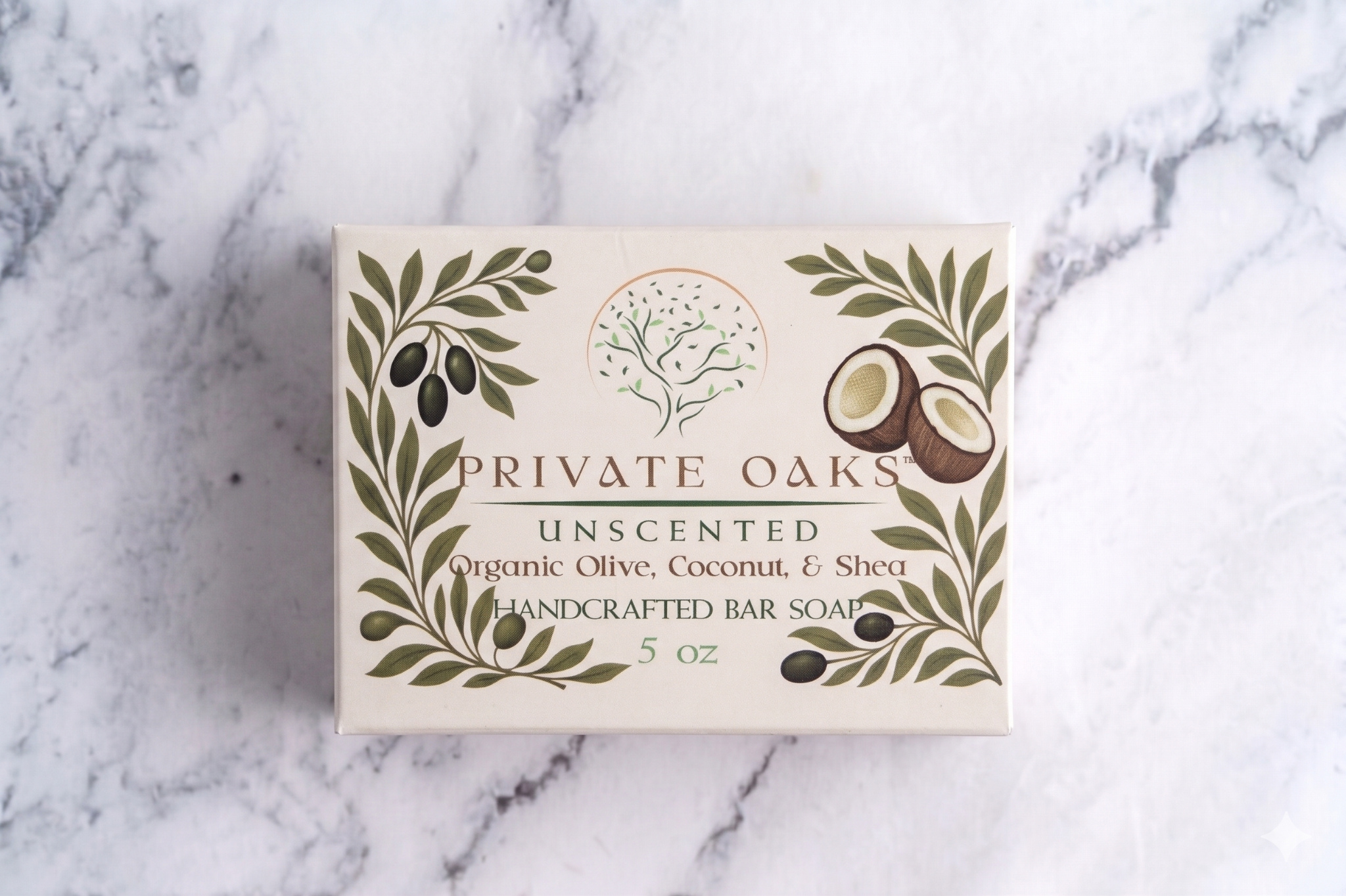
Our Unscented bar is the honest recommendation for anyone with psoriasis who wants a genuinely clean rinse-off cleanser made with organic oils. It contains no synthetic fragrances, no SLS, no synthetic preservatives, and no synthetic colorants. Every one of those ingredients is a documented psoriasis trigger in a cleanser. Removing them from your daily routine doesn't treat psoriasis but it does stop your cleanser from actively making things worse, which is more than most commercial bars can honestly claim.
The pH limitation we've discussed in each of these articles still applies here. Our bars run at a pH of 9 to 10. Psoriasis skin is compromised even between flares and alkaline cleansers can disrupt the barrier further. If your psoriasis is active or significant, discuss your cleanser choice with your dermatologist. If your skin is in a stable place and you're looking for the cleanest daily option available without synthetic triggers, our Unscented bar is worth trying.
If you're new to Private Oaks and want to start somewhere, start with the Unscented. Use it for a few weeks. Pay attention to how your skin responds. That's the most honest recommendation we can give.
A Note on Our Scented Bars
The same thinking from our eczema article and rosacea article applies here. If you've never specifically reacted to fragrance but have struggled with commercial bars, our scented bars may be more tolerable than you'd expect. Our fragrance oils are a blend of naturally derived and lab-created aroma-safe compounds, phthalate-free, paraben-free, and free of heavy metals, used at less than 4 percent of the cured bar. Every other ingredient is the same clean formula as the Unscented bar. No SLS. No synthetic preservatives. No stripped glycerin.
That said, fragrance is a documented skin irritant and psoriasis-prone skin is reactive skin. The Unscented bar is always the safest starting point. Try it first and go from there.
Our Dry and Normal Skin Cream
As we covered in the cleanser and moisturization section, the leave-on product matters more for psoriasis management than the cleanser. Our newly launched dry and normal skin cream is the product in our lineup most directly relevant to what psoriasis-prone skin needs between flares and alongside clinical treatment.
Pair the Unscented bar with our dry and normal skin cream as your daily routine. Apply the cream while your skin is still slightly damp after cleansing to help the occlusive beeswax layer lock in moisture rather than sitting on dry skin. If you're using a prescription topical treatment, apply the cream immediately after to support penetration and moisture retention.
Remember to patch test the cream on a small area before committing to full use. Psoriasis-prone skin can be reactive to new products even clean ones and taking it slowly is always worth the extra few days of caution.
One honest note on Dead Sea salt. Several of our bars contain Dead Sea salt and we've documented its mineral content and skin benefits in our clays and salts article. There is a 1989 clinical study showing meaningful improvement in psoriasis patients using Dead Sea salt treatments. We want to be transparent about what that study actually involved. Those patients were bathing at the Dead Sea itself, combining mineral-rich water immersion with specific UV radiation at that altitude and a therapeutic environment. The Dead Sea salt in our bars is a genuine ingredient with real mineral properties. It is not equivalent to that clinical experience and we'd rather you know that than discover it yourself.
Psoriasis is one of the most researched skin conditions in dermatology and one of the least understood by the people living with it day to day. The immune system complexity, the unpredictable flares, the systemic connections to joint health and cardiovascular disease, and the sheer number of things that can make it worse make it one of the more isolating conditions to manage. If you've been dealing with it for years you already know that no single product, diet change, or lifestyle adjustment is going to solve it. We know that too and we're not going to pretend otherwise.
What we hope this article gave you is a clearer picture of what's actually happening in your skin and your immune system, what's worth paying attention to in your daily routine, and where a genuinely clean soap and moisturizer fit into the broader picture of managing this condition without making it worse.
Psoriasis requires a dermatologist. If you don't have one or haven't seen one recently, that's the most important step you can take, more important than any product decision. The biologics and targeted immune therapies available today have genuinely transformed outcomes for moderate to severe psoriasis in ways that weren't possible even ten years ago. A dermatologist who specializes in psoriasis can help you access those options.
Our role in all of this is small but it's honest. Clean ingredients. Nothing hidden. A daily routine that doesn't add to the burden your skin is already carrying.
That's always been the point of Private Oaks.